Lawbore Future Lawyer
6Jan/120

What I wish I had known when I started Law school – Amin Rahman-Esene

Author Amin

With the tuition fees set to go up, rising youth unemployment and the increasing scarcity of jobs, there isn’t much to envy about the law student’s plight, especially as the law has always been a very competitive and difficult profession to enter. Nevertheless, take courage young law scholar, for one, you will not be an English literature graduate (bless their soon to be impoverished socks); and secondly, I am about to offer you some words of advice which could have, had I been given them earlier, made that elusive first class a real possibility.

Get things right the first time

Firstly, the first year matters. Honestly, it does. You will be rewarded if you build the right work ethic from the start. I am not saying become a first-year puritan, but lets just say I would have done well to drink less of certain liquids – or scaled down the numerous nights spent in sweat boxes.

The key to this law business is making sure your foundations are well built; for example, make sure you take the first cases you encounter seriously, attend all the lectures, and even read a few of those “dry” self-help law guidance manuals (I recommend Letters to a Law Student). For you will find all these first principles and lectures haunting you like some demented ghoul. How I wished I had paid attention in Legal Method, I might not have been so shocked to encounter Advanced Legal Method (!) in my subsequent Masters in Law.

7Nov/110

Never say never! – Priyanka Jain

Author Priyanka

Why am I studying Law? No, it is not down to any family expectation to study medicine, engineering or law at higher studies (as in some Asian families). Admittedly, ‘Law?’ was the reaction that people would get from me when they asked if that was an option for me to study at university. It was the one subject I ‘knew’ I was never going to study. Ever. Why?

After my aunt had studied law in university, the most common reaction, in any discussion which involved my applications, from my grandparents would consist of, ‘don’t do law, it’s strenuous, laborious and tiring.’ It was a subject I wasn’t encouraged to do as a young child, therefore, I never took it to be an option.

My interests fluctuated from engineering, to art, to journalism during the course of the past four years. Why then did I settle for law, a subject I supposedly ‘knew’ I was never going to read? A subject, the thought of which scared me? A subject which now I am going to spend the next three years of my life reading?

I guess my interest in law sparked from my regular holidays to New Delhi where in the space of a twenty minute journey, the visible human landscape would change drastically; from passing luxurious mansions with Bentleys parked in wide, green and clean avenues into the contrasting world of polluted slums. This raised a number of questions within my mind - As we know the Indian economy is exponentially expanding each year, with growth rates reaching their pinnacle and progress is evident. However, does this progress which translates into obvious consumerism, create a desire within under-privileged individuals? A desire to change their positions, through the world of crime and venality; the contra montage of the law, the law I now wish to represent?

22Oct/110

Hey! Lawyers! Leave them kids alone! – Emily Allbon

First a little background: the Legal Education and Training Review is a joint project between the Bar Standards Board (BSB), the Solicitors Regulation Authority (SRA) and the Institute of Legal Executives Professional Standards (IPS). As its name suggests, the findings of the research generated by this review will have far-reaching implications on the nature of future legal education and training. The research team are essentially looking at whether the spectrum of legal education and training in the UK is fit for purpose. It has been widely reported to be the most wide-ranging review of legal education since the Ormrod Report in 1971. Final recommendations will be published in December 2012. Research for the Review is being led by Professor Julian Webb of Warwick University.

Legal Education Debate 2011 panel - Thanks to LexisNexis for image

UCL hosted a LexisNexis-sponsored debate on 11th October 2011 'Do Lawyers Need to be Scholars?' with a view to kick-starting discussion around the Review. Chaired by Professor Dame Hazel Genn DBE QC, Dean of UCL Faculty of Laws, the panel was more weighted on the academic side, though their views were far from uniform. It included:

David Bickerton (Managing Partner, Clifford Chance)
Rebecca Huxley-Binns (NTU and winner of Law Teacher of the Year 2010)
Professor Stephen Mayson (Director of Legal Services Policy Institute, College of Law)
Professor Richard Moorhead (Cardiff Law School)
Professor Philippe Sands QC (UCL Faculty of Laws/ Matrix Chambers)

Each panel member got 5 minutes to state their position before some debate amongst themselves and then a final passing over to the audience. Sir Mark Potter who chairs the LETR Panel also said a few words around the review, although he was treading carefully so as to convince us no preconceptions were driving the review.

Key areas of discussion centred around the standard of the undergraduate law degree, with Phillippe Sands kicking off with a controversial stance, declaring his one regret in life was studying law and not doing something else first, before going to study law as a graduate. His assertion centring around the belief that studying law as an undergraduate in this country is stifling, closing your mind down to thinking in a particular way, at the very point when it should be opening up in new ways.

1Aug/110

Twitter for Lawyers

LLB1 student Dilara Alibayova has put together a great article on her experience of Twitter on Learnmore, but here are some quick reflections on why you should jump to it and get tweeting:

It’s diverse and its users come from all walks of life. Even if the intention of your account was to keep up-to-date with legal affairs, you will quickly notice that the majority of tweeters have at least one other subject they enjoy tweeting about
The twitter page is very user friendly and easy to use. You can personalise the page/brand it via images and change the colour scheme to make it more accessible for those with learning difficulties.
Twitter suggests people to follow - which is a great thing, especially for those who have joined the site recently. Be aware it can sometimes come up with some weird random ones!
Tweeting helps you to develop an ability to summarise and structure thoughts better, as a tweet can be no more than 140 characters.
Raising an awareness about a particular issue or campaigning? Twitter is a perfect way to spread the word. Just add “please RT” at the end of your tweet.
Those who prefer to chose who follows them for security or other reasons may protect their tweets making it impossible to see what they talk about to non-followers.
When accessing the site through your mobile device you can also tweet photos - which is great for art lovers and ‘a picture is worth a thousand words’ type of people

There are loads of ways of managing your tweets whether on your desktop computer, laptop or mobile phone - it can get a bit overwhelming as the number of those you follow increases. Hootsuite and Tweetdeck are the two most popular. These products also allow you to do all sorts of other cool things around integral url shortening (or you can try bit.ly) and statistic gathering on who retweets (RT) your tweets and who clicks through on links you've tweeted.

We at Lawbore love Hootsuite for its owl of course!

More thoughts from students can be found all over the web, here's one from a University of Kent graduate.

I also put together a slideshow on why I use Twitter recently:

27Apr/112

Legal research: are today’s students deep thinkers or expert-skimmers? – Emily Allbon

After completing my very first podcast in the company of the legendary Charon QC (the only man I know with a voice as wonderfully deep as Tindersticks frontman, Stuart Staples), I got thinking about a post on legal education, legal research and law librarians.

Hierarchy
Law is full of hierarchies! Thanks to Cristian Pop for the image via CC licence on
flickr.com

Actually teaching students how to carry out their legal research is on the wane; the new BPTC no longer includes a formal legal research skills assessment, with such skills now being assumed to be covered within other subjects. Within most undergraduate programmes the law librarian will have some kind of presence, whether it be embedded within the curriculum and face-to-face, online via tutorials on a VLE, or wheeled out to give an en-masse demo to hundreds of students on the finer points of the legal databases like Lexis and Westlaw. At City, Legal Method is where students learn how to do legal research, alongside the other core skills of legal writing, mooting, ELS, sources as well as reading cases and statutes. This is a compulsory module and is taught by an academic and myself. The research elements are taught via a mixture of lecture and hands-on workshops and importantly, are assessed.

Students at law school have the hardest transition I think; there are so many things to learn even before you can start to make sense of the substantive law - legal citations, hierarchy of sources, precedent, statutory interpretation, as well as all the terminology.

20Sep/100

Welcome to the GDL! Laurie Wilks

Firstly, don’t panic, but you must get comfortable and buckle up - this roller coaster ride is about to begin. What follows is an attempt to give you some idea of the corkscrews, cobra rolls and hammerhead turns that lie ahead. Several other veterans have kindly passed on their top tips for the journey, but every experience is different, so what you read below will on some level be coloured by one perspective. Take or leave the advice as you want – here I just want to give you a taste of the ride!

THE COURSE ITSELF. It is fast moving. It will be June before you realise. One thing that many of us in my cohort realised too late, is that looking at past exam papers early on is invaluable. In a spare moment in these early weeks, get on Cityspace and look at exam answers from previous years. This will give you a rough idea of the kind of thing that you will i) be able to and ii) need to write in nine months time.

GETTING YOUR MOUTH AROUND THE LAW. Tip – Talk law. You will be competent in legalese (both English/Welsh and European) by Christmas, and fluent by March. Like all languages however, it’s about confidence and practice. Mooting is a great way of doing this, regardless of whether you’re an intending solicitor or barrister. Be confident to make mistakes. Your colleagues around you now are in exactly the same position and are the best people to bounce ideas off. Tutors are also, obviously brilliant, but even the most patient adults eventually get bored of conversations with toddlers. While we’re here, you will quickly come to realise that some of the people on the course around you now, will be close friends and colleagues for a lot longer yet – remember, these relationships will be a very important source of support.

4May/100

Exams made easy – Elizabeth Cruickshank and Penny Cooper

That headline was a “teaser”, something to attract your attention, because nothing can really make exams feel easy except hard work. But how to utilise your hard work to best advantage?

Get healthy

The Romans had a saying “Mens sana in corpore sano”, meaning “a healthy mind in a healthy body”. They knew a thing or two, these Romans, for the best way to alleviate stress is to get and stay healthy. Caffeine and alcohol may seem like good short-term stress relievers, but their effects are just that – short-term. The best way to deal with the stress of exam revision is to ensure that you eat sensibly, keep alcohol and caffeine intake down to a minimum and factor exercise into your revision plans.

Planning

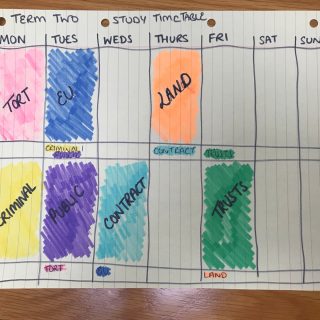
One thing that is fatal to any notion of effective revision is not to plan it. If you get up in the morning uncertain about what you are going to work on, what time you are going to start or even whether you are going to do any work at all that day, then you are wasting precious energy in identifying and making decisions that you should have made before you went to bed the previous evening.

At the beginning of the lead up to your exams:

- Identify what it is that you need to cover
- Work out how many days you have available for your revision
- Divide each of those days into one hour work periods
- Then fit the topics into the work periods.