Learnmore logo
  • Directory

    Topic-themed guides to the legal web

  • Learnmore

    Multimedia law tutorials & features

  • Blog

    Our Future Lawyer careers & alumni blog

  • City Hub

    City Law School student resources

  • About Us

    Our history, staff & philosophy

Lawbore Future Lawyer
15Apr/130

The Gavel has arrived! – Emily Allbon

Get reading!

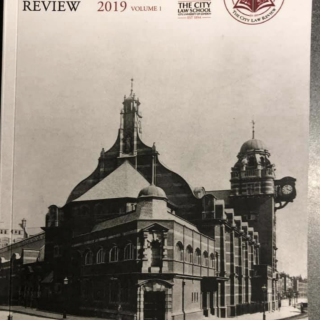
The inaugural edition of the City University Students' Union Law Society's magazine The Gavel has been published. Editor-in-Chief Jordan Shay explains its beginnings: "This publication was conceived with the belief that students should have access to a medium of sharing academic work that circumvents a curriculum or grading rubric".

Board of Editors includes:

Jordan Shay (Editor -in-Chief)
Mattia Banassi and Kamran Zaheer (Managing Editors)
Patrick Smith, Omar Joseph, Greg Weedon and Cody Moskovitz (Editors)
Justin Wong, Musawwar Alam, Nivetha Yogonathan, Eshver Singh, Nimra Ehsan, Veera Thakral and Tahsin Cashmawala (Committee Members)

All articles have been written by students at The City Law School and cover topical issues like squatters rights and regulation of online social media. Full article listing as follows:

Christopher Vallis - Marital Coercion: Obsolete in the 21st Century?
Eshver Soor - Sexual Assault in the Military: Why is the Law So Ineffective?
Myles Kaufman - Squatters and Finders: An examination of possession in English Property Law
Jack Schiffer and Miranda Meades - M & A in Germany for Anglo-Saxons
Mattia Benassi - "Une petition est un poeme, et un poeme est une petition": Why the USA is no Country of 'Poets'
Shrene Shergill - Regulating the Phenomenon of Online Social Media
Hayley Silvertown - A Law Degree with Nowhere to go
Nimra Ehsan - Miscarriages of Justice
Nivestha Yoganathan - The Diversity of the Judiciary

2Apr/130

Practical Presenting Pointers – Elizabeth Cruickshank and Penny Cooper

Gary Player once said of his success at golf, “the more I practise the luckier I get”. This is certainly true of giving presentations, but only if you take them seriously, prepare well, think about your audience and afterwards reflect on how successful they were and what you could do better next time.

Presenting the presenter

Introducing someone effectively is an art in itself. If you are asked to introduce a speaker, accept willingly as it’s good practice for getting the feel of the podium. Your purpose is to focus the audience’s attention by smiling, welcoming and possibly saying something amusing if the occasion warrants it. Don’t risk getting your facts wrong. Ask for the speaker’s resume, do a Google search and if possible have a chat beforehand. It can avoid the embarrassment of welcoming a speaker as an expert on corporate tax when he specialises in VAT.

It follows that if you are the keynote speaker, sending your resume beforehand and arriving in time to have a few words with the person who is introducing you increases the chances that you will be introduced in a way that you will be pleased about.

Voice control

Refine your facial expressions! Credit: Lee J Haywood

Looking and sounding natural when you are very nervous takes practice. Here are some suggestions:

- Type out what you are going to say in large type and then read it through aloud a couple of times, looking at yourself in a mirror if you can bear it.
- Speak more slowly than normal. Most people speed up when they are nervous. But don’t slow down to a crawl.
- Break up the pace of your presentation. If you ask a rhetorical question, pause and sweep the audience with your eyes. And then move on to the next point. BUT if you are asking a real question and nobody replies, treat it as a rhetorical one, give the answer and then move on; don’t risk an uncomfortable silence where your audience feels inadequate and hostile.

28Feb/130

Do you present well? – Elizabeth Cruickshank and Penny Cooper

Credit: hiddedevries

We can interpret this question in two different ways – how do you present yourself or how do you present your ideas? This article is not about dressing smartly and looking well-kempt, but about what you do once the neat and tidy appearance has been achieved. It’s not about making a presentation of yourself but about making presentations a.k.a. public speaking, which you might be asked to do:

- at an interview for a law firm summer vacation scheme
- at a training contract selection day
- when delivering a CPD seminar
- when pitching to a group of clients.

Even if you don’t want to be an advocate, you will find that public speaking is very much a part of legal life, from start to finish.

Do you think you are a good presenter?

In many ways it doesn’t matter what you think. However good, or for that matter bad, you think you are, it’s the audience’s perceptions that really matter. If the audience thought that you were boring or uninformative, then you were. If they thought that you were knowledgeable and persuasive then you were. You can’t make the audience think a certain way (unless perhaps you possess special hypnotic powers which would in any event be unethical to use without first getting their consent) but you can increase your chances of making an audience listen attentively – in other words of being a good presenter.

Caring and sharing

It helps to show that you care. You don’t need to adopt the admirable and sympathetic characteristics of a counsellor, social worker or nurse but you do need to:

- arrive in good time
- take care with the way you look
- do your research
- prepare and practise what you are going to say.

13Nov/120

How many hours in a day? – Elizabeth Cruickshank and Penny Cooper

We all know that there are 24 hours in a day, but do we always remember that we can maximise their usage through proper Time Management or TM?. This means managing your books, your notes, your surroundings, your day and yourself.

Organise everything! Credit: Dan4th

It’s all about structure

Have you ever thought why working in a library is so pleasant? It’s not just because you will find a flat desk, free warmth and friends to have a “quick” cup of coffee with when you are weary.

It’s because the information that you need has been helpfully arranged and made easy to locate by your librarian.

Replicating the library structure in your own work space will help you to avoid wasting time locating material before you get started on an assignment. You can do this by:

- Arranging books properly by subject or author on a bookshelf rather than on the floor.
- Sorting out notes in subject files with proper file dividers and a contents list at the front of each one file.
- Ordering documents into folders with sub-files to make information easy to locate on your computer.
- Getting your stationery stationary, together with all your other work paraphernalia. ‘A place for everything and everything in its place’ may sound like boring advice but searching for a stapler, which when located is devoid of staples, is not only time wasting but is likely to terminate your work session through frustration.

Contract hunt

The training contract process can generate a swamping amount of paper or computer space if you are not careful. Paper applications and correspondence can be most easily handled if you file them in firm alphabetical order with a contents list at the front of your file. The contents list should include the following to indicate how each individual application is proceeding:

- Date application was sent and to whom.
- Date acknowledgement was received (if any). If your application is not acknowledged after a couple of weeks, you may decide to send a polite enquiry, taking the same care that you did over the application and covering letter.
- Date of interview/assessment day. Make some very brief notes of your impressions of the firm, the interviewers and what you spoke about.
- The result of the interview. Don’t throw away rejection letters in disgust.
- The date by which you should provide an answer to an offer.

You will then be able to see at a glance how many applications are outstanding and if – and it does happen – a firm phones you up at short notice to ask you for interview, you will be able to find a copy of your application and covering letter. Trite as it sounds, it’s astoundingly important to remember in minute detail what you told your interviewing firm about yourself in your application.

21Jun/120

Show Some Respect – Elizabeth Cruickshank and Penny Cooper

R.E.S.P.E.C.T? Credit: Sebastiano Pitruzzello

Respect is a powerful word. We all want to be respected. It’s the swaggering demand of cinema stereotype gang members. It’s the name of the UK membership association for domestic violence prevention programmes and integrated support services. It’s the name of a political party.

Lawyers’ professional codes of conduct insist on respect for the rule of law. The SRA code of conduct requires solicitors to ‘uphold the rule of law and the proper administration of justice’ and to comply with ‘legal and regulatory obligations’. These are written rules that lawyers must follow but at law school and in law firms the rules of showing and earning respect are not always so obvious.

Like trust, respect is something that has to be earned and one thoughtless act can destroy what has been carefully built up. For you as a law student or a trainee, earning respect is something you should be working on if you want a smooth career path. One of the best ways to earn it is to show it.

Showing respect will get you assistance with your work, your job applications and your future career

First, recognise that for the next few years most of the people who can help you are older than you and many of them have struggled as hard as, or even harder, than you to gain their qualifications and their present positions. It’s not pompous to expect a little acknowledgement of their position.

Second, remember that seniority does not bring only power and pelf, but also pressure and time shortage.

19Apr/120

Money, Money, Money! – Elizabeth Cruickshank and Penny Cooper

One of the main differences between being at Law School and working in a law firm is money. Not just the money that you earn for yourself but the money that you earn for the firm. One of the most difficult adjustments you will have to make is assessing how well you are working. It will no longer be calculated by the number of hours spent studying your law books but by the number of hours spent earning hard cash for the firm.

The external valuation of your work at Law School (as at university) is done in terms of percentage marks and final grades, where high numbers are good, low numbers are bad and nobody expects you to get 100% -- well, not too often anyway. Law firms are different. The result that is aimed for is 100% accuracy -- anything less could result in your client making the wrong decisions and your firm being sued.

Fill it for your firm Credit: kenteegardin

Law firms are businesses

Law firms don’t make chocolate bars or designer suits or even fill teeth, all of which are visible end-products. Their end-products are mainly legal advice, representation and negotiation.

At one level trainees are simply part of the tool kit used to provide these law firm products, so your firms needs to know what you are doing. Older lawyers may reminisce about the days when partners used to weigh files in their hands before plucking a figure out of the air which represented the amount of time spent on a matter and its “complexity” although it could be simply an estimate of what the client would bear. Those arcane practices have long since disappeared, along with would be solicitors paying substantial amounts of money to their principals and receiving little or no salary until they qualify.

16Mar/120

Sweet Tweet? – Elizabeth Cruickshank and Penny Cooper

Social media: career suicide or career success in your hands?

We expect you have heard that good old fashioned advice about not sending letters written in anger until you have reviewed them the next day. Chances are you will bin them or at least tone them down. You could call this “the cold light of day” test.

Sending an irate letter requires a certain amount of effort on the part of the writer. Apart from the drafting there’s the printing, the envelope-filling, the stamping and the posting which are not demanded by more modern forms of communication. In fact the easier communication methods become, the more vigilant you should be about what you say.

Tweeting and booing

Easy to get hooked! Credit: carrotcreative

Online communication has morphed from email through the blogosphere to the latest forms of Twitter and Audio Boo, and the new freedom has made many of us a lot more casual about what we say. We forget that sending a tweet, post or audio boo into the world is the virtual equivalent of sending a letter in indelible ink.

We forget that tweeting, posting and audio booing weren’t exactly designed with serious and contemplative communication in mind. Some of the most successful tweeters (if you measure success by the number of followers) have their tweets read so intently precisely because they are immediate and informal. The followers get the scoop direct from the tweeter as it happens: from the movie star at the premier of her latest movie, from the rock star back stage at his concert, from the MP in the Commons -- or even from the lawyer at a hearing.

Good personal publicity

If you decide to boo, post or tweet, the upside can be good personal publicity, although possibly not as effective as some journalists have suggested. The Guardian reported recently that a law graduate had landed a training contract at a top City firm thanks in part to his tweeting. That law graduate was Ashley Connick who rather gave the lie to this piece of information by writing in his blog that he had had posted only one article prior to getting his contract – and that his interviewers had not been remotely interested in his writing.

Perhaps they should have been because his pieces are informative, well-crafted and sensible.

19Jan/120

Gender Imbalance – Elizabeth Cruickshank and Penny Cooper

In 1919 Parliament passed the Sex Disqualification (Removal) Act 1919, which permitted women to enter the professions and to serve on juries. In 1957, almost 40 years later the Law Society recorded that 356 women now held practising certificates; by contrast this qualification was held by 18, 244 men. Over the last decade the total number of women holding practising certificates has nearly doubled and now women account for 45.8% of solicitors holding practising certificates.

Massive progress has been made and it is now easier than ever for women to enter and progress in the legal professions. However, a glance at the proportion of women made up to partner in the major legal firms does not reflect this. Certainly not 45.8% of them are women. The general proportion is much nearer to 20% and in some City firms it is much less.

If you are a woman how can you maximise your chances of getting a training contract and then making progress through the ranks?

Like it or not, women are seen as being meticulous in their attention to detail, conscientious in their attitude to work and caring towards others.

Play to your strengths

Attend to the details in your CV and application letter. Make sure that they demonstrate your precision and excellent presentation skills. Make sure there are no sloppy spelling and grammatical errors – prove to your prospective employers that any advice that you give to clients will be not only be well thought out and accurate but also legible and easy to understand.

Demonstrate your conscientiousness by thoroughly researching the firm you are applying to and tailoring your application to the firm’s requirements. Don’t say that you are interested in Media Law if the firm does not offer that but specialises in Human Rights work and equally don’t trumpet your concerns for the downtrodden if you are applying to a major corporate firm – they may applaud your humanity, but give the contract to someone else. Remember that law firms are businesses and need to make a profit in their chosen areas of legal expertise.

5Dec/110

Don’t be a Space Invader – Elizabeth Cruickshank and Penny Cooper

Beware the space invader. Thanks to Xabi Gomez for the image.

The unwritten office manual

On your first day in most legal offices you will be handed a heavy folder called the Office Manual, which contains information on such things as health and safety, holidays and complaints procedures.

What you will not find in any Office Manual is information on the unwritten rules, otherwise known as “office etiquette”, on how you should behave towards your work colleagues. The word “etiquette” has connotations of a set of rigid social rules – think “Downton Abbey” for fastidious rules relating to cutlery placements or standing aside for someone regarded as a social superior.

Office, or business, etiquette on the other hand is essentially a set of rules based on the assumption that we want to make other people feel comfortable by showing them respect whatever their position in the office hierarchy, in the hope that they will accord us the same respect. If we follow these rules we have a better chance of rubbing along together in close proximity without causing offence. In modern parlance we are simply “respecting each other’s boundaries”. On the other hand, breaching them could make you very unpopular or even spell the end of your career at your firm. The difficulty with these rules is their unspoken nature.

8Aug/110

What makes a recruiter tick? – Sue Lenkowski

In my final blog this year I have chosen to interview a recruiter to give you an insight into the other side.

I assume you are an expert at being interviewed –the perfect candidate? But have you ever made a mistake as a candidate?

Our author, Sue Lenkowski

I have made many interview mistakes; nerves cause us all to make a gaff. Two major ones spring to mind, telling an interviewer “I don’t know the answer and I’m not going to b**l S**t you” I was rejected unsurprisingly for swearing but I was unaware I had even said it until I received the feedback! And secondly telling a story about my dislike of children at an interview for a well known retailer of children’s wear .These anecdotes make the point that engaging mouth before brain is NEVER a good idea and over confidence and relaxing too much can be a big mistake. The best interviewers will put you at your ease and that’s where these mistakes can occur.

What’s the most bizarre thing you have seen a candidate do?

That’s an easy one and you may find this tale hard to believe but I swear it’s true!
Many years ago I was running an assessment centre. A young woman arrived late and was very loud and erratic telling other candidates that she had been out all night. Not a great first impression but it got worse. In the group exercise she proceeded to grab a glass of water and pour it over her head. I thought I was about to feature on “you’ve been framed” but Jeremy Beadle didn’t appear so I removed her from the group and her chance of a legal career at the firm was no more.
To this day I have no idea why she did this but I suspect she spent many hours regretting it.