Learnmore logo
  • Directory

    Topic-themed guides to the legal web

  • Learnmore

    Multimedia law tutorials & features

  • Blog

    Our Future Lawyer careers & alumni blog

  • City Hub

    City Law School student resources

  • About Us

    Our history, staff & philosophy

Lawbore Future Lawyer
22Apr/130

Book launch: The BRIC States and Outward Foreign Direct Investment

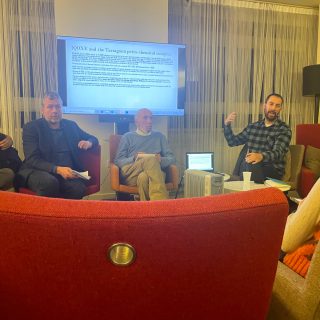
David Collins speaking at his book launch

Reader at The City Law School David Collins launched his book at the international City law firm Arnold & Porter LLP on 16th April. The BRIC States and Outward Foreign Direct Investment was published by Oxford University Press in March 2013. David's book discusses the growth of foreign direct investment in services from the large emerging markets Brazil, Russia, India and China and the role that international investment law has played in this process. He sums up its appeal:

"This book captures a very important and unexplored trend in economic globalization and should be of interest to academics and practitioners in the field of international investment and international trade law."

The launch was attended by lawyers from the firm's international arbitration group as well as staff and students of the CLS. David acknowledges the support of Arnold & Porter: "I am very appreciative of Arnold & Porter for allowing me to host the event at their offices and was quite pleased to have a number of my CLS colleagues and students share the success of the book's publication with me."

David Collins teaches and researches in the field of international economic law specializing in the law of the World Trade Organization and international investment law. He is a Fellow of the Institute for Globalisation and International Regulation at Maastricht University, a frequent Visiting Professor at Esade Law School and a Current Development Editor for the Manchester Journal of International Economic Law.

15Apr/130

Report No.3 from Cape Town: Commonwealth Student Moot – Matthew Sellwood

Today was hectic, to say the least. Up late last night finalising our submissions for today's moot, we got up early to go along to the Law Society's Young Lawyers Breakfast. Immediately afterwards, we attended the Opening Ceremony of the Commonwealth Law Conference, complete with choirs and a keynote speech from South Africa's Chief Justice.

Then it was on to what was, for us, the main event of the day. Our first moot of the competition, against Namibia, who qualified as champions of Southern Africa. We knew that they must be excellent, as they had knocked out South Africa in the qualification process, and had exchanged a highly detailed and legally complex outline argument with us yesterday. They didn't disappoint.

In front of a panel of three judges, we presented first as the Applicants. Essentially, the Applicant in the moot problem we are using is a large, nuclear weapon using state, often regarded as the world's last remaining superpower (sound familiar?). The Respondent is a non nuclear weapon using state, whom the Applicant suspects of developing nuclear weapons covertly.

We made a series of applications, splitting our time between Lead Counsel (10 minutes) and Junior Counsel (15 minutes), whilst reserving a right of reply of 5 minutes at the end. These applications covered a whole range of issues, including the lack of safeguards for the Respondent's nuclear programme, the potentially arbitrary detention of the Applicant's citizens by the Respondents, and many more.

We were very pleased with our performance as advocates, but must admit that we found it difficult to match the complexity of the legal submissions made by the Namibian team. Having already knocked out other countries in an international human rights moot, they had crucial experience of this kind of competition, and in the end it proved decisive. Unfortunately, Daniele and I have officially recorded our first ever mooting loss.

However, now the task is to dust ourselves off quickly, because we have a moot with the same problem tomorrow against India. This time, we will be acting as the Respondents, and if we win it is still possible for us to progress to the semi-finals. It'll be a tough ask, but we'll do our best. Cross your fingers...and I'll let you know how it goes as soon as I can....

Matthew Sellwood and Daniele Selmi (students at The City Law School) are representing the UK at the Commonwealth Student Moot in Cape Town, after winning the ESU National Moot last year.

15Apr/130

Report No. 2 from Cape Town: Commonwealth Student Moot – Matthew Sellwood

Credit:~Prescott

So, here we are in Cape Town. Firstly, thanks should go to Inner Temple and City Law School for paying for our flights, and to the Commonwealth Legal Education Association for putting us up in a lovely hotel (not to mention organising the moot). Having a day off on Saturday to climb up Table Mountain in bright sunshine also didn't hurt our mood! Now, however, the business end of the mooting competition has started...

All of the teams met up in a room at The Cullinan Hotel in Cape Town Sunday afternoon, in order to be introduced to each other and to witness the drawing of lots for the first round. This will consist of two moots, to be held on Monday and Tuesday, after which the top four teams will go through to the semi-finals on Wednesday. Unfortunately, the Nigerian team have had to pull out due to visa issues, but that still leaves us with six opponents. Australia, Canada, India, Kenya, Namibia and Sri Lanka are all bound to present firm opposition!

After the introductions, we found out that our first moot is to be against Namibia. We shall be acting as the Applicants to their Respondents, in the same problem that will be used all week – the United Republic of Utopia and the Socialist Republic of Alpines. Essentially, it is a set of facts which focuses around the legal and illegal use of nuclear power programmes, as well as the extent to which states can arrest the nationals of other states on grounds of espionage.

Our second moot will reverse our role, so we will be acting as Respondents against India. A small country. Barely anyone lives there. How good could they possibly be? Rather good, it would seem, given the content of their outline argument, which we also exchanged at the meeting this afternoon.

In fact, the exchange of outline arguments has illustrated an interesting cultural difference between the various teams. Our approach has been to make our points quite concisely, with only the reference to treaties and ICJ case law which seemed appropriate to support the skeleton argument. However, both of our opponents have submitted quite dense written submissions, containing significantly more detailed legal argument.

Our strategy has always been to signpost the arguments that we will be making for the judge in our outline, but to put the 'flesh on the bones' with our oral advocacy. Our opponents, in contrast, have already written down most of what they will be saying ahead of time. We shall see which approach wins the day on Monday! Another update will follow afterwards....

Matthew Sellwood and Daniele Selmi (students at The City Law School) are representing the UK at the Commonwealth Student Moot in Cape Town, after winning the ESU National Moot last year.

10Apr/130

Representing the UK at the Commonwealth Student Moot (in Cape Town!) – Matthew Sellwood

Two students taking the Bar Professional Training Course (BPTC) at The City Law School have been selected to compete in a high profile international competition. Matthew Sellwood and Daniele Selmi will travel to Cape Town in South Africa for the 13th Commonwealth Student Moot.

The invitation-only Moot is limited to representative teams from regions of the Commonwealth. Matthew and Daniele secured their place by winning the English Speaking Union National Mooting Competition, the largest and oldest of its kind in the country. They will compete against the best teams from North America, the Caribbean, Asia, Africa, Australasia and the South Pacific for the Commonwealth Shield.

The competition is held in conjunction with the 18th Commonwealth Law Conference (CLC) and takes place between 14th April and 18th April 2013. It has been ten years since a team from the UK triumphed at the competition.

Matthew and Daniele will be sending regular updates about their experiences which will appear here on Lawbore's Future Lawyer blog. Drum roll for the first report in this series!

Daniele and Matthew at the ESU National Final 2012

My name is Matthew Sellwood, and I am a recovering politician. Specifically, before I started down a legal path, I used to be a local councillor. After getting better, I thought I’d take the law conversion and study to be a barrister. That brought me into contact with Dr Daniele Selmi, who is a recovering academic scientist, and who also wanted to do a bit of mooting whilst learning what the legal world was all about.

Daniele and I first started mooting together in October 2011, as part of an internal competition during our law conversion course. That first round was one of the hardest moots we’ve ever had to face, but we got through it somehow, and managed to win the competition.

After that, we represented our university in the English Speaking Union/Essex Court Chambers national competition, and were lucky enough to win the final. Being grilled by a High Court judge about the law of trusts was quite an experience, particularly given my less than stellar grasp of the equitable jurisdiction at the time.

We had expected that to be our last moot, but after we had both chosen to pursue the BPTC at City Law School, we were asked to represent the United Kingdom at the Commonwealth Moot. We would have said yes anyway, of course, but the fact that it is to be held in Cape Town didn’t hurt. However, if I had thought that my grasp on equity and trusts was poor, imagine our slight consternation when we found out that the problem was going to be based on the legality of nuclear programmes and the sovereign rights of nations. Neither Daniele nor I have been taught a day of international law in our lives.

Fellow BPTC students will also be aware that early April is not the best time to be attempting to learn something new, given the workload imposed by the central litigation exams. Nevertheless, Daniele and I have put together our submissions, sent them off, and are preparing to fly out to South Africa. Only an enormous amount of photocopying in order to prepare our bundles remains. Along with the small matter of presenting oral arguments in front of some of the world’s leading judicial minds, on a topic which we have learnt from scratch.

What could possibly go wrong?

30Mar/130

Margaret Hodge MBE MP to speak at The City Law School

City University London Honorary Graduate, The Rt Hon Margaret Hodge MBE MP (Civil Law 1993) will be the guest speaker at our forthcoming City Law Alumnae Network event (CLAN).

CLAN is our network for female City Law School graduates. The group meets twice-yearly and provides a unique opportunity for alumnae to meet like-minded solicitors, barristers and other law graduates from across the UK. However for this special event all graduates and current students are welcome. Please find out more and book via the Events Signup.

At this event, Margaret will speak on the topic of 'Women in Public Life' followed by questions from the audience.

Tagged as: , , , No Comments
29Mar/130

Woman’s rights and the law – City Law Alumnae Network (CLAN) event by Marie Tay

A room full of female barristers and solicitors networking over delightful canapés and wine without the men. Not a sight you often see given that women in the legal industry tend to juggle multiple roles balancing work and family life.

Amidst the clink of wine glasses, the female alumni of City Law School were gathered for an evening centered around women’s rights and the law as well as sharing their experiences as women in legal practice.

Charlotte Rachael Proudman (BVC 2010), a barrister at 1 Mitre Court Buildings and author with a commitment to human rights, social justice and equality opened the evening with a powerful address on her experiences in the Democratic Republic of Congo where she established the country's first free legal advice centre.

Speaking about battered women and victims of domestic violence, one particular topic stood out – that of forced marriages – a social issue affecting women in many parts of the world. It is thought that there are over 8,000 forced marriages every year in Britain alone. A forced marriage is likely to become a criminal offence soon and this will send out a strong message to the public that victims will be better protected and deter perpetrators and their relatives although not all favour criminalisation.

In Pakistan, where Charlotte also visited, it emerged that the battered women were counselled by men and leaders reluctant to change an age-old custom that was ingrained in their society, and thus there was little to help the women. Even the women themselves were afraid of openly defying the traditional custom of forced marriages, fearing that their family members could be jailed or discriminated against within their own community.

28Mar/130

Visiting the Supreme Court – Andrew Weston

The famous SC carpet! Credit: IanVisits

On Friday morning, a small group of City University Law School First Years was treated to an insightful tour and small Q&A session at Middlesex Guildhall, home to the UK Supreme Court and the Judicial Committee of the Privy Council.

The tour, given by Head of Communications for the Supreme Court Ben Wilson, lead students through the courts origins as the House of Lords, the political and philosophical reasons for its establishment and reform, along with the history and selection of Middlesex Guildhall, its construction and current role in English Law. To end, students were treated to an informal chat with Lord Carnwath.

Originally built as the City Council building for Middlesex in 1913, the building naturally occupies its place in Parliament Square, gracefully representing the Judiciary next to the House of Parliament, the Executive Offices on Whitehall, and Westminster Abbey. However, the building required extensive renovations in order to meet the reforms of the Constitutional Reform Act 2005 and the needs of the new UK Supreme Court. Beginning in 2007 and with considerable input from the current Justices, the courtrooms and concourses were transformed into bright and inviting spaces, striking a near seamless transition from today's modern requirements and the remarkable original architecture and detail.

27Mar/130

The United Kingdom in a Re-Formed European Union: Professor Alan Dashwood’s Inaugural Lecture – Dilara Alibayova

Professor Dashwood in action...

The initiative of reforming the European Union through establishing an economic and monetary union (EMU) underpinned by a political union and a new treaty formally presented by the president of the European Commission in his State of the Union address in September 2012 is gaining momentum. The role of the United Kingdom in this endeavour is unclear, with domestic debate being filled by arguments of all sorts, at times rather confusing. In such situation, a well reasoned, informed and balanced opinion of well known expert in the European Law is more than welcomed. The public lecture of Prof. Alan Dashwood delivered at City University was a master class in this respect – the policy options for the UK government were clearly defined and their relative advantages and limitations assessed based on the analysis of the effective EU legislation.

In the introductory part of his lecture Prof. Dashwood outlined three possible choices for the UK and existing legal grounds for each. The first choice represents a decision to fully embrace the initiative, which means adopting single currency and joining the European Stability Mechanism (ESM), among others. This option is out of discussion as, in Prof. Dashwood’s words, there is no such a UK government which could sign an agreement to ‘join euro-zone in any foreseeable future.’

The second choice is to make best of being a genuine member of the Union, while not participating in euro-zone. The argument behind this course of action is that the central organising principle of the EU constitutional order always has been differentiation, meaning that not all member states are subject to the same rules or accept the same commitments. Therefore it is fair for the UK to negotiate its own place in the reformed Union. In Prof. Dashwood’s opinion, in the face of problems the EU is liable to face and particularly in interaction between EMU and internal market there are some possible solutions for the UK to consider. The third option represents a possibility of satisfactory accommodation with EMU and exit the Union with an attempt to negotiate a disassociation agreement. This would mean adopting a model similar to those of European Economic Area (EEA) countries or Switzerland.

5Mar/130

Martin Dockray Inaugural Lecture – Sean Knight

During the last term, I attended the Martin Dockray Inaugural lecture at City University, with the subject being secret justice.  Many people will have heard the name Martin Dockray, but some may not be familiar with the nature of the man in relation to the creation and success of City Law School, or in relation to his beliefs on open justice and the rule of law. 

Professor Dockray was instrumental in creating the current City Law School we have today, including being an innovator in bringing the Inns of Court School of Law into the fold, bringing his dream of creating a London legal school that had education at all stages of legal education into reality.  Professor Dockray joined in 1989, after having taught at Kings College.  He came with a Ph.D in law and a successful career as a solicitor, bringing that knowledge and experience into what was an excellent academic career unfortunately cut short by his untimely death.  In accordance with his far ranging legal views, this inaugural lecture has chosen Lord Ken Macdonald to speak about the need for open delivery of justice in the face of expanding secretive justice now in the UK.

Can secrets get in the way of justice? Credit: stevendepolo

Lord Ken Macdonald is uniquely qualified to give this lecture, having been Director of Public Prosecutions (DPP) from 2003 to 2008.  Prior to that, Lord Macdonald was a Queen's Council (1997) and was also a founder of Matrix Chambers.  After leaving his position as DPP, Lord Macdonald was a frequent contributor to The Times, and in 2010 was made a Liberal Democrat peer in the House of Lords. In addition to this, he also resides as Warden of Wadham College, Oxford.

Lord Macdonald has been a tireless supporter of human rights throughout his career as a barrister to his public service, from positions standing against increases in pre-charge detention and inappropriately long prison sentences.  His positions on the “War on Terror”, government prosecution of terror suspects, and the Iraq war in particular are well known and well reasoned.  In the House of Lords, he has reviewed and continues to work on government reviews of security powers and the supervisory powers over the secret service.  Lord Macdonald continues to be a voice in the debate for reasoned oversight of the counter terrorism powers in the UK, and is well suited to discuss secret justice and the closed material proceedings that are of concern here.

The lecture primarily concerned itself with three pillars of discussion, the secret justice often employed in the search for national security and in counter terrorism, the supervisory role over the secret service or sufficient lack thereof, and the concerns over closed material proceedings (CMP) and conflicts with the rule of law. 

It would perhaps be surprising to most people to learn the front line position the House of Lords has taken on these and other civil liberties issues.  This is due in part to the nature of the House of Lords, where a lack of pressure by a voting electorate allows a more long term and rational debate on the issues.  The policy makers in the executive and the legislative branches beholden to the voters and concerned for their offices are so risk adverse that civil liberties are often at risk of being sacrificed to the swaying public mood.

18Feb/130

Careers With a Law Degree – Ahou Hamedani

Author Ahou

We are almost more than halfway through the academic year and if you are in your first year of studies you might be having second thoughts. Some are now reassured that law is their forte and some may be beginning to doubt if they have chosen the right course of study. If your case is the latter of the two there is no need to panic.

If studying law has been a dreadful experience for you until now and it has disappointed you, it is not late to think about what other programs you would enjoy more and apply to switch. However, if you enjoy studying law but what you have learned about being a lawyer scares you or doesn’t impress you then you would benefit from reading this post.

On the 11th February once again the Career and Skills Development Service at City University held a helpful and successful event called Careers with Law Degree. A self-explanatory title, the evening showcased successful individuals with law degrees that had either chosen the path of becoming a lawyer or used their law degree in a different direction. If you missed the event below is an overview of each individual and the career path that they chose:


1. Ed Hall: Senior Lawyer – Crown Prosecution Service:

Career Path:
• B.A in English Literature
• Joined the CPS as an administrator and became interested in law
• Completed GDL & BPTC at City Law School
• Returned to CPS with a law degree
• Started as a Trainee Crown Prosecutor and went to become a Senior Crown Prosecutor
• In 2004 decided to specialise
• Continues to work in the special casework unit

Example of previous/current work:
• Football riots
• Prosecuting individuals involved in 2010 student riots
• People trafficking
• Armed robberies
• Forged passports