

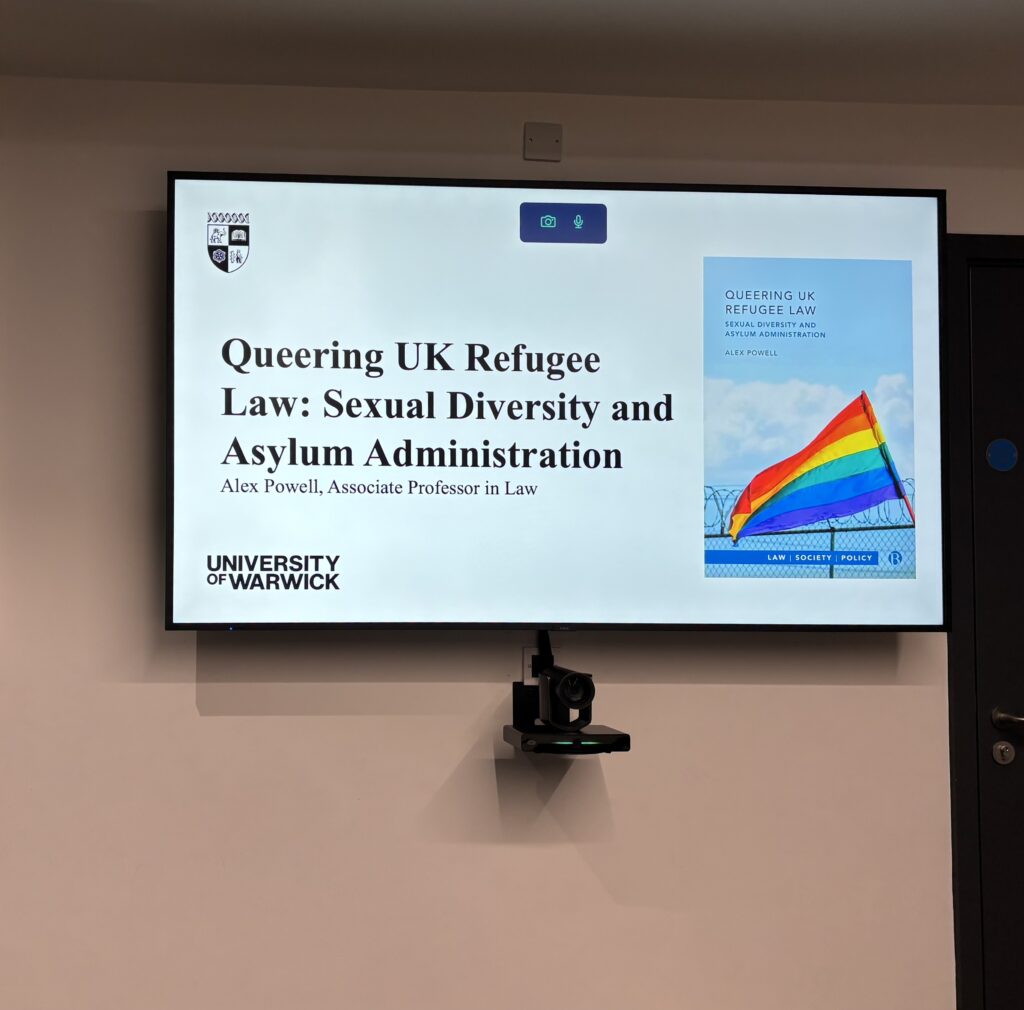
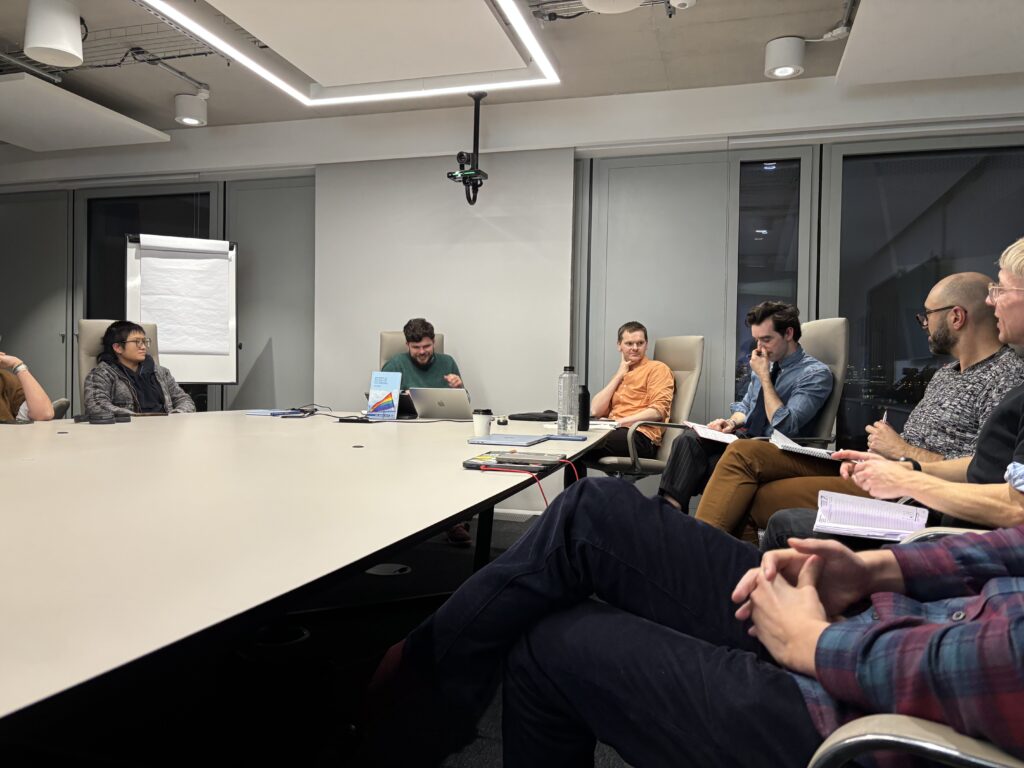
On the 11th of February, City St. George’s International Law and Affairs Group hosted the launch of Alex Powell’s new book, ‘Queering UK Refugee Law: Sexual Diversity and Asylum Administration’. Alex, currently an Associate Professor in Law at Warwick Law School, completed his PhD at City, and shared with us that sections of the book which originated from his PhD thesis. The discussants, Dr Alexander Maine and Dr Calogera Giametta, guided the audience into important insights and questions arising from Powell’s work. Throughout the event, Powell explained in depth the nature of the research and the book’s core themes, which critically review the experiences of LGBTIQA+ individuals within the UK asylum system.
Methodology and Context
To start off, Alex explained to the audience that in writing this book, he adopted a queer methodology by reconciling legal analysis with elements of critical and cultural studies. As he said, this was not a traditional legal analysis, as it focuses on creating space for broader forms of human behaviour by examining the idea of a counter-normative queer theory.
In thinking from this starting point, Alex made reference to Foucault and his theory of identity as a raison d’être, the very core of one’s being. This is particularly relevant because of the very identitarian way in which LGBTIQA+ identities have been constructed within the asylum system, something that came up repeatedly within the interviews he undertook for the book. One of problems faced by queer asylum seekers is having to prove to the Home Office that they are in fact queer, as there is an expectation that they understand their difference as a form of identity.
He also made reference to Andrew Sullivan’s work, ‘Virtually Normal’, by explaining that in the United Kingdom, the predominant idea is that queer individuals are treated as such, meaning that, but for the differences in sexuality and identity, we are all virtually the same. Alex goes on to explain that this is a way of dismissing difference.
He also drew attention to problems with the ‘born this way’ narrative, which has discursive effects, particularly when it arises within the asylum system, when individuals might not frame their experiences in those terms and where people are socialised in different contexts.
An important legal change relevant to the context in which his research was completed was the UK Supreme Court decision in HJ (Iran) & HT (Cameroon) v Secretary of State for the Home Department [2010] UKSC 31. The decision recognised that the previous approach of refusing asylum claims on the grounds that individuals could return to their home countries and be discreet about their sexuality was inconsistent with the Refugee Convention and unlawful. Here, however, he called attention to the shift from discretion to disbelief, where the new way in which refusals are engineered is based on putting an individual’s sexuality to the test.
The study and Findings
Alex went on to explain that the study consisted of two socio-legal data sets: in-depth interviews with individuals who were granted refugee status on the basis of their gender and sexuality, and interviews with legal practitioners and people working to support queer asylum seekers. The aim was to investigate how individuals understood their own gender and sexuality, and how practitioners understood the asylum system, and to examine whether some people’s experiences were not visible or articulated within the framework.
One of the refugees interviewed shared that they found it difficult to adjust the way they understood themselves to fit the system, as the questions posed by the Home Office were framed around elements of their identity, such as when they realised they were queer, how that condition affected the places they frequented and how they spent their time, among others.
Another case mentioned was one where a refugee had been previously married in their country of origin and had a difficult time proving that they were queer because of it. Powell framed this disjunction between getting married or being in a heterosexual relationship to protect yourself and not draw suspicion to your sexuality, and the Home Office approach, where this is inconsistent with the extremely prescriptive identity framework, referring back to the ‘born this way’ element that you’re either in it for life or you’re not.
Alex drew attention to the fact that many of these issues relate to the DSSH model (Difference, Stigma, Shame, Harm), endorsed by the United Nations, which states that authorities must consider a narrative of difference when determining whether someone is LGBTQIA+. According to him, this model prescribes a fixed way of looking at gender and sexuality, which is problematic, since individuals who do not frame their identity in such a way face denial and incredulity.
According to his research, practitioners also reinforced this point, stating that many policies on this issue create additional difficulties for individuals navigating the system.
State of Play
Alex finished his introduction to his work by stating that the policies introduced over the last few years undermine asylum seekers’ ability to comply with evidential requirements. He also made reference to how this way of framing identity, gender and sexuality is harmful, with practitioners and organisations such as Rainbow Migration criticising it. On a last note, he also shared that many of the participants working in the sector who were interviewed felt like the whole system is on the brink of collapse.

My take on the event
The event was extremely insightful, and it was a privilege to better understand the framework and asylum system through the LGBTQIA+ lens. If, like me, this has sparked interest in reading Alex’s work, you can use the code CNF26 for a discount when purchasing the book via this link.
Many thanks to Francine Juarez Bulio for this review. She is a member of the Lawbore team and a second year LLB student, originally from Brazil.
Here’s what she says about herself:
“I have always been interested in Law and actually started a Law degree back home, but I wasn’t able to complete it before moving to England at the age of 19. I hope to work with human rights law one day. Beyond my studies, I really enjoy reading and trying out new coffee shops around London.”