
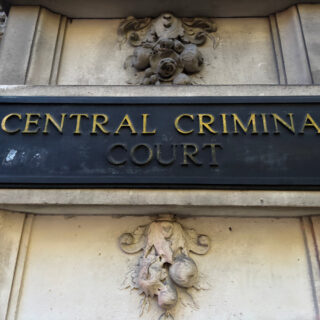
The Central Criminal Court, more commonly known as the Old Bailey, is a building suffused with the weight of history. As the foremost criminal court in the English-speaking world, it has presided over many of the most infamous trials in British legal history. These range from cases which shaped the nation’s moral and cultural conscience – from Penguin Books’ obscenity trial for publishing Lady Chatterley’s Lover, the scandal of the Profumo Affair, and Jeremy Thorpe’s farcical ‘trial of the century’ – to the ghoulish murder cases of Dr Crippen, Peter Sutcliffe, Denis Nilsen, and Ian Huntley.
For a building which has seen some of humanity’s most tragic and depraved episodes, it is also, as Forrest Fulton, Recorder of London (1900-1922), observed, “well adapted for the transaction of legal business, [and] possesses architectural features at once dignified and beautiful.”

Upon entry, a soaring staircase ascends to a grand chamber of Sicilian marble, crowned by a dome ceiling adorned with allegorical sculptures depicting Charity, Mercy, Temperance, and Justice. Built on the site of Newgate Prison, the Old Bailey embodied the sweeping reforms to the criminal justice system at the turn of the century. At its opening in 1907, Edward VII spoke of replacing the “barbarous legal code” of the nineteenth century with a system marked by the “mercy shown to first offenders which is…often the means of reshaping their lives.”
Underneath the splendour of the Grand Hall lies a very different world. The accused, transported daily from remand prisons, wait in the bowels of the Bailey for their day in court. Jonathan Aitken, imprisoned for perjury in the 1990s, described his time in ‘the cage’ as:
“…an animalistic iron-barred enclosure…All men there seemed totally devastated. It was the saddest environment I had ever been in during my life.”
This dichotomy made the Old Bailey a fitting venue for the second instalment of the Justice For All series on 4th February 2026 – Justice for the Accused – which examined defendants’ rights, procedural fairness, access to legal representation, and justice in the ‘machine age’.

The keynote address was delivered by Sir Geoffrey Vos, Master of the Rolls, who argued that “justice means something very different in 2026 than it did in 1873, when our current civil justice system was enshrined in the Judicature Acts.” No longer reserved for the wealthy, justice is now expected to be equally available to all, delivered without delay, and capable of handling the unprecedented scale and complexity of modern disputes. This ambition, Vos suggested, can only be realised with the assistance of technology.
Each year, courts in England and Wales handle some 15 million civil cases. “The resolution of disputes quickly and efficiently is essential to the economic wellbeing of our country,” Vos said.
“Lengthy disputes affect the productivity and psychological wellbeing of all those involved…and cause significant economic drag.”
As AI becomes increasingly embedded in everyday life, litigants in person and small enterprises now turn first to ChatGPT or Copilot rather than lawyers. Minor disputes might increasingly be resolved by machines, offering outcomes that are faster, cheaper, and potentially more reliable than those delivered by human judges. While concerns about AI “hallucinations” have attracted media contrition, Vos said it is “pointless” to dwell upon them, because “hallucinations will very soon be things of the past.”
Yet Vos was careful to insist that human judgment must remain central to civil and criminal trials, particularly in cases affecting fundamental rights. Article 6 of the ECHR guarantees “a fair and public hearing within a reasonable time by an independent and impartial tribunal,” and AI should enhance – but never replace – the human element in justice.

Vos’ remarks framed a panel discussion moderated by Andrea Coomber, Chief Executive of the Howard League for Penal Reform. Katie Wheatley, Head of Crime at Bindmans Solicitors, delivered a defence of juries as a cornerstone of Britain’s democratic settlement. Citing the Lammy Review, she noted that juries are the only part of the criminal justice system where minorities do not suffer disproportionate outcomes – the irony being that the Review’s author now proposes to restrict them. Addressing the prison crisis, Wheatley argued that prison is not just a physical space, but is also a system designed to deprive liberty; she therefore advocated an expansion of electronic tagging and community punishments for low-risk inmates, rather than short prison sentences.
David Gauke, former Lord Chancellor and now Chair of the Independent Sentencing Review, brought political realism to the discussion. Although many criminal practitioners argue for increased Ministry of Justice resources, Gauke noted that NHS and defence spending inevitably dominate Treasury priorities; the annual expenditure of the Ministry of Justice is not worth three weeks of the Department of Work and Pensions’ budget. Yet, without further investment the system risks collapse, as Gauke witnessed with the prison staffing crisis during his tenure as Justice Secretary. Funding justice, he argued, is a sound long-term investment: reducing reoffending is cheaper than perpetuating costly cycles of imprisonment.

Charlie Taylor, HM Chief Inspector of Prisons, offered a bleak account of the UK’s prison system. 20% of the prison population is on remand – legally innocent people – sometimes waiting three to four years for Crown Court trials. Most are held in overcrowded, violent, and drug-addled Victorian jails, locked in cells for up to 22 hours a day, with minimal access to mental health support or rehabilitation. Some 6,000 prisoners undertake lengthy journeys from remand prisons to court each year in transfer vans known as “sweatboxes”, causing significant trial delays when they are often late. Taylor argued that greater use of video links to prisons could mitigate this, though he stressed that the prison estate remains an ‘analogue system’: technology should be rolled out with immense caution, and should never replace human contact within rehabilitative schemes.
Professor Richard Susskind CBE, a leading authority on artificial intelligence, articulated a vision of the future at once dazzling and terrifying; he described the development of artificial general intelligence (AGI) as potentially imminent. These systems could revolutionise access to justice, but in the wrong hands could be a powerful tool for criminals, overwhelming law enforcement. Managing AI, he concluded, is the defining issue of our era – one which traditional government structures are ill-equipped to cope.
Justice For the Accused principally explored how technological innovations may shape the future delivery of justice, but it did not lose sight of justice’s fundamental purpose. John Mortimer, creator of Rumpole of the Bailey, once quipped (only half-jokingly) that: “High among the great British contributions to world civilisation [are] the plays of Shakespeare, the full breakfast, the herbaceous border, and the presumption of innocence.” To preserve the most precious elements of Britain’s justice system – and, by extension, its national identity – the accused cannot be condemned by political expediency or misguided algorithmic reasoning. Foundational principles of justice, carved in stone on the walls of the Old Bailey, must not be overwritten in the machine age.
Thanks to Joey Ricciardiello for this insight into the second installment from the Justice for All series. If of interest to you, have a look at Iain Lynn’s review of the first one. Next up is ‘Justice for Victims and Survivors’ on 23rd March.