

Understanding how the legal profession operates across different countries can feel overwhelming, particularly for students trying to picture where their law degree might take them. Hosted by City’s Bengali Legal Network Society, Crossing Borders: Insight into British and Bangladeshi Legal Practice brought together two distinguished legal professionals: Muhammad Sakhawat Hossain, Barrister-at-Law (Lincoln’s Inn) and Advocate of the Supreme Court of Bangladesh, and Sajib Hosen, Solicitor and Founder of Gigalegal to explore exactly that. Unfortunately the third planned speaker (Md Salequzzaman) was unable to attend.
The panel offered a rare comparative look at legal practice in the UK and Bangladesh, while also providing candid reflections on the realities of entering, and thriving in the legal profession. Both speakers shared their personal journeys, the challenges they faced, and the strategies that helped them build resilience in demanding fields. From mindset and skill building to cross-broader opportunities and the importance of networking, the event provided practical, grounded advice for aspiring lawyers navigating an increasingly global legal landscape.
Developing the Right Skills: Insights from Barrister-at-Law Muhammad Sakhawat Hossain.

Muhammad Sakhawat Hossain, a Barrister-at-Law and member of Lincoln’s Inn, offered one of the most striking perspectives of the session. Now an Advocate of the Supreme Court of Bangladesh, he reflected on a legal journey that began more than two decades ago, one shaped by discipline, resilience, and an unwavering commitment to personal growth.
Hossain explained that the pathway into legal practice in Bangladesh follows a different structure to the UK, with its own set of examinations and progression stages. After completing his legal studies in the UK and being called to the Bar at Lincoln’s Inn, he retuned to Bangladesh, where advocates build their career in stages, first by qualifying to practice in the lower courts, then by gaining the experience and certification required for appearances in the High Court, and eventually the Appellate Division. His description highlighted how this step-by-step progression allows lawyers to steadily develop confidence, practical judgment and professional maturity.
Reflecting on his early years in practice, Hossain emphasised that networking and initiative were essential to his development. He encouraged students to place themselves in environments where learning happens naturally, whether through visiting chambers, observing senior lawyers, or building professional relationships withing the legal community. He noted that even when senior practitioners are busy, showing consistent interest and maintaining contact can open doors to invaluable guidance.
His advice was clear: surround yourself with people who challenge you to grow. By actively attending chambers, seeking out mentors and engaging with practitioners, students can develop teamwork, communication and professional awareness. Skills that Hossain believes are just as important as academic ability. His journey serves as a reminder that legal careers are shaped not only by qualifications, but by the networks you build and the effort you invest in your own progression.
Building Skill Through Experience: Insights from Solicitor Dr Sajib Hosen

Dr Sajib Hosen, a solicitor and the founder of GigaLegal Solicitors, shared a practical and honest account of what it takes to build a legal career in the UK. His journey began in 2009, after completing his LLB and the Legal Practice Course, followed by a PhD in Philosophy with a focus on international and criminal law. Unlike many students who enter law with a fixed career plan, Sajib explained that he originally saw himself in academia rather than legal practice.
While teaching and completing his PhD, he worked part-time in a law firm, an experience that gradually changed his perspective. Being in a working legal environment and seeing the impact lawyers could have on real people made him reconsider his career path. Over time, that practical exposure played a key role in his decision to qualify and practice as a solicitor.
Sajib was open about how challenging the UK legal market can be, particularly for those starting out. From his experience as both a practitioner and recruiter, he stressed that work experience across different firms is crucial. He explained that when reviewing applications, he looks beyond academic results and focuses on whether candidates have developed practical skills, particularly in drafting and understanding how the UK legal system operates in practice. For Sajib, combining academic knowledge with hands on experience was what ultimately shaped his career, and he encouraged students to take every opportunity to do the same.
Navigating Challenges and Building Resilience in Law
When discussing setbacks and long-term resilience in the legal profession, both speakers offered honest reflections drawn from their own experiences, highlighting that resilience is not something you are born with, but something developed over time.
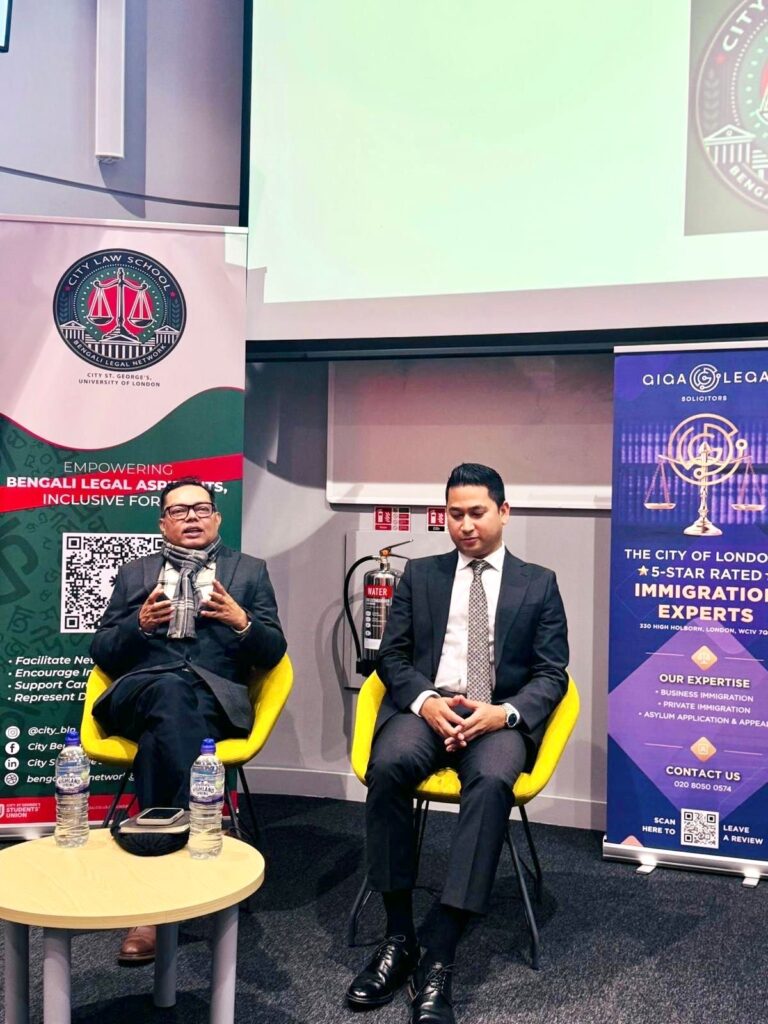
For Sajib Hosen, resilience came down to attitude, consistency and mental wellbeing. He openly acknowledged that there were many points in his career when he considered stepping away from practice altogether, but what ultimately kept him going was persistence and a long-term mindset. As both a solicitor and business owner, Sajib emphasised that mental health is central to sustaining a career in UK legal practice. He explained that structure plays a key role in managing pressure: he carefully plans his time to balance professional responsibilities, business development and personal life. Early mornings are often dedicated to strategic planning and marketing, while weekends are largely kept work-free, aside from time spent staying legally up to date. One habit he shared with students was his commitment to continuous learning, aiming to understand at least one new legal principle each week. For Sajib, resilience is built through discipline, reflection and accepting that progress takes time.
Muhammad Sakhawat Hossain offered a perspective shaped by his early years of practice in Bangladesh, where financial security is not immediate. He explained that when starting out, junior advocates often work without a salary, and maintaining close communication with senior lawyers can be challenging due to their demanding schedules. Rather than framing this as a barrier, Hossain highlighted the importance of patience and long-term thinking. He advised students not to become discouraged by short term financial uncertainty, noting that experience and credibility naturally lead to financial stability over time. His focus was on developing strong legal knowledge, remaining firm in professional integrity, and knowing when to say no so that the quality of work is never compromised. For Hossain, resilience comes from trusting the process, staying committed to learning, and believing that sustained effort will eventually be rewarded.
Their insights offered a clarity for students navigating their future careers, setbacks are a normal part of legal careers across jurisdictions, but resilience, patience and a clear sense of purpose can help lawyers navigate even the most challenging stages of their professional journey, qualities both speakers identified as essential to being a good lawyer.
How Legal Careers Really Take Shape
For Muhammad Sakhawat Hossain, this meant making the most of university life. He encouraged students not to underestimate how valuable this stage is, describing it as the best time to explore, experiment, and build confidence. He stressed the importance of putting yourself in spaces where learning happens. Attending chambers, engaging with the legal community, and seeking out practical experience can all make a real difference. For city students, this can be as simple as actively using the opportunities already available, from those on the CareersHub and Lawbore City Hub to mini-placements, insight events and networking sessions.
Sajib Hosen shared a similar advice, from his perspective of someone who has gone on to build his own firm. Looking back, he explained that two things mattered most: Knowledge and Networking. He encouraged students to actively develop their legal understanding while also building a professional presence, platforms such as LinkedIn. In today’s competitive legal market, being visible, engaged, and informed can be just as important as academic success.
Reflecting on his journey to founding GigaLegal Solicitors, Sajib explained that building a law firm requires far more than legal expertise alone. Drawing on his own advice about the importance of experience and resilience, he described how before setting up his own practice, he deliberately worked across different firms to understand how they operate day to day. This exposed him not only to drafting and legal process, but also to client care, communication, marketing and professional reputation. Sajib emphasised that paying attention to these details early on helped him appreciate that running a firm is as much about people and planning as it is about law.
Throughout the event a consistent message emerged for students: that being that there is no single formula for success in law. Careers are built gradually, shaped by persistence, experience, and a willingness to learn along the way. Whether students aim to practice internationally, work in the UK, or eventually build something of their own, the message was the same, staying curious and using your time at university to explore what truly fits you.
The panel closed with a powerful reminder that legal careers are rarely straightforward, whether in the UK, Bangladesh or beyond. By sharing their experiences openly, the speakers demonstrated that patience, honesty and consistency are as important as legal knowledge itself. For students navigating their own future, Crossing Borders reinforced a reassuring truth, with resilience, curiosity and the willingness to seize opportunities, there is more than one way to build a meaningful and successful career in law.