
This new feature sees undergraduates from The City Law School taking on the role of specialist Lawbore EU journalists. Here, and in future posts, they will reflect upon events, speakers and developments originating from City’s Institute for the Study of European Law (ISEL). A big welcome to Haya, Mahnoor and Otilia!
European law is one of The City Law School’s premier research fields and this piece outlines the content of ISEL’s first event of the academic year, along with a profile of its speaker (a leading professor of EU law) and the academic article which inspired the talk.
The CLS Event
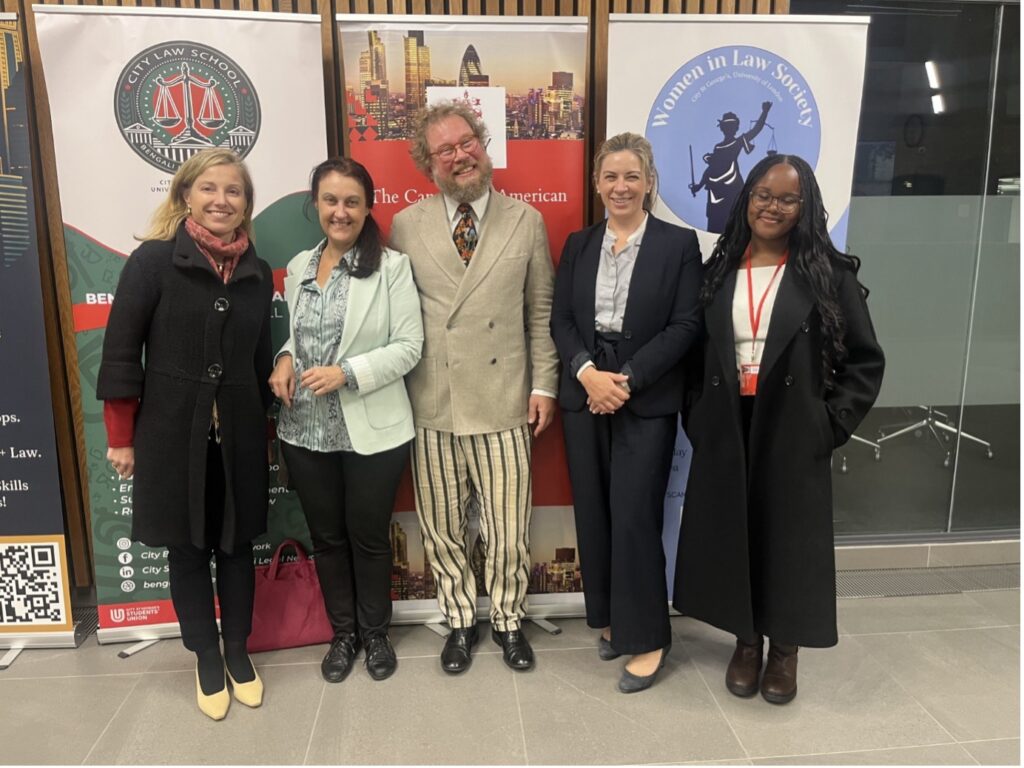
Outline: ISEL hosted its first EU law research event of 2025/2026 with a Moot Court room packed with attendees from both the City community, as well as the wider EU law sphere to listen to Professor Dimitry Kochenov speak on the Rule of Law. He spoke on ‘Autocratic Legalism meets Supranational Opportunism’, along with with discussants Professor Francesca Strumia and Albena Azmanova, and the Chair, Professor Elaine Fahey in a lively and friendly atmosphere full of thought-provoking exchanges.
The Rule of Law is a fundamental pillar of the European Union (EU) and is a recurrent target of widespread debate. To open the event, Professor Kochenov offered a well-crafted mirror to the EU: ‘It is absolutely indispensable to scrutinise the Union the same way as all other legal systems on this continent …’. Professor Kochenov warned about the institutional vision of the Rule of Law developed by the Court of Justice, which he terms ‘supremacy Rule of Law’ in his work. This vision dismisses the essence of the Rule of Law – accountability – and instead promotes the idea of holding the supremacy of legal Law sacred. This shift, he argues, results from the Union’s response to the democratic backsliding in Member states by expanding its own power.
Does this deserve to be labelled as the Rule of Law? Professor Kochenov answered, suggesting that the ‘supremacy Rule of Law’ reflects the opposite of what the Rule of Law is about, but its terminological use highlights how this deteriorating effect is disguised by the Court.
Professor Kochenov’s main point was that although the EU presents itself as the “guardian of the rule of law,” the reality is quite different. The Union often fails to act when member states undermine judicial independence or democratic standards, and at times it even avoids accountability for its own actions. Much of the lecture focused on Hungary and Poland, which have faced criticism for undermining judicial independence. The Court of Justice of the European Union has produced important case law under Article 19 TEU, but Kochenov argued that these rulings have changed very little on the ground. Judges are still being unlawfully appointed and courts remain under political pressure. Article 7 TEU, which was supposed to be the EU’s strongest tool for dealing with these breaches, has not been effective at all. In practice, it has become a political dead end. For Kochenov, this shows how the EU often talks a lot about values, but struggles to enforce them.
Another striking part of the lecture was his discussion of migration. The EU spends huge sums outsourcing border control to third countries, even when this leads to serious human rights problems. Kochenov described this as a double standard: the EU criticises member states for breaking the rule of law, but at the same time engages in practices that avoid accountability and put lives at risk. He suggested that in this sense the “rule of law” can feel more like propaganda than a real check on power. Instead of restraining the EU, it becomes a way to justify whatever the Union wants to do.
For Kochenov, the real danger is how the EU has started to redefine the rule of law itself. Traditionally, the rule of law is meant to act as a restraint on governments and leaders. But in EU law, it is increasingly tied to the supremacy of EU law. This, he argued, removes the conflict that makes the rule of law meaningful in the first place.
This left the audience with difficult questions: how can we trust the EU to enforce the rule of law against member states if it does not apply the same standards to itself? And what happens when democracy and legality, the two key checks on power, both appear weak?
The event ended with a lively discussion. Some asked whether tools like conditionality, linking EU funds to respect for the rule of law, might work better. Others questioned whether the EU is even capable of enforcing these values within its current structure. Kochenov did not give easy answers but instead encouraged everyone to think critically about what the rule of law really means in the EU.
The speaker at the event
Professor Dimitry Vladimirovich Kochenov leads the Rule of Law Workgroup at CEU Democracy Institute and teaches at the Department of Legal Studies. He has guest lectured to City Law School students on the EU law course of the LLB undergraduate degree previously on EU citizenship.
The Publication behind the event
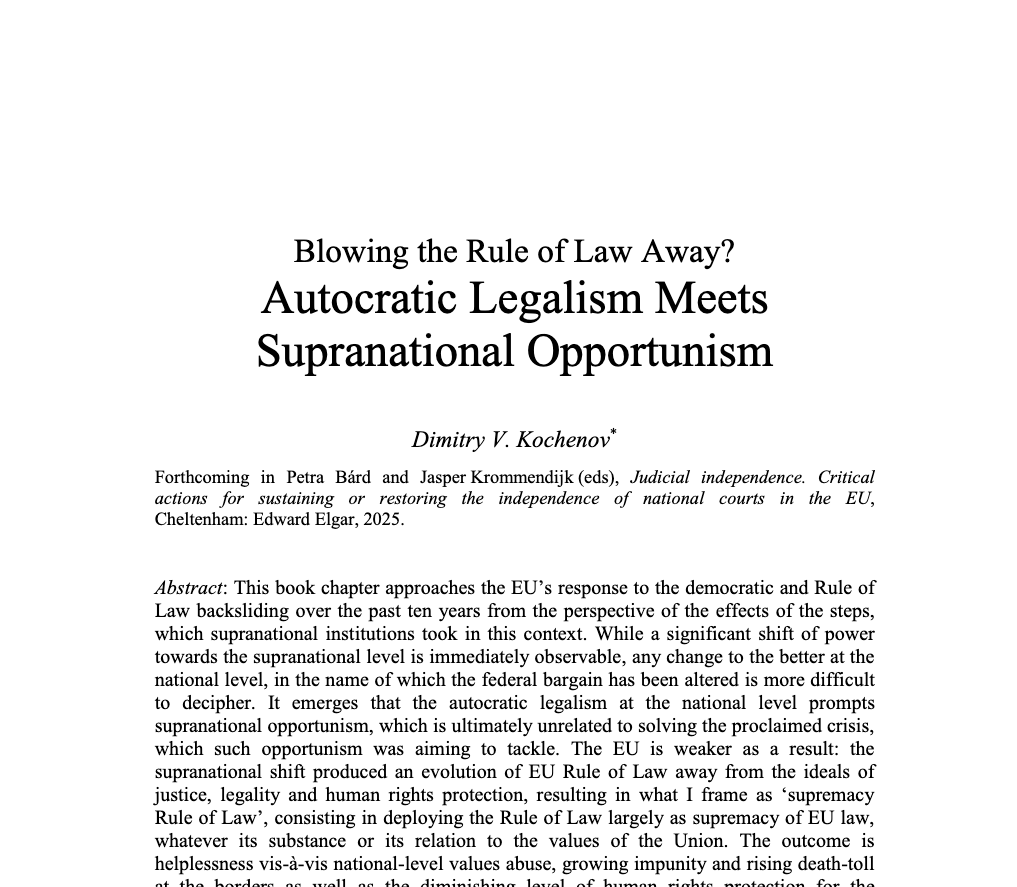
The Lawbore EU law journalism corner seeks to report on academic events but also look at the academic publications behind them. For this event, it was Kochenov’s piece on ‘Blowing the Rule of Law Away? Autocratic Legalism Meets Supranational Opportunism’ which provided the backdrop. This paper highlights the EU’s misuse of the rule of law to preserve its supremacy and essentially marks it as a lawless entity, utilizing this fundamental value to mask its ultimate political weakness.
Professor Kochenov also spoke about a high-profile recent publication on lawlessness and migration co-authored with Professor Sarah Ganty.
His publication raised the question of how a supranational authority comes to abuse the very law it was created to protect, and what repercussions can we see the more it progresses? When legality is used as a tool to abuse the justice system, it effectively erodes its legal substance. Kochenov’s piece also made it increasingly apparent that it was condemned from its origin, as its shaky foundation exacerbated its misuse of Article 19 due to its inadequate political power, which prompted it to use its legislative powers as a political tool rather than a safeguard. This begins the EU’s “Supremacy Rule of Law,” a phrase coined by Kochenov, which exemplifies its misuse of the very value it was created to protect. He sees the EU as using ‘the rule of law’ to legislate itself as a sovereign supranational entity, leaving corruption within member states afloat and tainting the EU itself, turning the rule of law from a value into a façade of political legitimacy.
We see this contradiction most clearly unravel in the EU’s handling of Poland’s judiciary, which operates on a basis that defies the rule of law, and, on occasion, party leaders have publicly slated it. This is a prime example of how the EU prioritizes its supremacy rather than the enforcement of EU values, with its political opportunism leading to it negating the basis on which it was founded. This also highlights the dangerous standard it set for member states, as it condoned the same behaviour it condemned in its member states.
Kochenov raises another way they abused their supremacy rule of law; through their institutional complicity in thousands of preventable deaths in the Mediterranean through deals with Turkey and Libya to stop migration at the border. He noted that 28,000 deaths were caused as a result. This exposes two very dangerous realities: The EU prioritizes supremacy over morality, and the basis of mutual trust on which the EU was built turns the other cheek to prioritize its interests. De Gaulle, a politician at the union’s conception, rejected proposals of the EC, as he believed supranationalism would take control of intergovernmentalism. Kochenov’s piece substantiates that fear as the EU legislates to maintain its power, not protect its citizens. As a consequence of the EU’s consistent lack of intervention and erosion of its values in practice, citizens may lost faith in these supranational organizations.
Conclusion
Overall, the talk was challenging but eye-opening. It showed that concepts like democracy and rule of law, which we often take for granted, are much more fragile than they appear.
Many thanks to LLB2 students Haya Hamze and Mahnoor and LLB3 student Otilia Nzoubou for their excellent summary of the first ISEL event in the 2025/26 series. We look forward to hearing about more ISEL activities in future posts.