
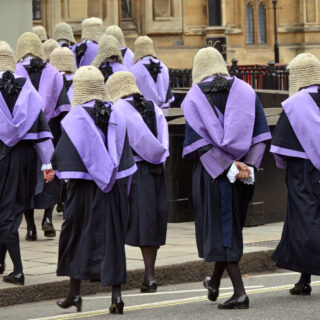
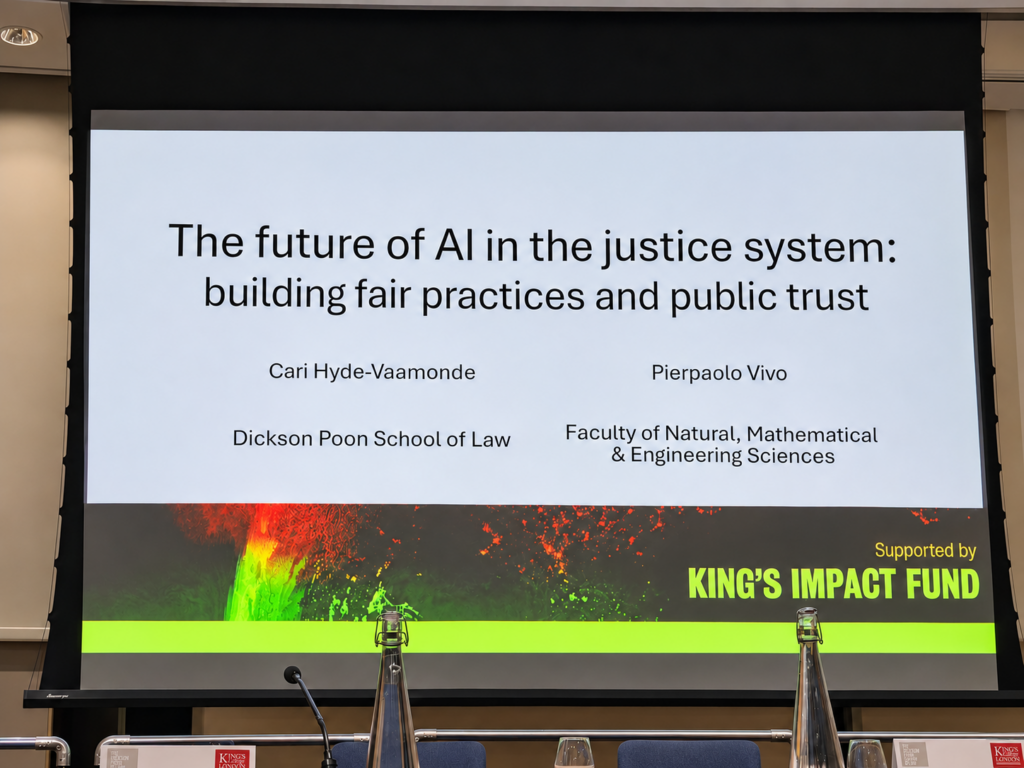
Few institutions change as reluctantly as the courts, and few technologies arrive as uninvited as artificial intelligence. The collision of the two was once the stuff of speculative fiction; it is now a matter of administrative routine. Whether a computer should ever help decide a case is no longer a question for futurists, but for judges, magistrates and the public who must live with their decisions. It was this question that drew researchers, campaigners and the merely curious to Bush House for “The Future of AI in the Justice System: Building Fair Practices and Public Trust”, hosted by King’s College London.
The occasion heralded the presentation of findings from an unusually wide-ranging piece of research. Led by Cari Hyde-Vaamonde, a legal scholar, and Pierpaolo Vivo, a mathematician, and built with King’s Digital Lab, the project produced a prototype decision-support tool and then exposed it to scrutiny from every direction: students of law, mathematics and psychology, members of the public, and Transform Justice, a charity. Joining them on the panel were Fionnuala Ratcliffe of Transform Justice, and Laura Burgoyne and Anne Hausknecht of JUSTICE, a law-reform charity.
The debate, it soon became clear, divides people into two camps whose fears are mirror images of each other. The first distrusts the machine: an opaque system whose reasoning cannot be cross-examined and whose errors no appeal to conscience can reach. The second distrusts the judge: a human being, and therefore a creature of habit, mood and prejudice. Each camp sees in the other’s remedy the very disease it fears. The panel’s task was to establish which anxiety is better founded, and whether the choice between them is quite as stark as it appears.
The ghost in the courtroom
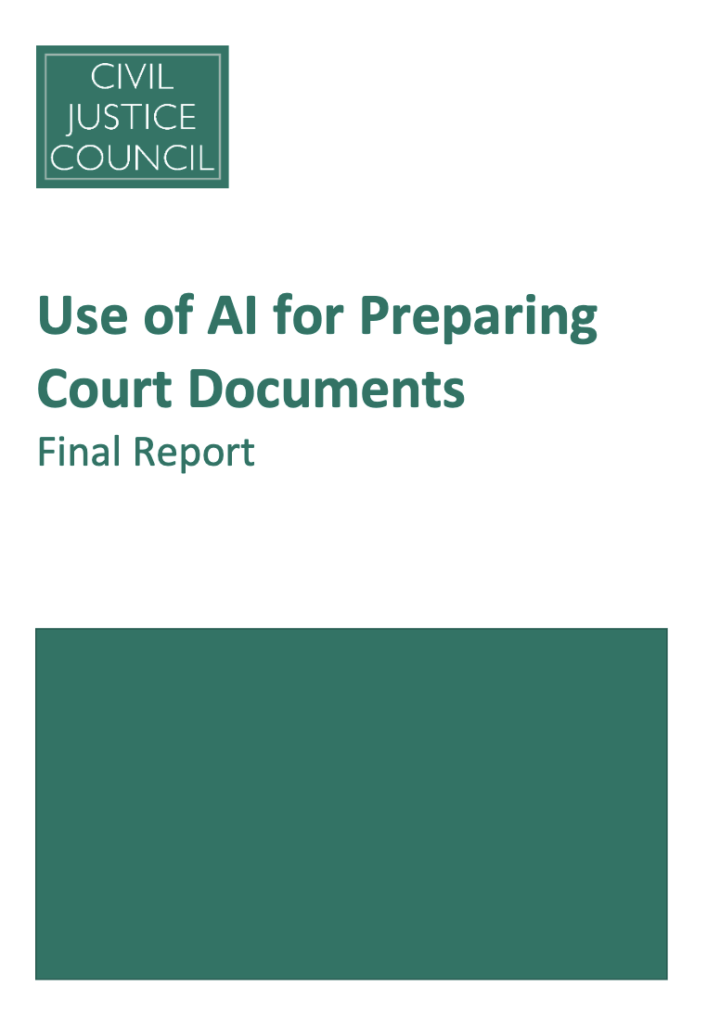
Those who imagine AI as a distant threat to the judiciary are already behind the times. Judges in England, the panel noted, now have Microsoft Copilot at their elbow: a general-purpose assistant, designed for everything and therefore for nothing in particular, and certainly not for judging. Whether it will sharpen judicial work or merely disrupt it remains an open question. Nor is it alone. Justice Transcribe turns speech into text and meetings into summaries; since October 2026 an AI “case readiness” assistant has been quietly at work in Inner London Crown Court, flagging outstanding actions and missing information before a hearing begins. Even witnesses are being drawn in: the Civil Justice Council recommends that they declare any use of AI that has shaped their evidence (see their report ‘Use of AI for Preparing Court Documents’ (Oct 2026)).
Beyond the courtroom, the transformation is less orderly. Legal advice is costly and scarce, and those who cannot afford a lawyer increasingly consult a chatbot instead; some lawyers, too, have come to rely on them for their drafting. The difficulty, as the panel observed, is not that such tools are always wrong, but that they can be wrong with complete composure, and the clients who depend on them are seldom equipped to tell the difference.
Justice delayed
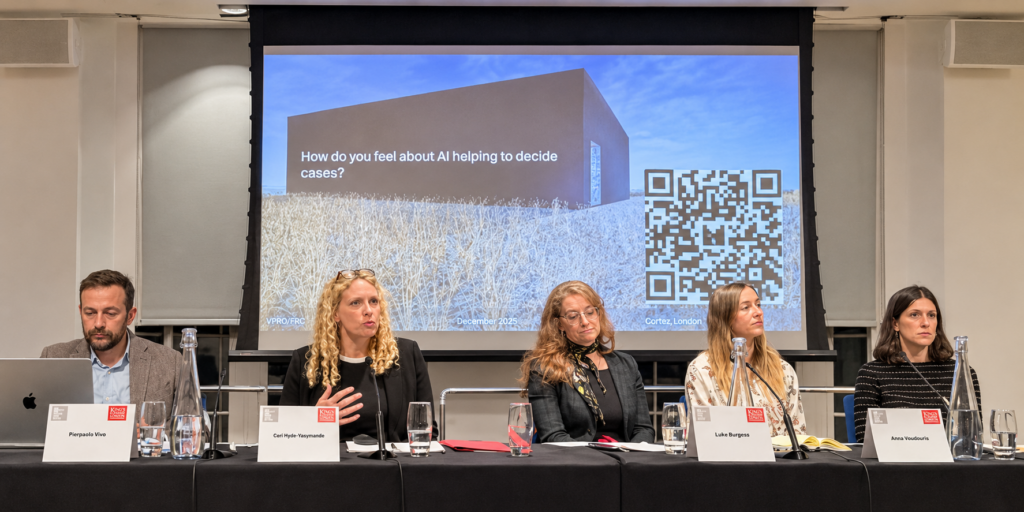
If the critics of human judges expected the public to share their misgivings, Ms Ratcliffe’s evidence must have come as a disappointment. Transform Justice trains ordinary citizens to observe court hearings; some 150 have done so. Their verdict on the judiciary was, on the whole, a generous one: inconsistencies here and there, but a process that was broadly fair. What dismayed them was not the quality of judgment but the length of the wait. They watched defendants and witnesses, frayed by anxiety, sit through an entire day in court only to see their case adjourned. And they saw defendants who arguably belonged somewhere else entirely: people whose real afflictions, homelessness and addiction among them, called for support rather than prosecution.
The lesson is a sobering one for enthusiasts of algorithmic judgment. The public’s complaint is not with the mind on the bench but with the machinery around it, and it is there, Ms Ratcliffe suggested, that AI might prove its worth: in preparing cases, supplying interpreters, mending the IT failures that stall hearings, accounting for defendants who are never brought to court, and chasing probation reports that are never ready.
Ms Burgoyne directed attention to the single justice procedure, under which a magistrate disposes of low-level cases on the papers alone. The procedure, she argued, has quietly transferred its administrative burden onto the very individuals it processes, many of whom must decide how to plead without a word of explanation as to what their options are. Here, at least, AI might do something genuinely humane: explain.
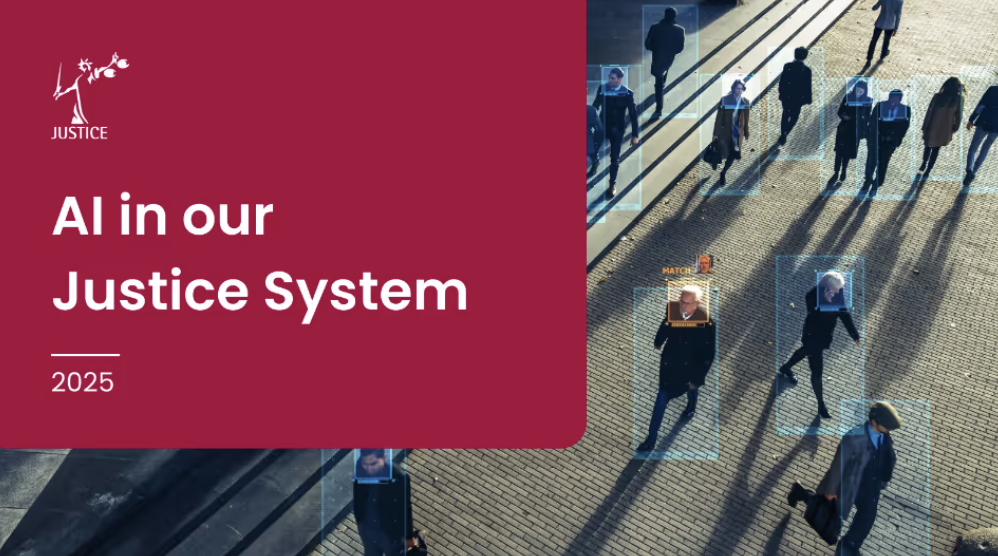
Ms Hausknecht, for her part, counselled against putting the cure before the diagnosis. Drawing on JUSTICE’s report on AI in the justice system (‘AI in our Justice System’ (Jan 2025)), she insisted that the problem must first be correctly identified, with an eye to international experience as well as domestic, before any technology is summoned to fix it. A tool should be judged by whether it achieves its purpose, by its speed and transparency, by who bears responsibility for deploying it, and by its effect on society, not least on public confidence in the courts. The point, she stressed, is not to replace people but to serve them; and what people in legal difficulty sometimes need most is the one thing no machine can supply: another human being.
The prejudice in the machine
If one theme haunted the evening, it was bias. The panel cited COMPAS, a risk-assessment tool used in America and criticised for racial discrimination, as a warning of what happens when algorithms inherit the sins of the system that trains them. The optimist’s case is that AI could cleanse human justice of its prejudices, perhaps by purging them from the training data. The pessimist’s reply is that it is more likely to launder them: to take the bias of a thousand individual decisions and return it bearing the imprimatur of mathematics. Those who fear the prejudiced judge may find scant comfort in a machine that has learned its trade from prejudiced judgments.
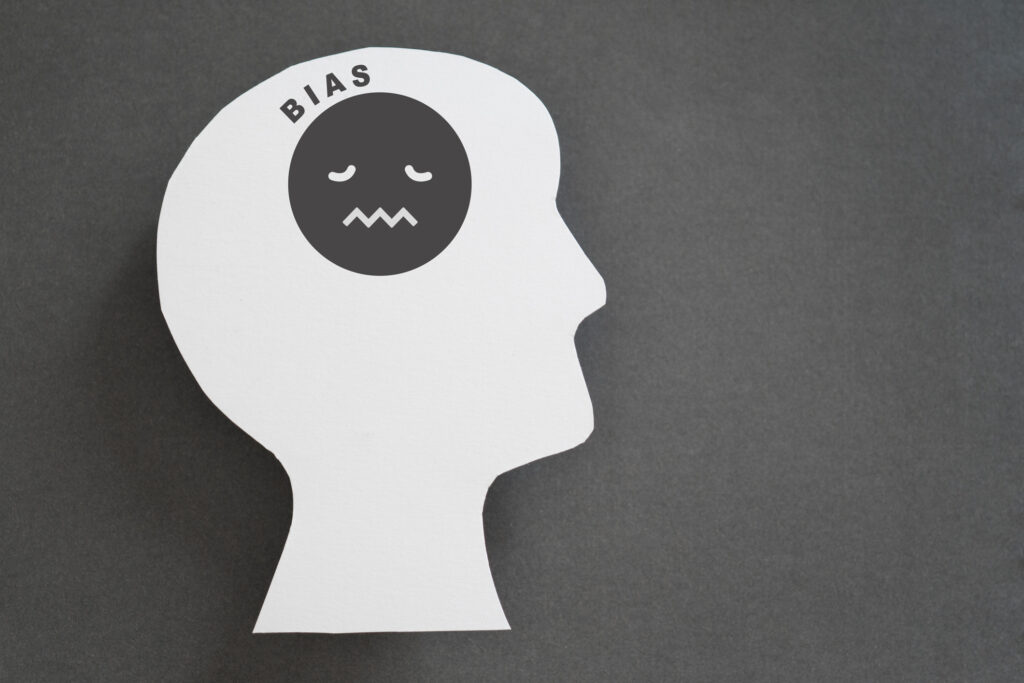
Mr Vivo, whose field is complex systems, explained why such machines resist prediction. Different models return different answers to the same question; their training data is frequently withheld from scrutiny; and their components behave one way in isolation and quite another in concert. Accelerate one part, and the quality of the whole may fall, or, perversely, the entire system may slow. This poses a question lawyers have rarely had to answer explicitly: which measure of success should take priority? Consistency, perhaps the most pressing concern about AI in law, may sit uneasily alongside other values. Compounding all of this is automation bias: the tendency of even conscientious magistrates and judges, fully aware that responsibility rests with them, to defer to the confident output of a machine.
The project’s own prototype supplied a cautionary tale. Presented with a fictional case under the single justice procedure, the tool misread the language of the defendant’s statement. Far from discrediting the research, the error vindicated it, demonstrating more vividly than any argument could that AI’s outputs cannot be taken at face value; and the team deserves credit for exposing the weaknesses of its own creation rather than concealing them. Language, indeed, proved a recurring vulnerability. Defendants with limited English may receive different outputs from fluent speakers, while those with a gift for embellishment may talk their way to a kinder result. Then again, as the panel conceded, the same is true of human magistrates.
The audience pressed further still. Might AI serve as an advisory jury, given that jurors decide the gravest cases? Might it assist in sentencing? I found myself wondering whether strict-liability offences, where no mens rea need be proved as to at least one element of the actus reus, might offer the most hospitable ground. Yet even there the comfort is partial: sentencing remains an exercise of discretion, and human judgment would be diminished rather than dispensed with.
Neither camp
The evening’s most persuasive conclusion was also its least dramatic: that the consequences of AI for justice cannot be understood through any single lens. Tools of this kind must be built by lawyers, mathematicians and psychologists together, with a sensitivity to context and, above all, a willingness to listen to those on whom the justice system bears most heavily. That is what this project attempted, and its candour about its own shortcomings is perhaps its strongest recommendation. For the two camps with which the evening began, the moral is an inconvenient one. The question is not whether to trust the machine or the judge; it is how to build a system, of people and of code, that deserves to be trusted at all.