

In my previous posts in this series (‘AI and the delivery of legal services’ and ‘Skills, AI and Legal Education’, I considered how AI is reshaping the delivery of legal services and the skills the lawyers need, both now and in the future. In this post, I will explore some of the risks and challenges around AI use by consumers and lawyers, including trust, transparency, pricing and upskilling.
Use of AI by consumers
Consumer research commissioned by the Legal Services Board (AI in Legal Services: consumer expectations and attitudes, published 10 June 2026) found that 70% of adults surveyed expected AI to improve ease of access to legal services, and 64% expected AI to lead to greater affordability. However, the same research identified five ‘red lines’ that survey participants considered to be non-negotiable:
“…a minimum guarantee of accuracy, no consequential action without informed consent, some level of human oversight, access to redress if things go wrong, and protection of personal data”.
AI is used in both regulated and unregulated legal services, and this gives rise to different levels of consumer protection, as the Existing Standards for AI-Powered Business to Consumer Lawtech report (published by the LSB 10 June 2026) concludes:
“…consumers using unregulated AI legal tools are primarily protected by broad regimes such as the GDPR and consumer protection law, which do not directly address the risks of AI-generated legal advice or guidance”.

Researchers at JUSTICE and the Administrative Fairness Lab have conducted a large-scale study of public use of AI chatbots for legal help (‘What Chatbots can teach us about unmet legal needs’, published 1 September 2026), which revealed one in six participants experiencing a recent legal problem had used a GenAI chatbot for some form of legal help. The reported findings provide fascinating insight into actual AI use by consumers and suggest that their use of AI extends beyond just asking for legal advice and information; it included asking for interpretation of legal advice in “normal person language” (a reminder of the importance of using plain language in client communications!), checking lawyers’ advice and service, help with drafting and interestingly, emotional support and reassurance. These types of AI interactions have the potential to impact on the nature (or even existence of) of the lawyer-client relationship.
Lawyers are also concerned about the risks to consumers from use of AI tools. For example, 77% of respondents in a recent survey (LexisNexis Generative AI Legal Survey H2 2026) believed that “AI is causing more clients or the general public to misinterpret the law”, and the use of AI chatbots by unrepresented litigants is expressly addressed in AI Guidance for Judicial Office Holders (October 2025).
Use of AI by lawyers
The statistics on AI use by lawyers vary but a broad trend of increasing and rapid adoption is emerging – for example, the LexisNexis survey indicated a sharp increase in use of AI by lawyers for legal work, rising from 11% in July 2023 to 94% in July 2026, and Deloitte’s June 2026 report, ‘The AI Imperative: Reshaping of the legal industry’ indicated that respondents reporting ‘no AI adoption’ had fallen from 76% in 2024 to only 2% in 2026, further predicting “28% of legal work is expected to be automated in the next 2-3 years.”
The LexisNexis survey also reported differences in the pattern of adoption of AI adoption across the legal profession – with higher use reported for in-house legal teams (89% using AI at least once per week), and lower levels of regular use reported by lawyers in the public sector and small law firms (68%) and the Bar (52%).
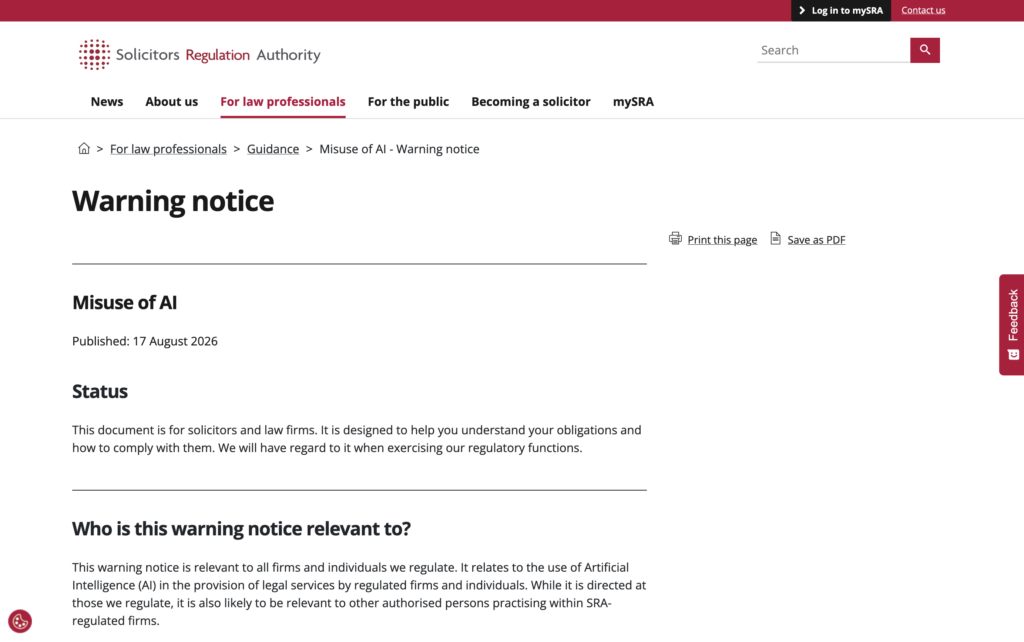
Against this landscape of rising AI use by legal professionals, the SRA’s Warning Notice on the Misuse of AI (August 2026) seeks to address two main issues: “AI hallucinations in legal work and submissions to the court” and “instances of confidential client information being entered into public AI tools, risking potential breaches of confidentiality”. This highlights the regulatory importance placed on verification, as well as the need for practitioners to have sufficient AI literacy to appreciate the confidentiality and legal professional privilege implications of using different types of AI tools (e.g. law-specific AI tools, enterprise AI or public AI) for legal work.
BSB Guidance on the use of AI and other technologies (May 2026) advocates a risk-based approach and specifically encourages “all barristers to maintain a basic level of general technology and AI competence, to understand how it may impact your practice even if you do not use the technologies yourself.”
There is potential for a mismatch between consumers’ expectations and concerns around use of AI in legal services, and the extent to which AI is actually being used and disclosed to clients. The BSB Guidance expressly comments on the need for transparency in the context of Core Duty 3:
“You must be transparent about your use of AI tools, especially if asked by your client, the court, or the BSB, if it materially impacts the nature and scope of your legal service, and if required under UK law (e.g. GDPR) or court practice rules.”
What about the ‘AI Dividend’ and pricing?
The ability of AI to provide efficiencies is often touted as a key benefit of AI, with many firms suggesting that the so-called ‘AI dividend’ (which describes the time freed up when AI takes on tasks that were previously done without AI) could allow lawyers to focus on higher-value work such as client development, relationship-building, strategy and the kinds of nuanced, human-centred work that AI is not currently well-placed to replicate. It is these human interactions that help to build trust in the lawyer-client relationship, and conversely, increasing use of AI may create a greater need for lawyers to build trust, as well as providing more time for that trust to be established and flourish.
The perennial debate about how legal services is valued is being complicated by use of AI. The Wolters Kluwer 2026 Future Ready Lawyer Survey Report indicated that 52% of respondents attributed a 6-20% increase in their revenue to their use of AI. PwC’s Law Firm Survey 2025 found that “across the Top 100 firms, the anticipated average reduction in chargeable hours has risen from 11% in 2024 to 16% in 2025”, and the Deloitte survey reported that “85% of respondents believe that AI will change how law firms price work”. These are striking statistics when set against the traditional billable hour model. If a piece of work that previously took four hours now takes one hour, how does law firm pricing need to adapt?
Clio’s UK & Ireland Legal Insights Report 2026 suggests that fixed fee billing is now the dominant pricing model, and some commentators suggest that AI will accelerate use of this model as it becomes easier to predict the time and resource required for a given piece of work, and as clients become more knowledgeable about what AI can do. The Deloitte survey predicts the “share of hourly-rate work (is) expected to fall from 72% today to 44% within 2-3 years.” The payment of ‘performance premiums’ for expedited advice may “become more common if AI can help clients obtain answers more quickly” (Rush, CEO of ILTA, quoted in the Wolters Kluwer report). The Wolters Kluwer report also identified five challenges to AI adoption for law firms as: ethical concerns (41%), inadequate training and resources (39%), difficulty integrating AI with existing processes (35%), resistance to change from legal professionals (34%) and a lack of understanding of AI (31%). As we have seen from recent case law, failure to address the challenges and risks around AI use in legal practice may result in exposure to professional regulatory and reputational risk for those delivering legal services.
There is also still a lag in many organisations between AI adoption and establishment of the governance guardrails to manage risks of adoption – for example, Thomson Reuters Future of Professionals Report 2026 indicates that 34% of professionals are using ‘shadow AI’, which they report as a sign of adoption outpacing governance. In the legal sector, this is particularly significant because ethical and professional conduct obligations create specific concerns around deployment of AI, illuminated in the recent BSB Guidance on AI and the SRA’s Warning Notice on Misuse of AI.
Upskilling and supervision

There are many other challenges on the path of AI adoption – in addition to risks such as hallucination, breach of client confidentiality and waiver of legal professional privilege, legal service providers have significant procurement and upskilling costs to factor in. AI upskilling takes fee-earners away from chargeable work (a particular issue for self-employed lawyers) and some firms are explicitly addressing this – for example Ropes & Gray launched a programme that allows junior lawyers to devote 20% of their billable time to AI upskilling. AI adoption is also impacting training strategies and policies around effective supervision of junior lawyers, with future training approaches including “simulations and scenario training” (Deloitte survey). Failings in the supervision of AI use by junior lawyers was recently highlighted in Malcolm Cork & Anor v Smith [2026] EWHC 1199 (Ch).
Whilst large firms have significant resources to invest in training, often with dedicated innovation teams, AI upskilling is a much trickier proposition for smaller legal practices and for self-employed lawyers. We are seeing the emergence of a competitive dynamic around AI use in the legal sector (a challenge reported in the Law Society’s Financial Benchmarking Survey 2026) , feeding into some firms’ brand positioning, and this only adds to the difficulty faced by those practitioners with fewer resources to draw upon.
Despite escalating AI adoption, automation of routine tasks and changes to pricing models, lawyers’ human judgment and relationship skills continue to be valued by consumers. The distribution of AI costs and benefits, balanced by the challenges and risks, are matters that the profession, its regulators and legal educators all have a stake in getting right.
As a law student, you could take inspiration from approaches to upskilling being adopted in legal practice by allocating some time in your weekly study schedule to develop your own AI literacy. If you are a student at The City Law School, you can find out more information about technology in legal practice, AI and upskilling on The Digital CLS Student Moodle site.