

In my May blogpost (AI & delivery of legal services), I looked at how Generative AI (GenAI) is reshaping the delivery of legal services. In this post, I’m suggesting what the rapidly changing legal landscape means for the skills that lawyers will need in the future. A task that once meant ‘draft a contract’ may now involve ‘prompt a tool to draft a contract, then review and verify the output’. Do those tasks require different or additional skills? And if so, how should legal education and training evolve to reflect that?
AI is already in the workflow – and is changing what lawyers do
Data from the Thomson Reuters AI in Professional Services Report (2026) indicates that 41% of law firm respondents are already using GenAI and 18% are reporting that GenAI is already a central part of their workflow. This report also indicates the top five reported GenAI use cases for legal were legal research (80%), document review (74%), document summarization (73%), brief or memo drafting (59%), correspondence drafting (55%) and contract drafting (49%). Their reported use of agentic AI (16%) is at odds with emerging views and expectations of consumers as reported in the Legal Services Board’s AI in Legal Services report (published June 2026): “public panel members are deeply uncomfortable with the idea of autonomous tools.”
Tech providers and large law firms are well-advanced in their use of AI tools – for example, in April 2026, Freshfields and Anthropic announced a “multi-year agreement to accelerate AI co-innovation and firm-wide adoption and develop novel AI legal workflows”. In May 2026, Anthropic’s law-specific AI offering, Claude for legal was launched, and law.com reported Harvey’s release of more than 500 pre-built AI agents designed for practice-group specific use cases (including M&A, family law and capital markets), as well as a self-service Agent Builder allowing customization of pre-built agents.
At a keynote speech at the Association of Law Teachers Conference at the University of Exeter in April 2026, Master of the Rolls Sir Geoffrey Vos offered us a measured perspective on this transition to the increasing use of AI, opining that:
“lawyers will be needed as much, if not more, in the machine age… but that they should not expect to be doing exactly the same things in exactly the same way, because new technologies will change much of that“.
Sir Geoffrey’s view was that “humans will remain instrumental in guiding and assisting other humans towards the understanding and acceptance of machine-made decision-making“. His suggestion for legal education was that students should understand the “basic parameters of contract, tort, criminal, family company, administrative and property law” with a view to using that knowledge to be able to “explain the output from well-trained machines“. He also highlighted the continued need for advocacy skills, alongside building an understanding of data protection, cyber security, and the ethical implications of the use of technology.
The digital skills gap
This conversation sits within a broader challenge around digital skills in the UK workforce. Research from Future.now identifies a significant digital skills gap, with 48% of 18–24 year olds and 43% of those with a degree being unable to complete 20 basic digital tasks that the government has identified as essential for the modern workplace. This points to a need for further research and intervention in educational settings, including law schools.
It is also helpful to remember that diffusion of AI across the legal sector is uneven, with reports prepared for the SRA and the Bar Standards Board both highlighting the organizational challenges faced by sole practitioners, small firms and some practitioners at the Bar in resourcing new technologies and upskilling. By contrast, ‘Big Law’ typically has larger budgets, and often has dedicated tech and innovation teams. This variation in resource and capacity has direct implications for law students, as how they encounter AI tools may differ significantly depending on where they end up working in the profession.

One initiative directly addressing this uneven diffusion and upskilling need is the AI, Law and Legal Training project, led by the Open University’s Open Justice Centre in collaboration with the University of Lincoln and Citizens Advice, and funded by UKRI Responsible AI. Launched in August 2025, the project produced a suite of free, open educational resources designed to build knowledge, awareness, and confidence in the use of GenAI in legal contexts by legal advice organisations, legal practitioners and law students.
Human skills and AI literacy (or ‘how to grow a future legal professional’)
There is a lot of discussion about how we identify the range of human skills that may become amplified in value, precisely because they are currently what AI tools are less capable of – many suggest that this includes client interviewing, negotiation, advocacy and client development. Effective delivery of these skills requires the exercise of professional judgement and application of emotional and cultural intelligence. The Legal Services Consumer Panel’s Service Delivery Research Report (December 2025) found that 50% of respondents preferred introductions and onboarding to be face to face, with trust and rapport identified as key drivers for this preference. Development of these human-centric communication skills, underpinned by trust in the lawyer-client relationship, has long been a feature of legal education, and continued emphasis on development of these skills will benefit students in increasingly AI-enabled workplaces.
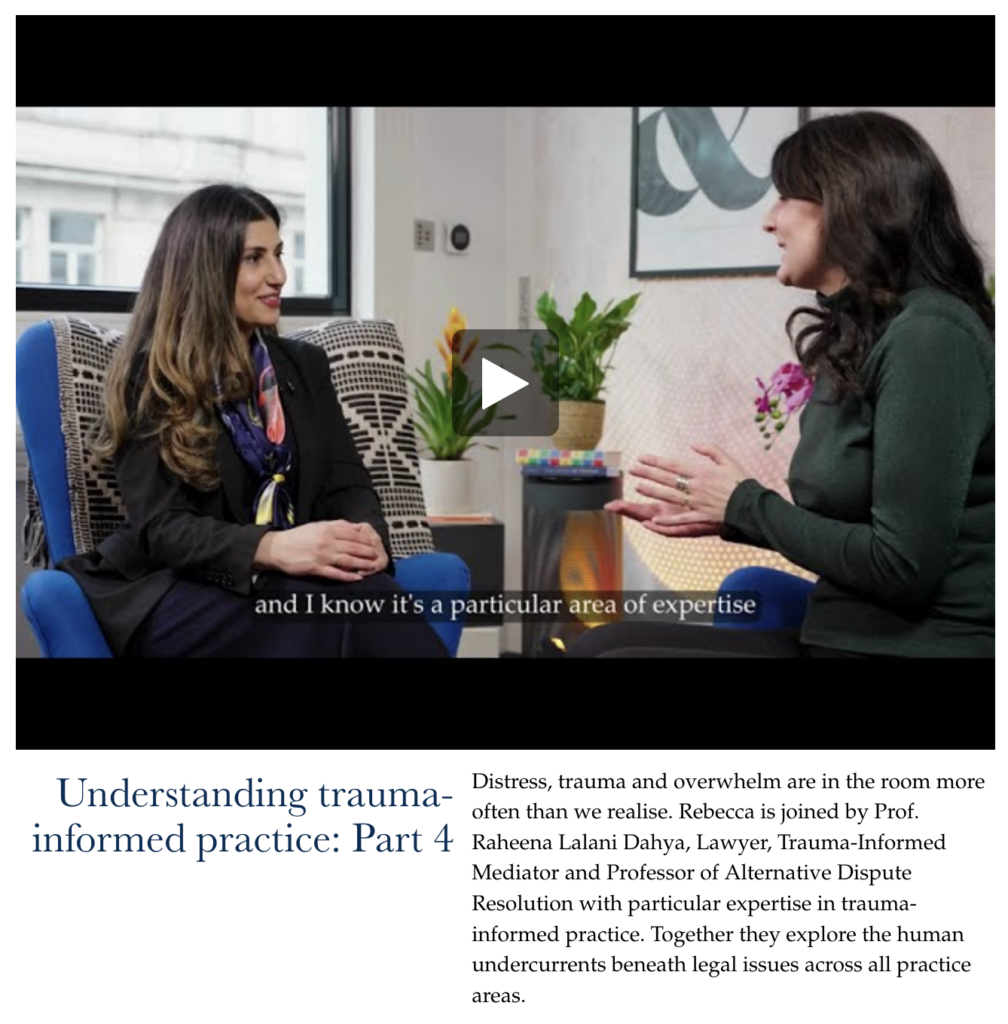
An under-discussed dimension of the future skills landscape is the importance of trauma-informed practice. Lawyers regularly work with clients who are experiencing some of the most difficult moments of their lives – bereavement, family breakdown, criminal proceedings, workplace disputes – and an awareness of how trauma affects people’s behaviour, communication and decision-making is increasingly recognised as integral to effective, ethical legal practice. The Bar Council’s Trauma-Informed Law initiative is doing important work in this area, providing resources and guidance to help barristers understand and apply trauma-informed principles in their practice. As AI takes on more of the technical, document-heavy work of lawyering, the capacity to engage sensitively and skilfully with clients in distress can become a more central aspect of what lawyers can offer.
Alongside these human skills, AI literacy is emerging as a distinct and essential workplace capability. This is much more than knowing how to prompt an AI tool – it encompasses the ability to critically evaluate AI output, to understand the principles on which AI systems operate, understand bias, and to make informed judgements about when AI is and is not appropriate to use. In a regulated profession, where accuracy, confidentiality and ethical conduct are highly valued, the capacity to interrogate and verify AI-generated content (and knowing how to effectively supervise those using AI, as recently highlighted by the case of Anthony Malcolm Cork & Anor v Mark Smith [2026] EWHC 1199 (Ch)) needs to be explicitly taught as a core professional competency.
Increased technologization has also seen the emergence of new law/tech hybrid roles, such as Legal Product Manager, Legal Data Analyst, Legal Automation Specialist, and Legal Prompt Engineer. These roles recognise the need for knowledge which spans both tech and legal domains, particularly around understanding and using data. If you are a student at The City Law School, you can find out more information about these emerging roles on The Digital CLS Student Moodle site.
Finally, change management and upskilling are integral to technology adoption, and there are well established theories (such as Lewin’s Change Management Model and Davis’ Technology Acceptance Model) which can help organisations and individuals navigate this challenging terrain. Thinking critically about the governance and ethics of AI use (not just its technical application) is an essential aspect of preparation for practicing in a regulated legal profession. In my next post, I’ll be exploring some of the economic and organisational challenges of AI in the delivery of legal services.