

Sofya Nemirovsky reports from UCL’s public lecture ‘Domestic violence and human rights: Lessons from the European Court of Human Rights’, 29 October 2026
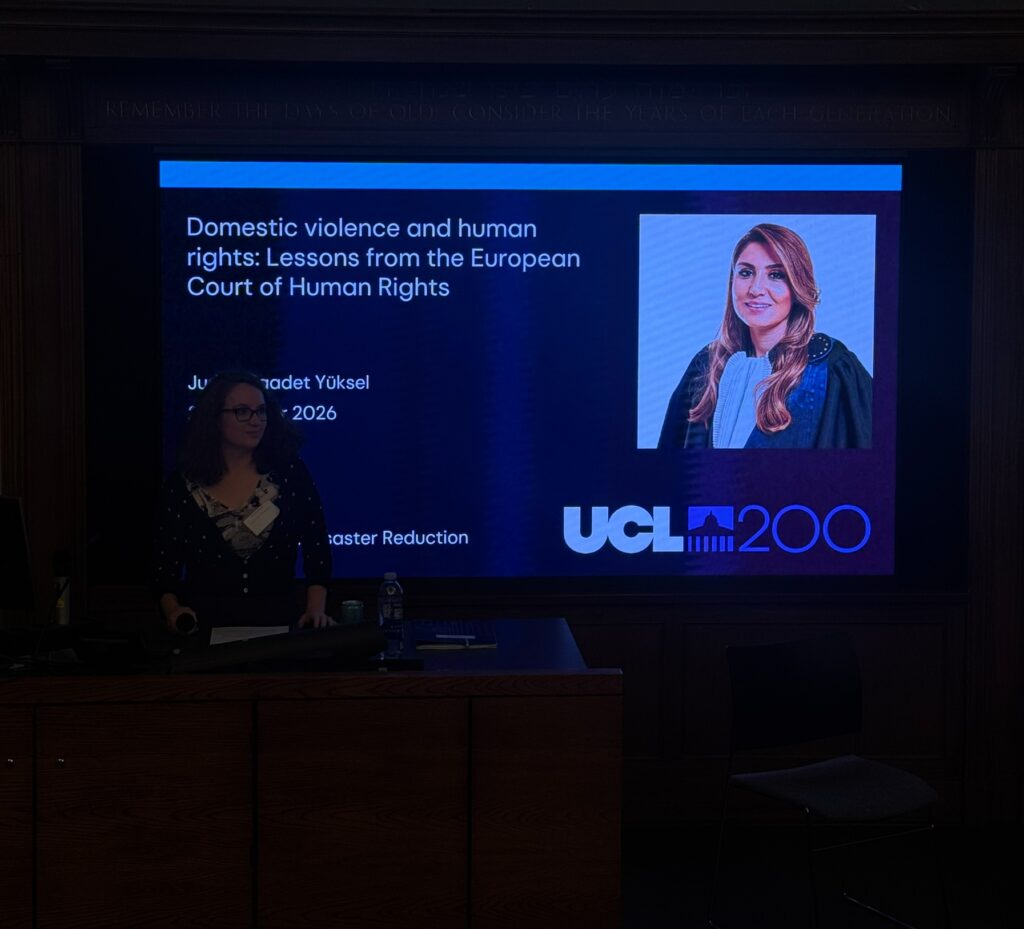
On a late October evening, the Gustave Tuck Lecture Theatre at UCL filled up to hear Judge Saadet Yüksel of the European Court of Human Rights. Held as part of the Department of Risk and Disaster Reduction’s UCL200 series, the lecture traced how Strasbourg has learned to treat domestic violence not as a private family affair, but as a question of state responsibility.
There is no single definition of domestic violence, Judge Yüksel began. It can happen in public or private life, and it affects men, women and children – but it falls disproportionately on women, roughly one in three of whom will experience it in their lifetime. The Covid-19 lockdowns turned it into a “silent pandemic”, and the problem is close to home: she cited 4.7 million people aged 16 and over affected in England and Wales.
Who is Judge Yüksel?

- Born in Istanbul in 1983, she was the youngest judge on the Strasbourg bench when she took office in July 2019, aged 35.
- She studied law at Istanbul University, took an LLM at Harvard Law School in 2011 and completed her PhD in Istanbul a year later.
- Before Strasbourg she chaired the Constitutional Law Department at Istanbul University.
- Her election ended a long stalemate: Turkey’s earlier candidate lists had been rejected three times.
- Since November 2024 she has been a Vice-President of Section at the Court.
There was a quiet irony to the evening: the case she called groundbreaking was brought against her own country.
Opuz: breaking the public/private divide
That case was Opuz v Turkey (2009). The applicant and her mother had reported her husband’s violence again and again, but proceedings were repeatedly dropped once complaints were withdrawn – the authorities saw it as a family matter that did not engage the state. The husband went on to kill the applicant’s mother.
The Court found a violation of the right to life under Article 2 and, for the first time in a domestic violence case, a violation of Article 14: gender-based violence was a form of discrimination. The authorities’ passivity had contributed to the escalation, and their failure did not need to be intentional to count. Drawing on international human rights instruments, the Court put what happens behind closed doors under legal scrutiny.
The right to life: rethinking Osman
Under the classic Osman test, the state must act when it knows, or ought to know, of a real and immediate risk to life. Domestic violence, Judge Yüksel explained, forced the Court to adapt that test. Abuse is a cycle: even when no threat to life is visible, escalation is always possible.
In Talpis v Italy (2017), a husband attacked his wife and later killed their son; the authorities had waited seven months before even questioning her. That, the Court held, deprived her of the immediate protection her situation required.
Kurt v Austria (2021) was harder. The applicant had obtained a barring order, yet her husband shot their son at his school. The Grand Chamber found that the authorities had done what they could – a conclusion from which Judge Yüksel, by her own account, was in the minority. Still, the whole Court agreed on the principles: a comprehensive, robust risk assessment and preventive measures such as alerting schools.
Beyond bruises: Article 3

The prohibition of torture and inhuman or degrading treatment has a minimum threshold, but physical injury is not required to cross it. In Volodina v Russia (2019), stalking, monitoring and death threats, alongside the fear they produced, were enough. In Eremia v Moldova (2013), protective measures were ordered, yet the husband was allowed to stay in the flat, leaving her at risk.
A.E. v Bulgaria (2023) showed how gaps in the law itself can fail victims. A 15-year-old girl was beaten and kicked by her 23-year-old boyfriend, but no proceedings followed: her injuries were deemed too minor, and the law required the couple to live together. The Court criticised both the minimum-injury threshold and the combination requirement, along with the weight the authorities placed on her refusal of a medical examination, though, Judge Yüksel stressed, not every such refusal will lead to a violation.
Investigations must also be prompt and effective. In one Italian case, a woman struck on the head with a helmet was still waiting seven years later. A failure to investigate, Judge Yüksel said, sends one message: the state does not take the violence seriously.
Discrimination: measuring progress: Article 14
Under Article 14, the Court looks at the authorities’ attitudes and language, and at general judicial passivity. Crucially, it also looks at progress. In Landi v Italy (2022) and M.S. v Italy (2022), it found no discrimination because Italy had already taken real steps. Bulgaria, by contrast, had produced no evidence of specific measures in A.E. – its third domestic violence defeat in Strasbourg.
Violence goes digital
The final theme was cyberviolence. In Buturugă v Romania (2020), the applicant suspected her former husband had accessed her electronic accounts, but the authorities declined to search the family computer. The Court treated the cyber abuse as a form of the domestic violence and found a breach of Article 8 – a reminder that abuse now follows victims onto their screens.
Has any of it worked?

Partly. Opuz helped lay the ground for the Council of Europe’s Istanbul Convention, and Turkey passed its own protective law, Law No. 6284, in 2012. Yet in 2021 Turkey became the first state to withdraw from that convention, although the 2012 law remains in force. The country behind the landmark case walked away from the treaty it helped inspire.
Italy’s picture is more hopeful, but mixed. The Interior Ministry counted 97 women killed in 2025, down from 118 the year before, an 18% fall. The number killed by a current or former partner barely moved: 62 in both years. In November 2025, parliament voted 237 to 0 to make femicide a separate crime punishable by life imprisonment, though opposition MPs said the law tackles only the criminal side of the problem.
A closing thought
The evidence is mixed. States do respond: laws are rewritten, new crimes created, and Italy’s falling numbers are encouraging, though no single judgment can claim the credit. But partner killings have barely moved, Bulgaria had no specific measures to show, and Turkey has stepped back from the framework its own case helped create. The Court rarely asks whether a state meant to fail. It asks whether the state did enough, quickly enough, for someone it knew was at risk, and the honest answer is often still “not yet”. For a future lawyer, that is a useful lesson: the law’s real test is how it is applied.