
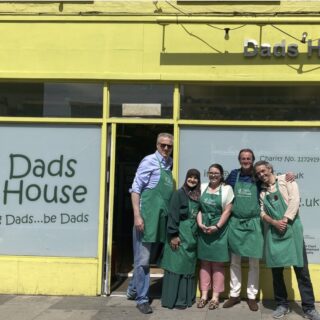
…in the company of Ceri Parker-Carruthers, Family Clinic Manager.

It’s difficult to describe the sense of calm that washed over me as I opened the door to Dads House. The walls were decorated for Christmas, I eyed a guitar to my right, and from somewhere in the back corner of the room the smell of warm soup wafted over. I was already 15 minutes late for the interview I had organised, but it was impossible not to feel at ease in this space.
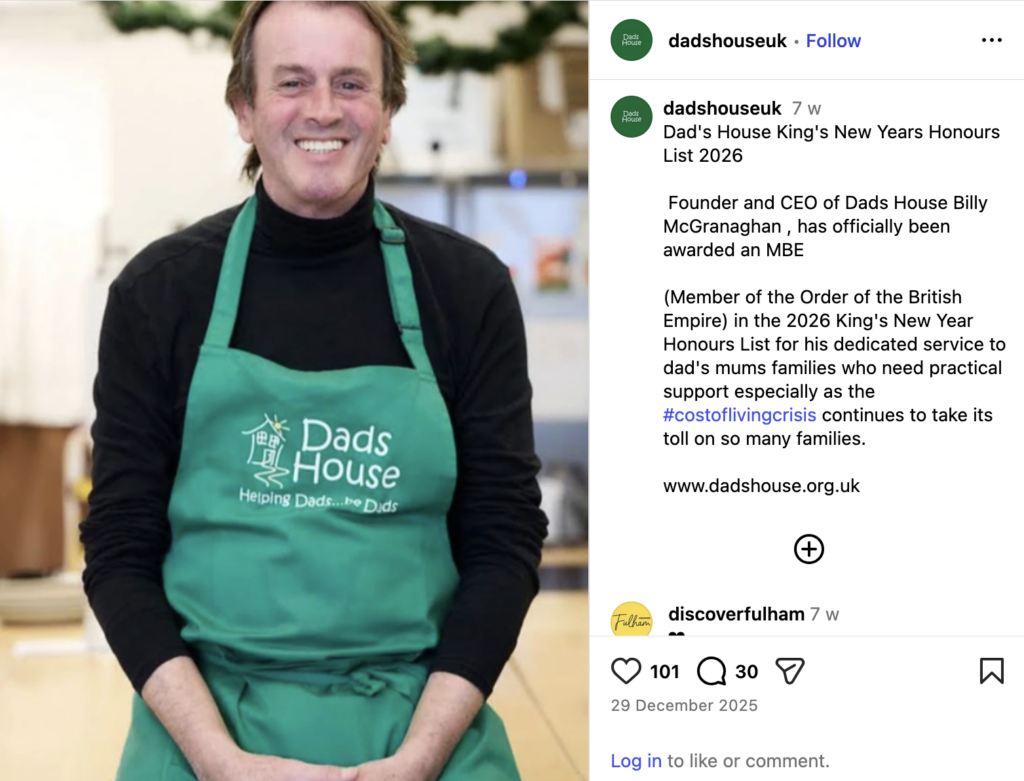
The physical space reflects the philosophy and practice of Dad’s House perfectly. Founded in 2008 by Billy McGranaghan, himself a single father who noticed an acute lack of support for other struggling dads, the organisation’s original purpose was to aid single dads with the practicalities of raising their children alone. A suite of related services followed, such as the food bank, support group, guitar lessons, and five-a-side football team. The family law clinic arrived in 2020. None of these parts feel at all segmented from each other, no doubt because they are all united in the founding mission of the place, and thanks to the binding glue that is Billy. He possesses an unmatched affability which makes every visitor (including this one) feel instantly welcome. It’s not for nothing that he was awarded an MBEin the King’s New Year Honours List 2026, for his contribution to fathers and families and leadership in establishing Dad’s House.
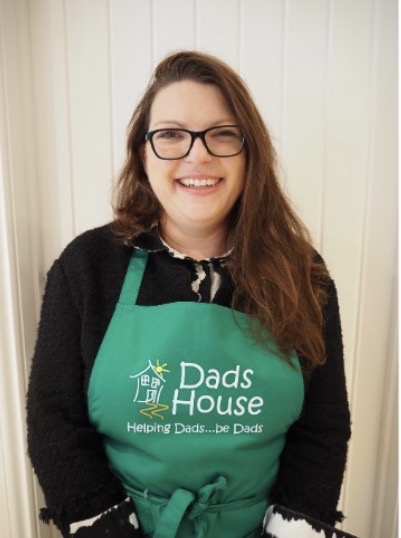
The MBE is certainly not the first award sitting in the trophy cabinet across from where I sat down to commence the interview, nor will it be the last. The trophies are a “great honour,” says Ceri Parker-Carruthers, since they attest to all the hard work done collectively by the whole team. Herself the winner of the Unsung Hero at the British Legal Awards 2024, and a shortlisted finalist for Champion of the Year at the Family Law Awards 2024 and 2025, Ceri joined Dad’s House as a volunteer in September 2022 before becoming the clinic manager the following year. After completing the Bar course at City, where family law was not yet offered as an optional module, she was encouraged by a tutor to develop an interest in the area and seek out volunteering opportunities. She went on to work as a county court advocate at LPC Law for three years, and, alongside this, briefly assisted a family law barrister. By the time she arrived at Dad’s House, she had the courtroom experience and the family law instinct that the clinic needed.
How does the clinic work?
The clinic runs every Wednesday and Friday afternoon, by appointment. Each session consists of at least three one-hour client meetings, staffed by a team of volunteer solicitors and barristers drawn from different firms and chambers. They advise on issues from child arrangement proceedings and navigating the court system through to mediation applications. Coram Chambers, in particular, has been a key partner: its barristers prepare cases and represent the clients in court. Barristers from other chambers, including Harcourt, 4PB, 36 Family, Monckton Chambers and now Deka Chambers, have also provided pro bono representation. With invaluable support from firms such as Dawson Cornwell, Laurus Law, Branch Austin McCormick, Hanne&Co, Farrer & Co supporting their solicitors who are the weekly pro bono advisers.
These partnerships are important, and many clients reach Dad’s House after being referred by barristers. Other clients find Dad’s House through referrals from local authorities and social services, or through the LawWorks network. Moreover, Ceri has been a member of the Bar Council’s Pro Bono Committee since April 2025, further cementing Dad’s House’s reputation among professionals.
What distinguishes Dad’s House from many other pro bono clinics is that it allows repeat appointments: over 45% of clients return. “A lot of clinics will have a cap”, Ceri explains. “We help clients all the way through the case.” Some clients have attended more than twenty sessions. Given that family law proceedings typically last a minimum of eighteen months, this continuity matters enormously.
The clinic also provides emotional support. An emotional support coach is available at sessions to help parents process the emotional weight of proceedings: a resource Ceri considers essential. “The majority of the job is actually not law,” she says. “It is being somebody’s therapist, and we are not trained for that as lawyers.” This is where Dad’s House’s broader ecosystem proves its worth.
Billy’s philosophy, as Ceri puts it, was that “if you went to any other charity, you’d have to go to one charity for this and another charity for that.” At Dad’s House, the legal advice, the food bank, the emotional coaching, and the wider support network all sit under one roof. Clients are not further burdened by having to seek help piecemeal.
The student volunteers
The student volunteers, too, are part of this ecosystem. Ceri noted that often younger clients appreciate having people of similar age in the room. During the client sessions, students take attendance notes (since clients and professional volunteers will not remember everything that was said), assist with drafting, research, and general support.
The cohort is varied: GDL students, SQE candidates, undergraduates, career changers. One current volunteer is a former social worker, a previous one was a psychiatrist before joining the team. What unites them all is an interest in family law, and this interest is rewarded by the student training programme Ceri was instrumental in setting up at Dad’s House.
Within this scheme, student volunteers receive “Hot Topic Talks” on family law issues, participate in advocacy sessions (mock hearings in which Ceri plays a “grumpy interventionist judge”), engage in drafting sessions with a district judge, and receive mentoring sessions. This is a two-way pedagogic street. The students learn from the professional lawyers in the room, and in turn they are actively encouraged to contribute their own perspectives; Simon Bruce, the clinic’s pro bono director, routinely asks for their views on cases. The training programme, Ceri says, is her way of giving back to the volunteers for the time they lend.
The supportive atmosphere felt by the clients also extends to the students. Ceri makes a habit of checking in on them after sessions, since few students will be used to the emotionally taxing work that often arises in private child cases (such as allegations of coercive control, or domestic abuse). “We always debrief”, she says. “We’re a team, we’re a family, and you’re never left alone.”
The wider context
Dad’s House does not exist in a vacuum. The demand for its services (and for pro bono family clinics more broadly) is inseparable from the crisis in legal aid that has been unfolding since the Legal Aid, Sentencing and Punishment of Offenders Act 2012 (LASPO). LASPO removed legal aid from almost all private child cases. The roughly £1.4 million per annum in pro bono advice that Dad’s House provides is thus a lifesaver for many. But as Ceri puts it and quoting someone far more senior, “the system is relying on freebies because legal aid is in such a poor state.” Private child cases can be inordinately expensive; Ceri describes clients earning £50,000 a year who have spent all their savings on one or two preliminary hearings, only to run out of money before the final hearing. “You’re not even between a rock and a hard place,” she says. “You just have to do this alone. And people cannot do this alone, because it’s not only emotional. It’s legally complex.”
It’s the lack of readily available legal advice on complex matters that Ceri believes is, in part, fuelling the current court backlog. Without access to initial legal advice, she argues, parents often have no understanding of their rights and responsibilities. Conflict that might have been resolved through early guidance or mediation instead escalates into a court application. Costs and emotions pile up, and the child often suffers.
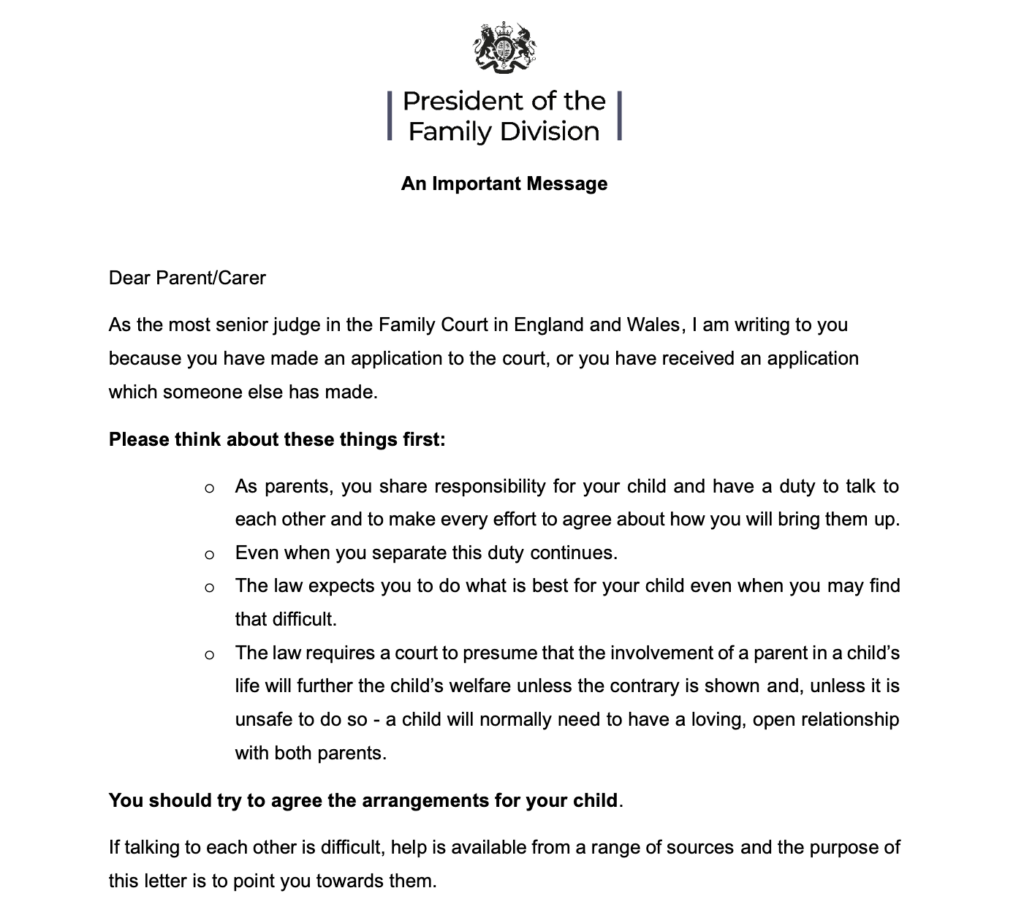
There are some positive prospects for the future though. Ceri points to the letter that Sir Andrew McFarlane (President of the Family Division) now sends to all parents involved in family proceedings, asking them to recognise their shared responsibility and make every effort to agree. This, alongside the Pathfinder scheme, points towards a private child law that is less adversarial and demanding on the court’s time, whilst hopefully resulting in better outcomes for the children. Ceri also hopes that family law could learn from civil courts, where mediation is mandatory but with the absolutely necessary safeguards in place to protect vulnerable parents and victims of domestic abuse.
Concluding remarks
When asked about whether Dad’s House has expansion on its mind, Ceri’s answer was characteristically modest: “We do what we do really well because of our size … We’re very happy as we are because of what we’re doing. That’s the most important thing.” At this point I was interrupted by a warm bowl of soup and a plate of lamb koftas being placed down in front of me. It was, I should note, excellent. As was all the work that gets done in this place. I had the privilege of confirming that firsthand that afternoon, since Ceri kindly offered that I remain and observe a client session. Everything I had been told about the philosophy and practice of Dad’s House was reaffirmed in front of me: the invaluable expertise of the volunteer lawyers, the diligence of the student volunteers, and the ways in which the client was both physically and procedurally ‘centred.’ The father in question spoke freely and uninterrupted, and was offered further emotional support when the contents of the case clearly became difficult to bear. He left some baklava as a gift to the team, a testament to the warm and continuous relationships that this small charity seems to effortlessly build. Despite all the problems that the family justice system faces today, it’s impossible not to leave Dad’s House with a sense of optimism.

A huge thanks to Ceri Parker-Carruthers for giving her time to be interviewed and for allowing Edward to sit in on the clinic that afternoon. We look forward to seeing Dads House go from strength to strength! Thanks also to Edward Sanders for this warm and informative piece about this inspirational clinic (undertaken just before Christmas 2025).
Edward is currently studying the Graduate Diploma in Law and is a member of the Lawbore Journalist Team 2025/26. He studied history at undergraduate level, during which he became particularly interested in legal history, which in turn led him to pursue a career in law. Family and land law are two of his particular interests, and he hopes to practice in these areas in the future.