

At first glance, company law is often taught as a technical discipline: incorporation requirements, directors’ duties, shareholder rights, exit strategies. Yet Professor Nina Boeger’s masterclass, Three Sisters, Three Paths: A Masterclass in Business, Law and Finance, invited students to step back from doctrine and ask a far more foundational question: what kind of economy are our legal and ownership choices creating?
Delivered through an imaginative narrative rather than a conventional lecture format, the session explored how business ownership models shape not only individual entrepreneurial journeys, but also wider distributional outcomes in the political economy. By framing business development as a journey rather than a moment in time, the masterclass challenged the tendency, particularly within corporate law to treat firms as static entities rather than evolving institutions embedded within legal, regulatory, and social frameworks.
From exit to legacy: Why business models matter
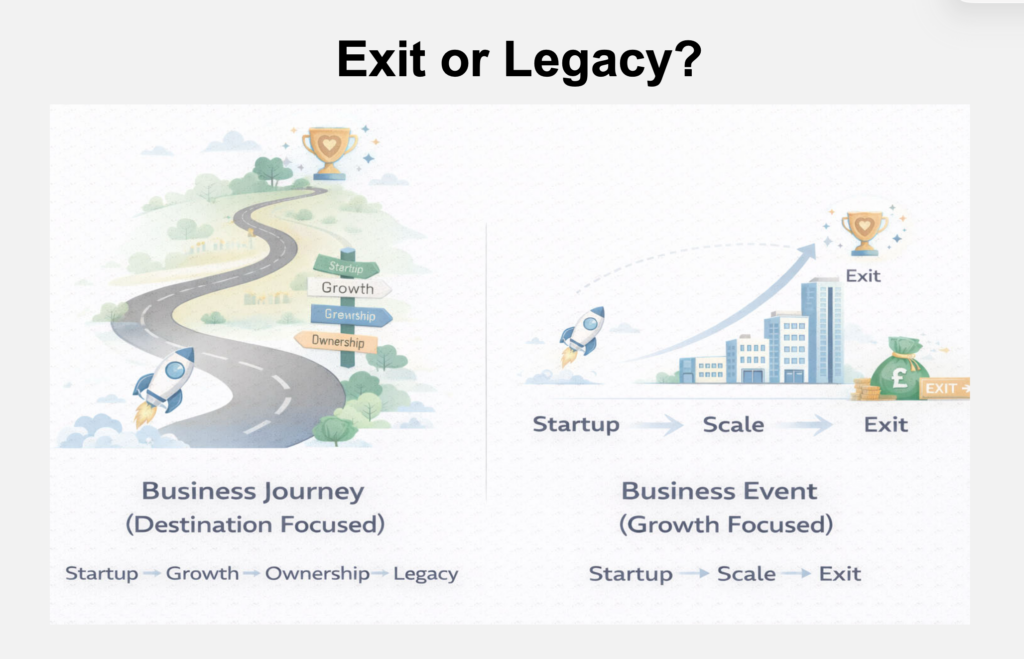
One of the central distinctions drawn in the masterclass was between exit-oriented and legacy-oriented business models. Exit models, typically associated with venture capital, rapid scaling, and liquidity events such as IPOs or acquisitions are often celebrated in entrepreneurial culture. Their appeal is clear: access to capital, speed, innovation, and investor liquidity.
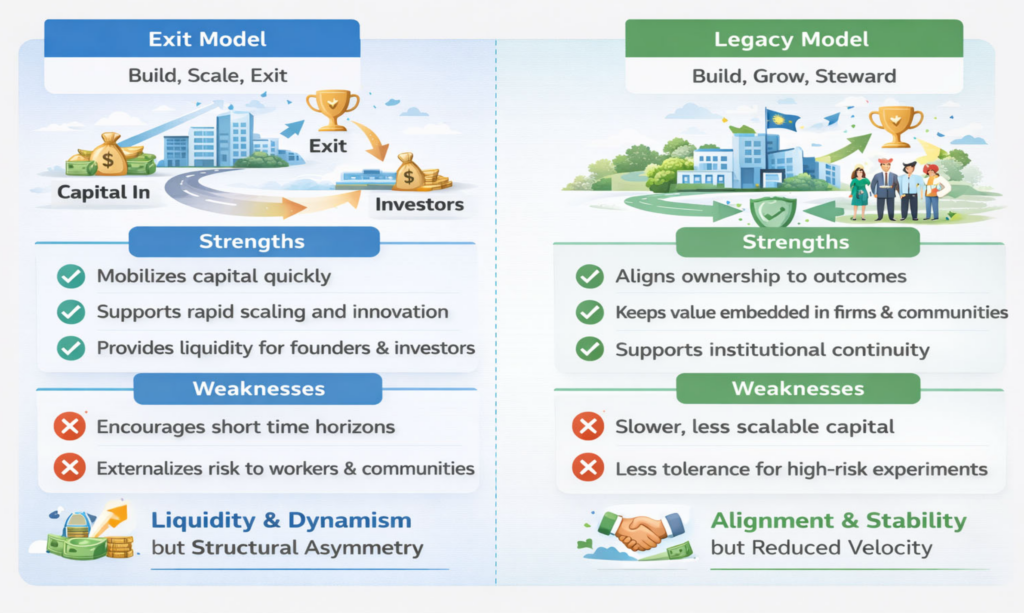
However, Professor Boeger urged students to interrogate what is often left out of this narrative. Exit-driven models tend to encourage short-term horizons and can externalise risk onto workers, suppliers, and, ultimately, the state. While none of this is conceptually new, it is frequently under-acknowledged in legal and business education, where “scale and exit” is often presented as the default or even ideal trajectory.
By contrast, legacy or stewardship models prioritise continuity, value alignment, and sustainability. These models aim to keep ownership, control, and responsibility connected over time, embedding values directly into governance structures. Yet they are not without weaknesses: slower growth, limited access to scalable capital, and dependence on supportive legal and tax frameworks.
Crucially, the masterclass resisted framing this as a moral binary. Instead, it emphasised that both models involve trade-offs, and that understanding these trade-offs is essential for lawyers advising businesses, and for students thinking critically about capitalism itself.
Ownership as the ‘Hinge’ of the Political Economy
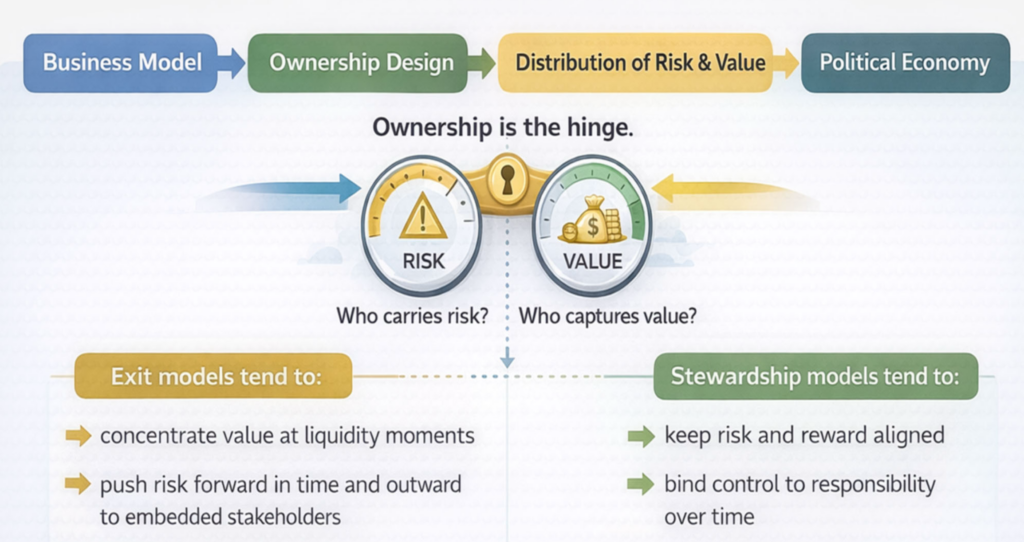
Perhaps the most powerful conceptual contribution of the session was the identification of ownership as the hinge between micro-level business decisions and macro-level political economy. Ownership structures determine who carries risk, who captures value, and who exercises control. They allocate not only economic rights, but also political power within firms.
Exit-oriented models tend to concentrate on liquidity moments, IPOs, dividends, acquisitions often pushing risk forward in time or outward onto embedded stakeholders. Stewardship models, by contrast, seek to align risk and reward over the long term, binding control to responsibility. When repeated across an economy, these ownership choices shape patterns of inequality, precarity, and sustainability.
Seen this way, company law is no longer a neutral framework facilitating market activity. It becomes a central mechanism through which power is distributed and economic outcomes are normalised.
Institutions, choice and the malleability of capitalism
The masterclass situated these debates within a broader institutional framework, drawing on ideas associated with Anthony Giddens’ theory of structuration. Business choices are shaped by existing legal and regulatory institutions, but those institutions are also reshaped through repeated practice.
For example, when tax incentives and legal frameworks make employee ownership easier, such models become more common. As they become normalised, institutions adapt further to support them. Economic arrangements, therefore, are not fixed. They are produced through an ongoing interaction between individual choice and institutional design.
This institutionalist perspective contrasted with more structural accounts of capitalism, such as those associated with Karl Marx or Joseph Schumpeter. While Marx viewed exploitation as structurally embedded and Schumpeter emphasised “creative destruction”, the masterclass aligned more closely with Douglass North’s view of capitalism as shaped by the “rules of the game” that societies choose. Capitalism, on this account, is malleable rather than inevitable.
The Three Sisters: Speedy, Steady and Soppy
To make these abstract ideas accessible, Professor Boeger introduced three entrepreneurial archetypes: Speedy, Steady, and Soppy, each representing a different relationship to capital, law, and ownership.

Speedy, the techno-optimist, embraces innovation and rapid growth. Her company scales quickly and reaches a successful IPO, creating jobs and technological advancement. Yet as ownership becomes increasingly dispersed, governance shifts. Shareholder pressure intensifies, experimentation becomes riskier, and the firm grows more financially fragile. Inspired by examples such as Patagonia, Speedy begins to question whether an alternative ownership structure could preserve the company’s mission. She explores foundation-controlled ownership models, which separate economic rights from voting control. While effective in embedding purpose, such models remain difficult to implement in the UK due to limited institutional support compared to countries such as Germany and those in Scandinavia.
Steady represents a sustainability-focused entrepreneur committed to decent work and long-term growth. When external investors introduce pressure to scale rapidly or sell, Steady opts for an Employee Ownership Trust (EOT). Under this model, a trust acquires a controlling stake in the company on behalf of employees, often financed through future profits rather than external capital. Notably, UK tax law actively incentivises this structure, illustrating how institutional design can support stewardship-based ownership.
Soppy, initially sceptical of capitalism altogether, begins with a Community Interest Company (CIC). This structure embeds social purpose through dividend caps and asset locks, limiting capital extraction. While effective in protecting missions, the CIC model restricts access to finance. In response, Soppy adopts a networked approach, using the CIC as a hub for cooperatives linked through licensing and profit-sharing agreements. In doing so, she moves toward a more institutionalist understanding of capital, recognising that alternative ownership models can operate within, rather than entirely outside, capitalist systems.
Law as an active Economic force
Across all three journeys, a clear theme emerged: law is not a passive backdrop to business, but an active economic force. Company law, trust law, tax incentives, and regulatory regimes shape which ownership models are viable, scalable, and attractive.
The UK context, in particular, was shown to be uneven. Employee ownership enjoys strong legal and tax support, while foundation ownership remains institutionally underdeveloped. Social enterprise structures, meanwhile, offer mission protection but limited scalability. These asymmetries reflect political choices embedded within legal frameworks, choices that lawyers both inherit and reproduce.
Conclusion: planning the business journey
The masterclass concluded by encouraging students to think deliberately about business destinations, ownership trade-offs, and institutional consequences. Rather than asking simply how to grow a business, Professor Boeger urged the audience to ask why, for whom, and to what end.

For law students in particular, Three Sisters, Three Paths offered a powerful reminder that corporate law is not merely technical or apolitical. Through ownership design, lawyers participate directly in shaping the political economy. Capitalism, the session suggested, is not a fixed structure, but a system continually remade through legal choices, institutional incentives, and collective imagination.
Many thanks to Nina for navigating through these issues in such an innovative way, and also to Shilan for sharing the essence of the session so comprehensively.
Shilan Shokohi is a Graduate Entry LLB student with a background in Criminology and Police Studies from Simon Fraser University in Canada. Her academic interests lie in corporate, finance, and contract law, and she is particularly interested in how legal systems shape the ways businesses and individuals interact.
She says that “…moving to London has given me a new appreciation for how deeply the law influences daily life, from commercial transactions to social structures, and has strengthened my commitment to exploring law in both its theoretical and practical dimensions.”