

For Women Scotland v The Scottish Ministers [2025] UKSC 16 has likely become the most socially significant case to reach the Supreme Court in some years and has arguably had greater reach and consequence than any other development for the minority group it affects. But what has led us to this point, and how can LGBT History Month help us understand it?
The UK courts first dealt with a case of gender identity in the Corbett v Corbett [1971] P 83, which you will be familiar with if you study/ied Family Law. April Ashley, a trans woman, entered into a marriage with a man in the 1960s. Upon the breakdown of their relationship, her ex-husband claimed that the marriage was void, meaning it did not exist, because April was trans and that, therefore, the marriage was not respectively between male and female parties. The Corbett case established that the law did not provide an avenue for a person to reregister their sex, and established a biological test for what sex is. For more on Ashley, have a look at Ellie Field’s piece for the National Museums Liverpool: ‘April Ashley: Life Stories’.
In the intervening years after Corbett, a number of cases came before UK courts that all came to the same conclusion; namely that it was not possible for trans people in the UK to legally change their gender. The reasoning for this gradually shifted, with several judgments pointing out that while sex is a fixed biological entity, gender could be changed, but a legal process for this needed to be created by government rather than through the courts.
This culminated in the case of Goodwin v United Kingdom Application no. 28957/95 before the European Court of Human Rights. The applicant, Christine Goodwin, was a British trans woman. She claimed that she had problems and faced sexual harassment at work during and following her gender reassignment, and worries about being outed because of her national insurance number. She therefore argued that the UK’s failure to provide a legal option for changing one’s gender directly excluded her from the ability to marry and had led to systemic discrimination, therefore violating her rights under the ECHR.
The court agreed with her and found that her rights under Articles 8 and 12 had been violated and that therefore the UK needed to introduce a mechanism that would allow people to amend their legal gender status. This was largely based on the fact that almost all other states who had signed up to the European Convention of Human Rights already had measures that allowed individuals to legally change their gender identity.
In response, Parliament passed the Gender Recognition Act 2004 (GRA); this was a world-leading piece of legislation that allowed a trans person to apply for a gender recognition certificate, which changes a person’s gender for all purposes when issued (section 9). However, it was not without its flaws and people have criticised the medical requirements (see F Renz, ‘Transgender Jurisprudence’ in C Ashford & A Maine, Gender, Sexuality and Law: A Textbook (Edward Elgar, 2024)).
Following the GRA, Parliament passed the Equality Act 2010. This prohibits discrimination based on certain protected characteristics, such as sex, gender reassignment, sexual orientation, disability, race, etc. For Women Scotland is a prima facie exercise of statutory interpretation, assessing how the EA should be interpreted when determining what is meant by ‘woman’, ‘man’, and ‘sex’. The case came as a challenge to the Gender Representation on Public Boards (Scotland) Act 2018 (the 2018 Act), which imposed a positive obligation on Scottish public authorities to have an equal gender balance, which included trans women in the definition of ‘woman’.
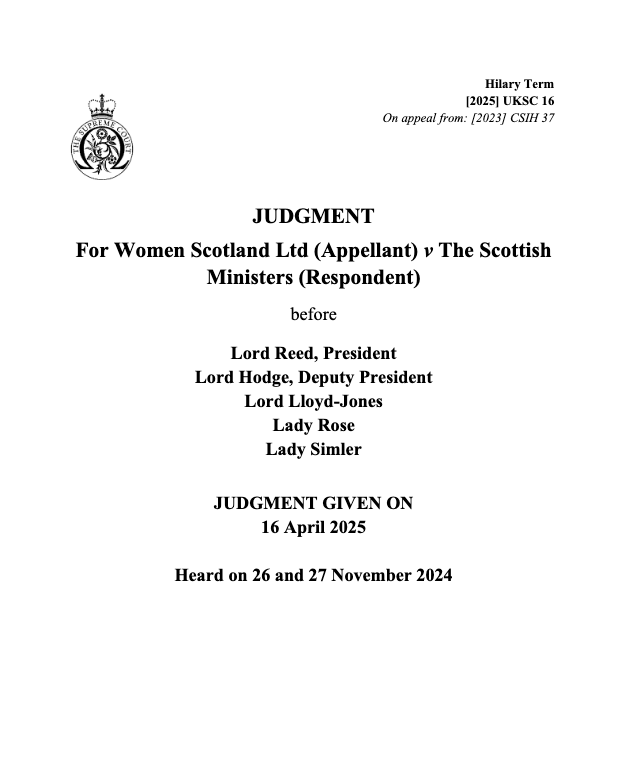
In the Supreme Court judgment, led by Lord Hodge, Lady Rose and Lady Simler (with whom Lord Reed and Lord Lloyd-Jones agreed), it was decided that the term ‘woman’ for the purpose of the EA referred to biological sex, and therefore did not include trans women, whether or not they possessed a GRC. First, the Court considered the Sex Discrimination Act 1975 (SDA) as a precursor to the EA, establishing the basis of equality and discrimination law.
The Court establishes that in 1975, Parliament, when using the terms ‘man’ and ‘woman’, referred to biological sex, and that the GRA did not amend the meaning of those words. Therefore, despite the effect of a GRC being the reregistering of a person’s gender ‘for all purposes’ (section 9(1) GRA), the GRA did not amend the meaning of ‘man’ and ‘woman’ within the SDA (para 80).
The judgment has been described as bringing clarity to decision-makers and service-providers, in terms of who can use what services. For instance, a University can now state that trans students would have to use bathrooms and changing facilities that accord with their birth sex, rather than their gender identity, if they are trans. But a lack of clarity remains, despite the welcoming of ‘clarity’ by policy-makers: it is now unclear what the utility of a GRC is, if it does not for all purposes establish a person’s gender.
If we think back to Goodwin v UK, which established that by failing to provide a form of gender recognition, the State was in breach of its obligations under Articles 8 and 12. Questions remain following FWS whether, if a trans person must use a service that appears at odds with their appearance, their right to privacy is breached once again. Further, a trans person in possession of a GRC is in the curious situation of being recognised as two different sexes at once, under two pieces of legislation. Far from clarity, questions remain about how trans people are included in society, and how trans people’s dignity can be maintained.
So, looking back on the development of trans people’s rights in the UK shows us that while progress isn’t necessarily linear, we can understand how the law works in recognising certain LGBT issues. We can also use historical law to help us understand the current state of equality, discrimination, and gender identity. Now we can also look to the future of how law and society will develop.
Want to know more about this? Try these options…

- A Maine, ‘For Women Scotland: an interpretation of equality rooted in biology’ (2025) JSWFL 1-4
- F Renz, ‘Transgender Jurisprudence’ in C Ashford, A Maine, Gender, Sexuality and Law (Edward Elgar, 2024)
- S Cowan, ‘Trans rights, queer times: in search of a new hope’ (2025) 47(1) JSWFL 108–129
- J Randall, ‘The GRA at 20: the development of a binary and permanent legal gender’ (2025) 47(1) JSWFL 87–107
Thanks to Dr Alexander Maine for this helpful insight into development of the law around trans people’s rights in the UK.