Learnmore logo
  • Directory

    Topic-themed guides to the legal web

  • Learnmore

    Multimedia law tutorials & features

  • Blog

    Our Future Lawyer careers & alumni blog

  • City Hub

    City Law School student resources

  • About Us

    Our history, staff & philosophy

Lawbore Future Lawyer
22May/130

Lawson Mooting Competition – Matthew Sellwood

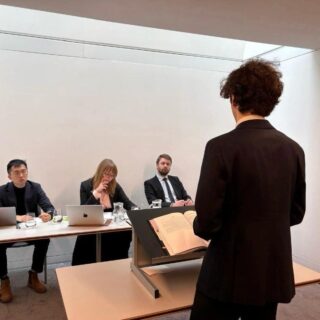
Clara making her submissions

On Friday 17th May, four of the best mooters that Inner Temple has to offer competed in the final of the Lawson Mooting Competition. Drawn from over eighty initial entrants over three previous knockout rounds, these four students had certainly had plenty of practice!

Jenny Brenton, Georgina Bryan and Clara Hamer are all studying the BPTC at The City Law School, whilst James Evans is a BPTC student at BPP Holborn.

Presiding over the moot was Master Christopher Brougham QC, of South Square Chambers. Usually an expert insolvency practitioner, he was afforded the opportunity to turn his skills towards human rights legislation on this occasion.

The moot problem concerned the very topical issue of freedom of belief and the right to manifest that belief, which has recently been discussed by the European Court of Human Rights in Eweida and Others v United Kingdom.

Finalists and judge, Christopher Brougham QC

After a close fought series of twenty minute submissions from the mooters, Master Brougham QC chose Clara Hamer as the outstanding mooter of the evening, praising the way in which her submissions ranged persuasively over both legal and policy issues. Whilst he was not ultimately convinced by her arguments, he did state that he was within a hair's breadth of agreement, despite the fact that her initial legal ground was weaker than some of her opponents.

Clara received her first prize from Julia Townend, a representative of the Inner Temple Junior Bar Association and a tenant at 4 Paper Buildings. Every other finalist also received a prize, and the standard of the final was uniformly excellent. On this showing, the future of the Bar is promising indeed!

Filed under: News No Comments
21May/130

Blackstone Mooting Competition 2013 – Joanne Moss

Winner Christopher Pulman (left) with Judge of the Final, Mr Tom Weisselberg (Blackstones Chambers)

The 2013 Blackstone Mooting Competition at City Law School for Full-time Students has been won by Christopher Pulman, shown holding the trophy presented by the Moot Judge, Mr Tom Weisselberg, who is a member of Blackstone Chambers and a former student of the CLS.

The Finals took place on Wednesday 15th May, and all contestants are to be congratulated on their performances. The Runner-up was Madeline Dixon, and the other excellent competitors were Charles Streeten and Gregory Ashurst. All these postgraduate students produced impressive performances, especially in response to the questions of the Moot Judge. Well done!

We also thank our Moot Judge most warmly for his welcoming attitude and for the enormous amount of time and effort that he had put into the preparation for the task of judging.

We are kindly sponsored by

Blackstone Chambers, London, with discretionary cash prizes; and
Oxford University Press who offer to the winner one copy of either Blackstone's Criminal Practice or Blackstone's Civil Practice.

In addition, the winner will receive £500 from the City Law School.

Filed under: News No Comments
21May/130

Legal Biography: A National Training Day – Alex Giles

SOAS treasures! Credit: born1945

Legal biographers mixed with librarians, research students and other academics to create a fascinating day at the Institute of Advanced Legal Studies (IALS) on 15th May. Organised by the IALS and the British Library along with the Socio-Legal Studies Organisation this was a chance to share resource information and biographical methodologies; encouraging a wider view of legal study beyond the traditional practitioner approach, and providing on opportunity for some good old fashioned story-telling…

We heard from writers of legal biography such as David Sugarman from Lancaster University who’s written on Albert Venn Dicey and the U.S’s Morton Horwitz aka “Mort the Tort”, and Mara Malagodi (LSE) who is currently working on an investigation into leading constitutionalist Sir Ivor Jennings’ time in Asia; fearlessly researching in Nepal. My personal favourite was Rosemary Auchmuty’s paper on her article from Legal Studies entitled “Whatever Happened to Miss Bebb?” (link only available to City students) – the hidden story of the first woman to take the Law Society to court in 1913 over the non-admittance of women. Rosemary proved to be a veritable Miss Marple as she uncovered the twists and turns of this courageous and ultimately tragic woman’s life; a touching as well as hugely entertaining portrait.

Les Moran from Birkbeck and Linda Mulcahy (LSE) provided much food for thought over the idea of pictures as biographical data – in fact images appear sometimes to be the only source of information when there is no historical institutional record of certain people, for example Women at Court (except as defendants or witnesses), or where the subject of the particular research is “hidden” such as sexuality. This combination of interpretation from an art history perspective and traditional legal scholarship really pushed the boundaries.

Judah Benjamin Credit: Mathew Brady

The vast array of sources that are available for those interested in legal biography were shared by some of our leading librarians in the nation’s legal and socio-legal collections. Their remits are often quite different: from essentially the records of running a legal institution such as Lincoln’s Inn (represented by head librarian Guy Holborn), or Canon Law going back centuries such as found at Giles Mandelbrote’s Lambeth Palace Library, to the vast collections within collections at the British Library – encompassing such things as the private papers of legal elites, oral histories, public and institutional records, published biographies etc etc etc; nobly explained by Socio-Legal Curator Jon Sims, and his colleague at the India Office Records, Antonia Moon.

Within all the collections presented there were some choice nuggets such as Lincoln’s Inn’s collection of photo portraits, or SOAS’s archive of the controversial marriage of Botswana’s first President Seretse Khama and Ruth Williams; a great cause celebre of the time related by Susannah Rayner. I also found out from Guy Holborn that Judah Benjamin (of Benjamin’s Sale of Goods fame) was the first Attorney General of the US Confederacy in the 1860s, and later in exile was called to the Bar at Lincoln’s Inn before writing his classic treatise. Who would have thought it?

The day was not only very informative but thoroughly enjoyable, and showed the great potential for legal study and research within any number of academic or literary fields – the possibilities are endless…

Many thanks to Alex Giles, Information Assistant at Grays Inn Place Library and volunteer at the British Library.

Filed under: News No Comments
16May/130

“Women in positions of power can really make a difference” – Margaret Hodge MP

The most recent City Law School Alumnae Network event (CLAN) featured The Right Honourable Margaret Hodge MP speaking on Women in Public Life. Margaret Hodge is the Member of Parliament for Barking and Dagenham, a position she has held for more than 17 years. In June 2010, she was elected Chair of the Public Accounts Committee.

CLAN is the network for female graduates of The City Law School. The group meets twice-yearly and provides a unique opportunity for alumnae to meet like-minded solicitors, barristers and other law graduates from across the UK. The network also provides an encouraging environment in which to discuss issues facing women in the modern profession, share experiences and offer mutual support.

On the evening of the 25th April, Margaret Hodge covered topics including the impact made by women in positions of power, the importance of networking and how to rebuild local trust in mainstream politics. Fear not, if you're kicking yourself for missing out, you can watch it via City's YouTube channel.

Filed under: News No Comments
11May/130

BTPC Part-time Moot Final – Joanne Moss

His Hon Judge Michael Hopmeier and winner Nick Scott

The 2013 City Law School Moot for Part-time Students has been won by Nick Scott (right), shown receiving the trophy from the Moot Judge, His Hon Judge Michael Hopmeier (left). The Finals took place on Friday 10th May, and all contestants are to be congratulated on their performances.

The Runner-up was Joel Wallace, and the other worthy competitors, Jamila Bernard-Stevens and Max Archer, achieved a high standard all round.

It is excellent to see the work and achievement of these dedicated postgraduate students produce such polished performances.

We extend our warmest thanks to our very learned Moot Judge, who made the proceedings both realistic and fun.

We are kindly sponsored by

The Incorporated Council of Law Reporting, whose prize is: a year's free subscription to the whole ICLR database for the winner, and a year's free subscription to the WLR via the database for the runner-up; and

Oxford University Press who offer to the winner one copy of either Blackstone's Criminal Practice or Blackstone's Civil Practice.

In addition, the winner will receive £500 from the City Law School.

24Apr/130

GDL Moot Final at The UK Supreme Court – Emily Allbon

The finalists (L-R: Howard, Daniel I, Daniel B & Louis) with The Right Hon the Lord Mance

An extremely competitive 4 rounds of mooting (with 96 students entering this year) was brought to an end on Monday 22nd April with our four finalists battling it out in front of Lord Mance, Justice of the Supreme Court.

Lord Mance judged The City Law School GDL Moot for the fourth year in a row and in announcing the winner, made it clear how astonished he was once again by the quality before him, from individuals who have only been studying law for 6-7 months.

Finalists were:

Daniel Black
Daniel Isenberg
Howard Leithead
Louis Zvesper

The topic of the moot this year was judicial review; concerning the closure of a local care home as a result of the increased spending of a local council on a new sewer system.

Our four mooters performed extremely well and Lord Mance declared Daniel Isenberg the winner, with Daniel Black in second place. Many thanks to everyone who competed in the competition this year. Hope to see some of you back next year as judges!

22Apr/130

Book launch: The BRIC States and Outward Foreign Direct Investment

David Collins speaking at his book launch

Reader at The City Law School David Collins launched his book at the international City law firm Arnold & Porter LLP on 16th April. The BRIC States and Outward Foreign Direct Investment was published by Oxford University Press in March 2013. David's book discusses the growth of foreign direct investment in services from the large emerging markets Brazil, Russia, India and China and the role that international investment law has played in this process. He sums up its appeal:

"This book captures a very important and unexplored trend in economic globalization and should be of interest to academics and practitioners in the field of international investment and international trade law."

The launch was attended by lawyers from the firm's international arbitration group as well as staff and students of the CLS. David acknowledges the support of Arnold & Porter: "I am very appreciative of Arnold & Porter for allowing me to host the event at their offices and was quite pleased to have a number of my CLS colleagues and students share the success of the book's publication with me."

David Collins teaches and researches in the field of international economic law specializing in the law of the World Trade Organization and international investment law. He is a Fellow of the Institute for Globalisation and International Regulation at Maastricht University, a frequent Visiting Professor at Esade Law School and a Current Development Editor for the Manchester Journal of International Economic Law.

17Apr/130

Report No. 5: Commonwealth Student Moot – Matthew Sellwood

Yesterday was a rollercoaster, and today was no different. We had both spent the evening trying to relax, although Daniele somehow managed to muster the energy to hone his submissions a little further. It was all I could do to stay awake! We both woke up early to put the finishing touches to our adaptation of the Respondent's argument, and then headed off to our second appointment with India – this time, in a knockout format. Whilst we had been lucky to qualify for the semi-finals, we knew that there was no alternative to winning this time.

Congratulations to Matt & Daniele! Credit: SJ Photography

Perhaps this new pressure affected the Indian team a little. They weren't quite as smooth and polished as they had been yesterday, although their submissions were still absolutely excellent and full of fact and detail. Unfortunately for them, however, since we were representing the same parties as in the previous moot, we had been able to anticipate more of their arguments, and were much better able to rebut them. Both of us were delighted with the quality of our submissions, despite some serious nerves – and when the judgment came in, we found that we had won!

We have certainly been on an upwards learning curve when it comes to international law, and getting to the final after losing our first two moots left us rather stunned.

We couldn't stay that way for long, however, as immediately after our semi-final Canada and Australia met each other to determine the other finalist. By a ridiculously small margin of one point, Australia prevailed, and we knew which team we would be facing.

After that, we only had a couple of hours to further refine our arguments. At 4 pm, we found ourselves in front of a panel of Chief Justices Archie, Elias, and Gardner – the presiding judges of New Zealand, Trinidad & Tobago, and the Falkland Islands respectively. As might be expected, they peppered us with interventions. The junior counsel for both parties suffered particularly badly, as Australia were putting forward an argument around the mandatory death penalty which the panel had not necessarily anticipated, and Daniele was attempting to argue some quite difficult to sustain points around the use of circumstantial evidence.

As expected, it was tight. Neither of us knew what to expect when we filed back in for judgment. I'm delighted to say that it was good news! We won, and became Commonwealth Mooting champions. Daniele was also named the best mooter in the final, due to his excellence in dealing with some very challenging questioning from the bench. Unexpectedly, we received a first place prize of £500 of LexisNexis vouchers, along with a number of other mementoes by which to remember the moot. Tomorrow, we'll be presented with the Turnbull Shield at the closing ceremony of the Commonwealth Law Conference. Perhaps, by that stage, it might actually have sunk in that we managed to win!

Matthew Sellwood and Daniele Selmi (students at The City Law School) have been representing the UK at the Commonwealth Student Moot in Cape Town, after winning the ESU National Moot last year. They are the first UK team to win the competition in a decade!

16Apr/130

Report No. 4 from Cape Town: Commonwealth Student Moot – Matthew Sellwood

What a day! Credit: bluebike

A mooting competition isn't necessarily where one would go to find some drama in Cape Town. Today, however, there was drama everywhere one looked.

As you might remember from the last blog, we were against India today, and we needed to do well after our defeat to Namibia yesterday. We are on a steep learning curve, but it's fair to say that we both felt much more confident today, both in our grasp of the law and our understanding of what the judges are looking for in an international competition. Despite a brief panic when we realised that we didn't have enough papers for every judge (reminder to self – double-check this next time!), we went into the moot feeling much more relaxed.

That didn't last through the submissions of the Indian team, made for the Applicant. Their knowledge of international law could only be described as encyclopaedic. Appendices to cases of which we had never even heard were being cited during questioning, and it was clear that they had spent months preparing. Frankly, we were rather outclassed on content, despite our best efforts.

However, we started to redeem ourselves during our submissions for the Respondent. Our legal arguments and application of the law to the facts was much better than yesterday, and we both dealt better with questioning, as well. An excellent right of reply from the Indian team's Senior Counsel won them the moot, however, and we were resigned to having gone out in the General Round.

We were so convinced that we had gone out, in fact, that we didn't check the results as soon as they were released, preferring to relax for an hour. Imagine our surprise when one of the Australian team told us that we had come fourth, and were in the semi-finals! The results were compiled by adding up all the marks from both moots, so as to prevent any team from being penalised by losing narrowly and yet performing well. As it turns out, that had happened to us twice. In fact, our performance against India was the second best Respondent performance of the entire General Round. I'm also delighted to say that I was awarded 3rd place in the individual advocate rankings, and Daniele came equal 7th.

So, as I write this, we are scrambling to pull together our submissions for the semi-final tomorrow morning. Against – you guessed it – India! We are even acting for the same parties, so deja vu will certainly be in play. The other semi-final consists of Australia v Canada, with a place in the final before Lord Chief Justice Judge and Lord Chief Justice Elias up for grabs. We are, suffice to say, a little nervous....

Matthew Sellwood and Daniele Selmi (students at The City Law School) are representing the UK at the Commonwealth Student Moot in Cape Town, after winning the ESU National Moot last year.

16Apr/130

First year undergrad? Enter a blogging competition…

Index on Censorship has launched a student blogging competition. If you're fascinated by freedom of expression and would like to see your work published on this influential website then write a 500-word post on the following topic:

What is one of the biggest challenges facing freedom of expression in the world today? This could cover a repressive regime, threats to digital freedom, religious clampdowns or attacks on media freedom, focusing on any region or country around the world.

Deadline is 31 May 2013 - find out more via the Index on Censorship website or take a look at the competition flyer.