
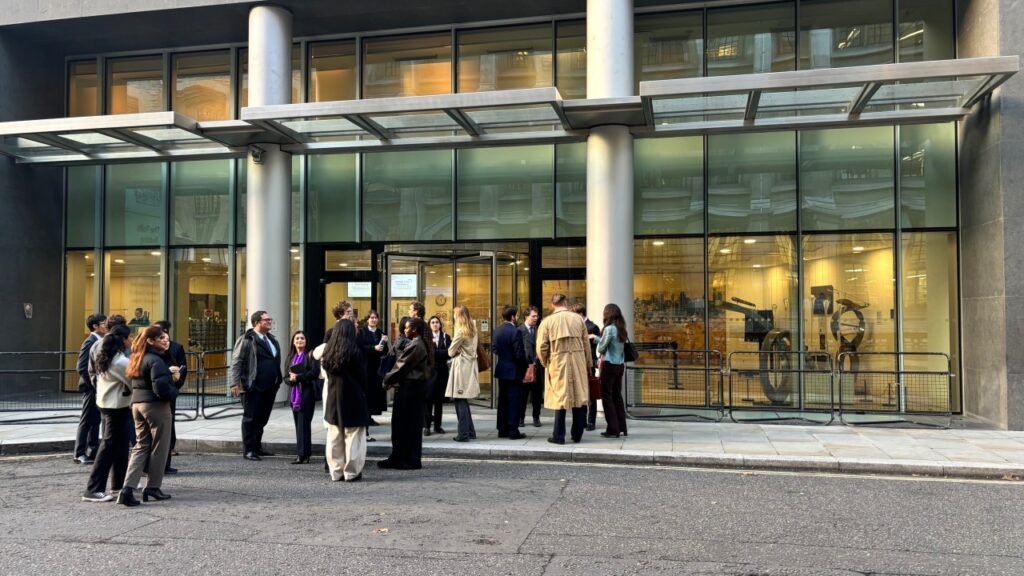
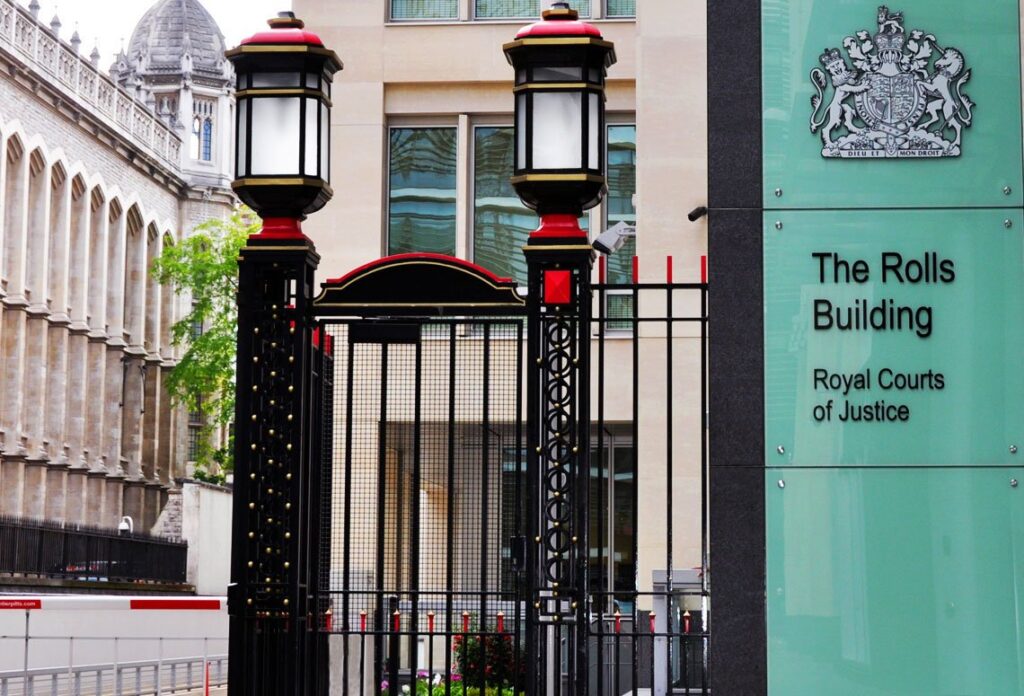
We sprawled out into the street, behind a piece of ornate 19th Century Grandeur. This was so ostentatious that you would assume it was the Rolls Building, but we were queuing in front of a great glass door that was attached to a great glass building – there, caught between modernity and antiquity, is where the evening began.
A group of students: a smattering of Graduate Diploma in Law students, a few Masters students, and I believe a couple of Bar Vocational Studies students, were brought through the glass doors of modernity into a lobby that could be an airport, a nice bank, or the centre of British Civil Justice. We were collected there to meet and to listen to the 99th Master of the Rolls, Sir Colin Birss – a man who, 38 years prior, had been a student at City – first for his GDL, and then for his BVS.
After a brief loiter in the lobby, we were led to Court 17, Birss’ court of choice, and introduced to the then-president of the Business and Property Division with a “Hello, call me Colin”. You would be forgiven for assuming someone so senior might be imposing, or have no time for students gawping at him, but instead what followed was an evening epitomised by his introduction – Colin led us through his life, he told us how he ended up in Court 17 with all these grand titles.
Colin’s main point was that any career, and a career at the bar in particular, is not linear – you have ups and downs and plateaus – the one great constant in his career it seemed, was that he is always ready to retire. Before he became a judge, he was about to leave the Bar to become a physics teacher, before he was elevated to the High Court, he was preparing for the PGCE, after the best part of a decade at the High Court, he applied for a position on the Court of Appeal, was rejected, and again began to dream of teaching – until his dreams were interrupted by a position as the Deputy Leader of Civil Justice in 2021.
At every step of his seeming unstoppable rise, Colin was ready to retire, happy and contented with the heights he had reached, not looking for the next step up. Here lies the tension in Colin Birss – he simultaneously told us how non-linear his career has been and how content he would be to stop being promoted, but at the same time, his career seems to be a more-or-less straight path to the top, with him suffering each blow of good luck admirably. It would be easy to be too cynical about his claims to contentment, but in the room with him you can’t help but believe him. Colin finished his talk with three fundamental truths he wants to relay to City St George’s students: Firstly, do not see people’s careers in retrospect, no one knows what will work and what will not; secondly, go to as many events as possible, talk to as many people as you can, it is the only way to really appreciate what this life is like; finally, he left us with this,
“…you can do it. If I can do it, you can too”.
From the talk we descended into the Q&A portion of the evening – which was largely devoted to a discussion on Artificial Intelligence and the Law. I have been lucky enough to see three distinguished judges talk about AI in the last month, first was Colin Birss, then there was Lord Neuberger at Gray’s Inn, and finally the previous Master of the Rolls Sir Geoffry Vos, also at Gray’s. Where the three agree, it is that AI is, at best, a potential tool for research. There seems to be an obvious analogy to research assistants in their minds, that an AI is, in essence, an artificial assistant whose work needs vetting just as any other assistant’s work would. Colin’s stance was probably the most AI-skeptic, and the nearest my own, ultimately AI is not about to replace judges (so says Colin), and really the concerns around AI should be answered with another question: “What do we want from our Justice system?”. For Colin, the answer is obvious, it is already in our Judicial oaths: To Deliver Justice According to the Law. That is, to provide a just outcome, guided by the law, not to deliver justice arbitrarily, or to apply the law without concern for whether justice is being done. As such, AI can never take that role, because justice is as much about a social decision as it is about a logical one.
Our evening in the Rolls Building was a unique insight into the career and mind of a particularly successful alumni of our University, who also happens to be one of the most senior figures in the British Judiciary. A figure whose great lesson was that the Bar is an excellent thing to do with our lives, and that it is difficult but do-able, and you never know when you will be succeed up in spite of yourself.
Thanks to Dr Marc Mimler, organiser of this terrific event, and a member of the School’s Intellectual Property Engagement Research Centre.
For another account of the City Law School’s visit to Sir Colin, see: The City Law School students visit Sir Colin Birss, the incoming 99th Master of the Rolls (penned by the Press Office).