
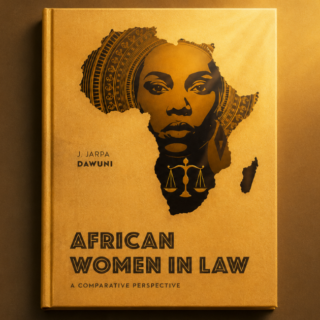
On 20 October, the City Law School hosted a fireside chat with Professor Jarpa Dawuni on her new book ‘African Women in the Law: A Comparative Perspective’ (OUP 2026), chaired by Dr Jessica Lynn Corsi, Senior Lecturer and Co-Chair of the Working Group on Gender Parity for the ICJ. It was an evening of discussion and reflection on an often overlooked experience of the legal world.
Ten years in the making
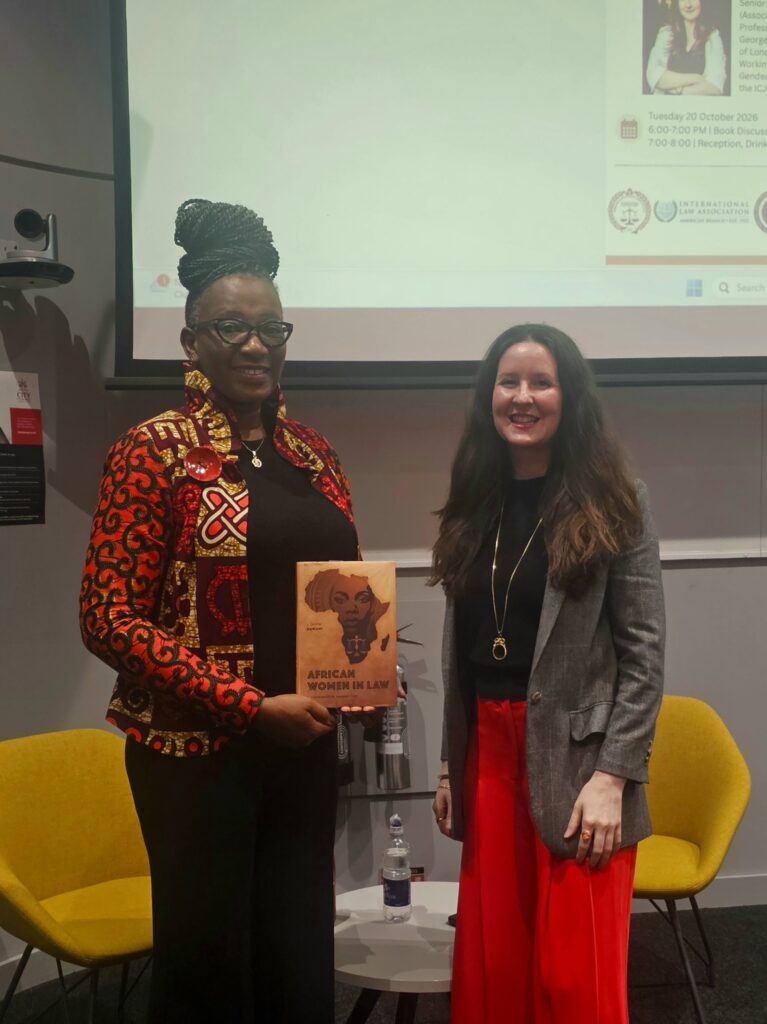
Professor Dawuni (Howard University) is a qualified barrister based in Washington DC and the founder and executive director of the Institute for African Women in Law. Her book, one of nine she has written so far, is a culmination of ten years of on-the-ground research, fieldwork and interviews with women across Africa, and is the first empirical study of its kind.
It also comes from a personal place. Frustration, bereavement and the harsh realities of human rights law (the field she first hoped to enter) brought her to academia.
Her first book, ‘Gender and the Judiciary in Africa: From Obscurity to Parity?’ (2016), which examined the experiences of women judges, was written ‘selflessly’ with other scholars brought in to collect data. This time however, she said she wanted to be ‘selfish’, thinking about herself and her interests. Her entrance into academia, which she referred to in her book as ‘the final frontier’, was partly driven by her desire to change the statistics on women professors.
Five research questions: Challenges and strategies
The book is guided by five research questions, and the discussion focused on two of them: the intersectional challenges African women in law face, and the strategies they’ve developed to overcome them.
The first challenge was women being perceived as lacking the merit for their position, whether from clients or colleagues. Now, couple this pressure with having a home to take care of. Caregiving expectations within African family structures also encompass the larger extended family. Another obstacle observed was sexual assault in the legal profession, which took her by surprise. In interviews, directly asking if they’d been sexually assaulted was counterproductive, but asking whether they knew someone who had been gave a clearer response.
Strategies developed in response are both individual and collective: working harder and staying longer to prove yourself, leaning on family networks for care, and forming associations, though Dr Corsi noted there are none for women academics (yet!). Consider this within the context that these institutions have been built before women could even enter them.
Stories from the field
Asked for a favourite story, Professor Dawuni recalled a phone interview in Nigeria with an academic who couldn’t teach while pregnant and worked hard to prove herself.
“When I type and my baby needs to be fed, I rest the baby on one elbow and type with both.”
A powerful, but likely common, snapshot of the crossover between profession and home.
Women judges offered an interesting perspective, acknowledging that challenges exist but many saying “my gender doesn’t matter to me”. Dawuni noted that some African women may not directly call themselves feminists, so she refers to them as “gender-aware”.
Innovative frameworks: HISP and Matri-legal Feminist Theory
Originally introduced in her 2019 article of the same name, matri-legal feminist theory explains African women’s experiences in law through historical matriarchal societies and the barriers of post-colonial patriarchal systems. Womanism and African feminism, she said, can describe Black women’s experiences, but no theory exists to explain women’s experiences in law, and certainly not to shed light on how Africa has so many women political leaders and judges, especially in international courts, so soon after independence. Professor Dawuni attributes this notable presence in the legal world to the agency of African women.
Dawuni explained the HISP framework, which stands for History, Institutions, Social norms and Positionality. Understanding the history, such as colonisation, is important for explaining women’s position. Institutions impose rules that impede access, some of which were borrowed, like the UK’s Sex Disqualification Act 1919, or norms, such as courthouses with no women’s restrooms or no equal pay. Social norms cast women with an ‘innate desire’ for primary caregiving: one Ghanaian interviewee said women (even in powerful positions) like to come home and cook for their husbands. Positionality looks at women’s place in society.
Questions and reception

In the Q&A, Professor Dawuni returned to sexual assault and the fact that it remains a serious problem beyond Africa, perpetrators including judges and litigants.The phrase “These are legal people” summing up why people don’t always pursue an action for such crimes. Victims often stay silent because of socio-cultural perceptions which are sometimes reinforced by other women, thus creating a situation where advocates can’t even advocate for themselves. On the impact of Associations, some interviewees said that they had done little for them, though it was felt this was less the case for women judges. As such, women are building their own ‘other bar’ and ‘other bench’, though some still feel like they don’t belong. On advice for aspiring academics, she credited her ‘feminist to the core’ mother and nan who helped her understand who she is as a woman, and that she could go as high as she wants to.
During the reception, I asked what she will write next. She indicated her writing would be focused firmly on leadership for the foreseeable. What did she miss about fieldwork? Her children and family, given this book was ten years in the making, and the kind people she met. (I also may have encouraged Professor Dawuni to take up Arabic again!)
My takeaways
This is a foundational work that topples preconceptions and puts the lives of African women within the perplexing spiderweb of the law. The first woman barrister in the UK was appointed 104 years ago, so our experiences as women are interconnected.
To young women entering the legal profession, note two things: support each other, and be an advocate who can also advocate for herself. Buildings may be set in stone, but the legal profession isn’t, and neither is our position in it.
If you would like to follow up on some of Professor Dawuni’s work, these three texts are a good place to start:
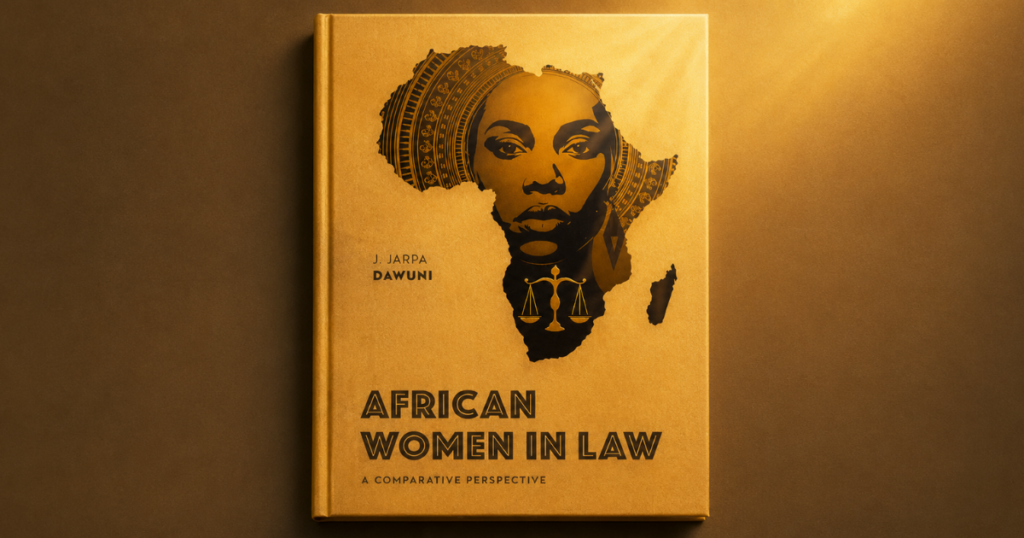
- ‘African Women in the Law: A Comparative Perspective’ (OUP 2026)
- ‘Gender and the Judiciary in Africa: From Obscurity to Parity?’ (2016)
- ‘Matri-legal Feminism: An African Feminist Response to International Law’ – chapter within Kate Ogg and Susan Rimmer (eds.) Research Handbook on Feminist Engagement with International Law (Edward Elgar 2019)