
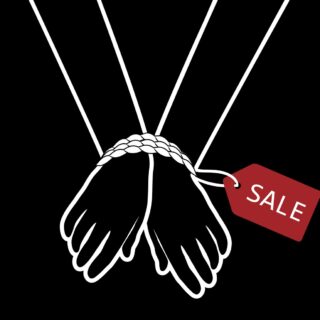
When you hear the word slave you might imagine something historical. Depending on your relationship to the British Empire you might picture Wilberforce and heroics, or the slave trade that tore apart the nascent United States of America, or the millions transported in the abject horror that was the transatlantic slave trade. When you hear slave in 2026 you might consider the quasi-slavery of modern states like Dubai or Qatar. What you would probably not picture is the estimated 122,000 people who are enslaved today in the UK.

The third event in the ‘Justice for All’ series opened much like the others – with a great conglomeration of stalls throughout the lobby of the Old Bailey – all spreading awareness of their place in the fight for victims and survivors, especially those of modern slavery. We were then whisked away into the Grand Hall for the centre point of the evening: Sir Edward Braham’s keynote speech and the panel discussion. As ever, there was a fantastic policy paper prepared by RAND Europe that covers the issues raised by the event and more.
Sir Braham focused on the scale of the problem posed by modern slavery in the UK and worldwide, as well as explaining what we could do to further the fight – especially, given the focus of the Justice for All series on the intersection of justice, economics, and business, how businesses could fight modern slavery in their own supply chains, . What was fascinating as a student was to be in a room full of people who are close enough to the levers of power to actually effect some change, it was a strange mixture of optimism – they were all there, they all listened to the horrors of the current state of modern slavery – and of pessimism – if they can help, why haven’t they already? Sir Edward Braham’s keynote was a damning indictment, but provided a way out of the quagmire: we need to reshape the public narrative of modern slavery, it is something that happens here not somewhere else; we need to strengthen intelligence services – those trafficking slaves are working across borders, our response must do the same; and we have to treat trafficking with the same seriousness as organised crime, it is not enough to motion towards a solution, we have to put our words into action.
The panel was moderated by Caroline Haughey OBE KC and comprised of Jane Lasonder, a victim of modern slavery and trafficking who founded ‘Red Alert Task Force’, a group designed to raise awareness of trafficking and modern slavery, Antoinette Mutabazi, a child survivor of the 1994 Rwandan genocide, James Clarry, CEO of Justice & Care, a charity dedicated to fighting modern slavery, and Dame Sara Thornton, the former Anti-Slavery Commissioner and currently the Professor of Practice in modern slavery policy at the University of Nottingham. With that panel make-up, it would be impossible for the evening to be anything other than a sobering, eye-opening evening, especially with the contributions of Jane Lasonder and Antoinette Mutabazi, who were rightly given the lion’s share of the discussion time, it was after all an evening championing the voices of victims and survivors.

One moment above all others really struck me – Jane Lasonder was discussing someone that she had helped, a victim of slavery, who was imprisoned in an attic room in an unnamed urban sprawl. The survivor told Jane how every day, whilst her captors and abusers were out of the house, she would stand at the window of the attic, begging someone from the busy street below to look up and see her. No one did. She escaped by sheer bravery and luck. The position of modern slavery in the UK is much like that survivor – very real, very much suffering, but just out of sight enough for us to turn a blind eye, in fact, out of the way enough that many of us, myself included, did not even know about the suffering we were ignoring. The great lesson of the night was that there is something you can do, even if you are not a business leader or a King’s Counsel, to fight modern slavery we first need to look up and be aware of the suffering that might be happening just next door.