

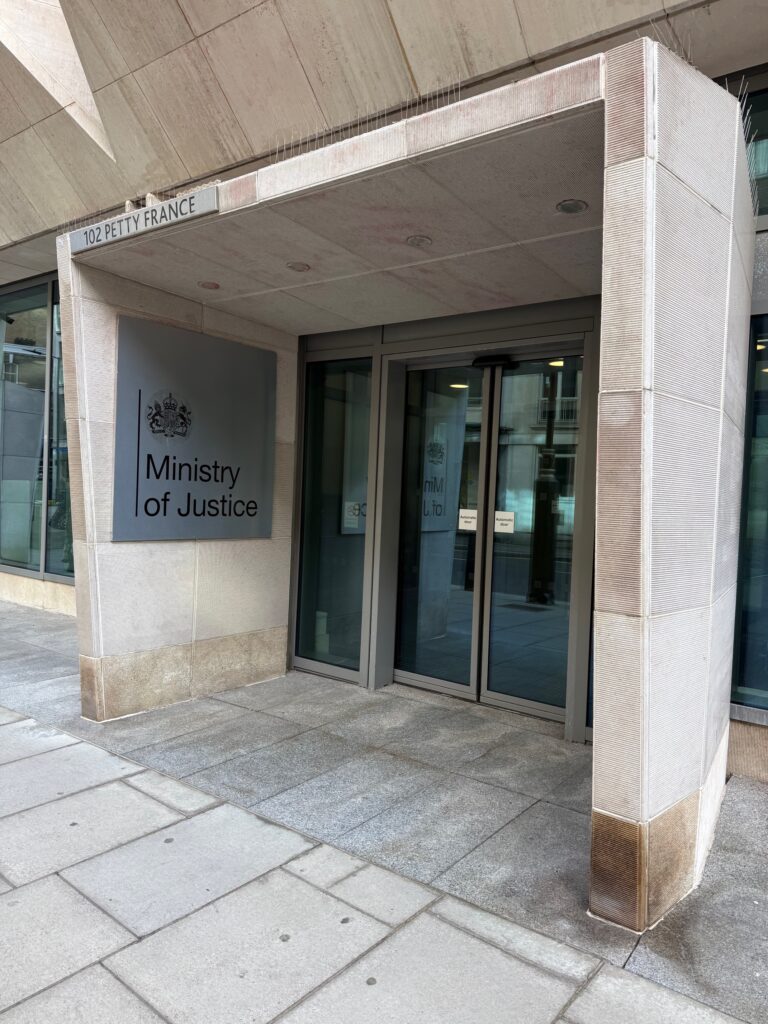
I arrived about ten minutes early. I filled the time by looking up at the hulking brutalist spaceship of a building that houses the Ministry of Justice. A stream of suits and lanyards weaved their way in and out of its slightly menacing doors. I regretted that I was not able to pass behind those doors myself. I had left it too late to arrange for the clearance, and so at two PM on that winter afternoon I was dragging one of that building’s most significant occupants, Professor Lisa Webley, the Law Commissioner for Property, Family and Trusts Law, out to the tube station. She emerged on time, smiling, and donning a striking purple patterned coat. She soon led the way to a little Italian coffee shop tucked away inside the station: the Caffee Grana, which she assured me was an ‘institution’ for those who worked at the MOJ. She was kind enough to buy me an Americano, and we settled down to conduct the interview at a little table (inevitably after a few technical difficulties on my end).
Professor Webley was keen to establish from the outset that she could not conduct any interview as a Law Commissioner per se: this is an official public role with strict protocols around it. Rather she would give her answers wearing one of her other, equally impressive, hats: in this case being as Chair of Legal Research and Education at the University of Birmingham. Nonetheless, she was happy to answer some questions about her time at the Law Commission, where she has worked for around four months. She spoke in glowing terms about the Commission’s ‘team spirit’ and ‘clarity of purpose’ and presented the organisation as a ‘well-oiled machine’ which she ‘feels to be working very well’. I was struck how quickly Professor Webley’s terms of reference moved into the realm of the academic. She compared her work at the Commission, where she leads teams in reviewing areas of the law potentially in need of reform, to the work of a ‘student’ answering an exam question, constantly asking ‘what is it we’re supposed to be looking at here?’

Professor Webley has spent most of her career in academia and is an expert on legal pedagogy and legal writing, so it is perhaps unsurprising that this is the analogy to which she would turn. I wondered how her work at the Law Commission compared to her work as a legal academic. I was surprised to find that she felt the work to be very similar. Professor Webley does not favour the ‘lone scholar’ model that works for some, and much of her academic work consist of ‘empirical projects’ conducted in teams. Her suitability for her role at the Commission is plain, as this kind of work is materially very similar to the Commission’s, if less likely to directly impact public policy. The key difference between the roles, she said, was that academic work was that her ‘purpose has, on the whole, been more individually defined’.
I got the sense that there was very little difference for Professor Webley as to whether she set her own goal or whether that goal had been ‘agreed with government’. She seemed an astoundingly organised person. I asked her whether this was a reasonable assessment, and she confirmed: she is, and needs to be, ‘very rigid’ with how she organises her time. Not only is her diary ‘very heavily planned’, but she also plans for things that ‘aren’t yet in my diary’. Her cheerful admission that ‘there is far more work coming at you than there is time to do it effectively’ should sound familiar to those enrolled on the GDL. I felt a little guilty and very honoured that she had made the time for an hour’s chat with me amidst that schedule.
As someone who has had a long and prestigious career in the legal academy, I wondered how she viewed the relationship of legal academia to the law and the legal professions. Having studied English as an undergraduate, I was struck by disconnect between literature as it exists in the wild and the world of literary academia; the dynamic in the law seemed clearly dissimilar. She envisions the relationship between law and the legal academy as ‘symbiotic’ or ‘circular’ and compared law to subjects such as engineering or medicine. She cited the late great Professor William Twining of UCL, in considering law as a ‘trade craft’.

I wondered whether a deeper academic study of the law might be hindered by shorter courses such as the GDL. I am set to spend no more than two years in formal legal education, compared to Professor Webley’s (at my count) eight degrees or diplomas. Reassuringly for me, she was quick to sing the GDL’s praises; despite being something of a ‘boot camp’, she found the course, which she has taught on, to be enriched by the variety of academic backgrounds that flow into it.
Though this is offered said of the GDL, I wondered how true it was in the light of other things I have heard. One of my academic tutors had warned me that — as an English graduate — my writing style might be badly suited to the legal writing and would need some significant changes. I asked Professor Webley what common mistakes people make when engaging in legal writing, and whether there was much scope for individual personality in legal writing, or if it must be defined by adherence to rigid formulae.
Professor Webley felt on the first point that there can be a tendency for work that might nonetheless be ‘really elegant’, to merely restate the law without engaging in actual argument. On the second, she saw plenty of room for individuality in interpretation — and indeed saw interpretation as ‘inherently personal’. She nonetheless was quick to warn against the tendency of students to become activistic in tone where it was not appropriate.

I wondered how someone so meticulously organised would suggest coping with the perennial problem of procrastination. Her response was to ‘demystify’ procrastination by unmasking it as simply ‘fear of failure and fear that it’s going to be difficult’. While she ‘no longer [has] a problem with procrastination’, this has not always been the case. Her most practical solution, and the one I suspect to be the most effective, was to break up tasks into ‘constituent parts’: to give yourself ‘permission to say’ that any work done at all can be a ‘step on the way’.
Of course, in recent years there has emerged a very quick way that law students to cut out a great deal of work: generative AI. This is also a subject of specialism for Professor Webley. She has written articles and chapters on the relationship between the law and AI, and this also formed the subject of her 2025 Lord Upjohn lecture which I had the pleasure of reviewing for this blog. Her views on AI are measured: she is ‘by no means a full techno-optimist’ but not a ‘techno-pessimist’ either. In the context of legal writing, while Professor Webley accepts that AI might be construed as a ‘tool’ like any other — akin to a ‘spellcheck’ — she is concerned that ‘heavy reliance’ on that tool might lead to ‘de-skilling’ of students. She holds the process of writing itself in high regard, seeing it less a simple transcription of -pre-formulated ideas but as crucial to process of critical analysis itself. Perhaps more important than even this is her regard for the law itself as a human institution — one which must reflect ‘human values’ in a way an algorithm simply cannot.

Compelling though I found Professor Webley’s analysis, it came, inevitably, from the perspective of a legal academic. As a student, I found myself perhaps less perturbed by the prospect of students being insufficiently skilled or principled to do the job, and more concerned that AI might prove such an effective labour-saving device that there would be no need for so many graduates in the legal world. In other words, that there would be a glut of over-educated and heavily indebted twenty-somethings with fewer and fewer jobs. This is a common narrative — that, as an article in the Spectator by Sean Thomas put it, ‘AI will kill all the lawyers.’ Yet Professor Webley’s response struck me as a very cogent counterpoint to this now common worry. The law is not in any real sense ‘oversubscribed.’ In fact, there may be too few lawyers: ‘there is a vast amount of legal need, most of which is not being met currently’. In meeting this need, it may be that not all the professions will need to be reconfigured, perhaps drastically:
‘There will be new and emerging branches of the profession’. Not everyone with a law degree can become a ‘barrister, solicitor, or legal executive’.
This was typically far-sighted for Professor Webley. A clear eye for the forest over the trees is one of the qualities that makes her so intellectually formidable. When I had got back on the District Line and came to transcribe the interview — using, I must admit, an AI software — I was also struck that while my questions were interrupted by ‘ums’ and ‘errs’, her answers were delivered almost uniformly in complete and grammatically sound sentences. Professor Webley proved just as impressive as I had expected her to be. The coffee wasn’t bad either.

Editor: Huge thanks to Professor Webley for giving up her time for this interview, and also to Paddy for some terrific questions and a truly reflective piece.
Patrick (who everybody calls Paddy) is an aspiring barrister on the GDL at The City Law School with an interest in public and commercial practice. As an English student by training, he is still keenly interested in literature, film, history and politics. He’s also willing to bet he knows more about dinosaurs than anyone else on the GDL (fighting talk!). Paddy is a member of this year’s Lawbore Journalism Team.