

LSE’s Clement House Hong Kong Lecture Hall was the location for Bryan Cheang (Director and Fellow of the LSE Hayek Program) to introduce a lecture entitled ‘Common Law: a better foundation for liberalism’. This took place in early December. The speaker? John Hasnas, Professor of Law at Georgetown University Law Centre, a Professor of Business at Georgetown’s McDonough School of Business, and the Executive Director of the Georgetown Institute for the Study of Markets and Ethics. This lecture offered insights into Hasnas’s recent book Common Law Liberalism (published by Oxford University Press) and attracted an audience of students and faculty.
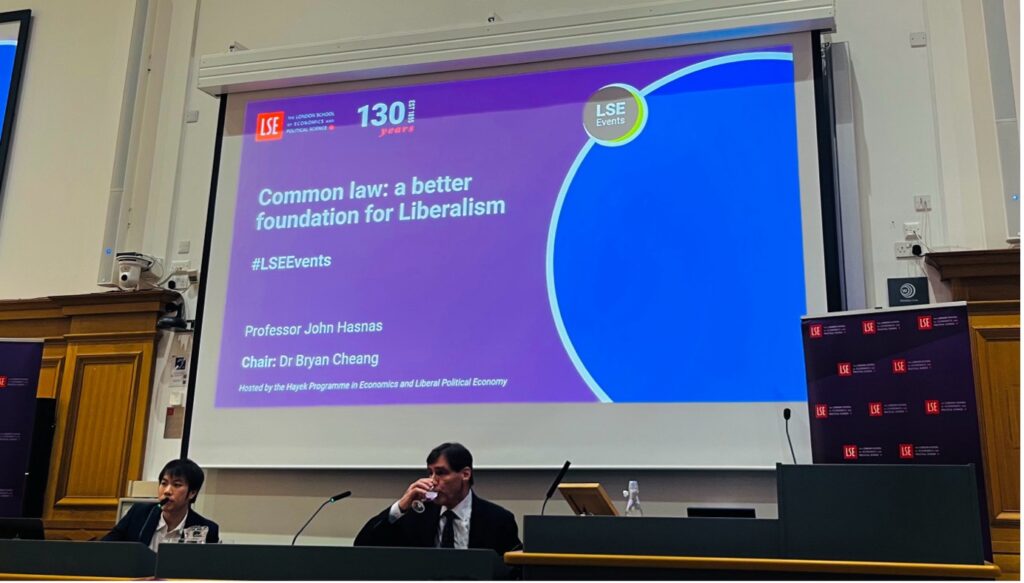
The primary aim of this lecture was to examine the ordinary understandings of law as necessary regulatory to free-market excesses, questioning whether this account adequately reflects the true function of law. Hasnas sought to provide his examination of the functioning and purpose of law, proposing a new theory of liberalism that illustrates common law serving as an alternative to traditional political legislation.
Hasnas begins with the two main thesis covered in his book: moderate and radical. Hasnas describes the moderate thesis as good policy analysis, requiring a comparison of the effectiveness of common law and legislation as regulatory mechanisms, illustrating how dominant political philosophy assumes a false dilemma. This false dilemma is where either human action is unregulated, or it must be regulated by government legislation. But Hasnas raised a third option: regulation through common law, civil liability, custom, and ethics. The second, radical thesis, described as the more controversial one, is imagined to be a peaceful and prosperous society existing without legislation and without state monopoly over essential services. Hasnas emphasises that the radical theory, while proactive, is not central and that the moderate thesis is more defensible and practically important.

The lecture moved to describe the common assumptions that markets are unregulated voluntary transactions, and law is government regulation imposed to correct market failures. These market failures occur because of transactions increasing wealth through voluntary exchange, and some transactions create negative externalities; therefore, government regulation is required to protect the public good. Our speaker defends this argument with the example of pollution from factories during the industrial revolution; unsafe products harming third parties, and cultural or moral degradation. Hasnas notes that this view relies on a misunderstanding of both law and the markets, creating an ignorance of the already played regulatory role by common law and civil liability. Our speaker describes this as an unattentional blindness which is reflected using the “invisible gorilla” analogy.
This is a psychological experiment where participants counting basketball passes failed to notice a person in a gorilla suit walking through the scene, imposing the idea that focusing solely on one task blinds us to obvious alternatives. Applying this to public policy, policymakers are so focused on government regulation that they fail to see civil liability.
Our speaker talked about the Anglo-American systems of law, consisting of common law and legislation. Common law develops from custom and dispute resolution, evolving incrementally through real cases governing various areas of law. In contrast, legislation is enacted through political processes and, while justified democratically, is often shaped by lobbying and special interests. Hasnas rejects the idea of unregulated markets, stating markets are always constrained by ethics, social norms, and civil liability. From this point of view, common law is both law and part of the market functioning as an internal regulatory mechanism. Accordingly, legislative regulation is justified only where harms are not adequately addressed by ethics, customs, or civil liability and where legislation can be shown to be more effective than common law.
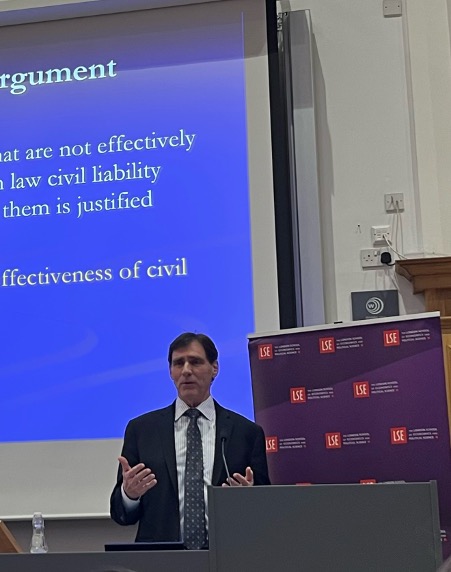
Throughout this lecture civil liability is described as an effective regulatory mechanism, shown in persistent corporate efforts to limit tort law, indicating civil lability as feared due to its efforts. This effectiveness is explicit in the McDonald’s hot coffee case; meaningful change occurred only after a jury award equivalent fines which can be treated as a cost of doing business, despite known risks and hundreds of prior complaints. Civil liability is enforced without fixed budgets, as well as resisting regulatory capture, and posing a serious financial threat to well-resourced wrongdoers making it a powerful determent.
The lecture concludes with Hasnas advancing a more radical claim, that law does not require legislation or a state monopoly. Common law existed before the modern state, courts historically operated without centralised control, and police forces are a recent development too. This suggests that a functioning and orderly society without state monopolies is not only conceivable but has existed in practice.
The main strength of this event was in the clarity of the analytical framework provided and its effective integration of legal theory, economics, and psychology. Hasnas’s use of illustrative examples, particularly from tort and environmental law, strengthened the persuasiveness of the argument by demonstrating how common law operates in practice. However, some in the audience raised issues with this analysis, drawing out the capacity of civil liability to address long-term harm, concerns regarding unequal access to litigation, and the reliance on after-the fact enforcement rather than preventative regulation. Overall, this lecture made a valuable contribution to legal education and modern law theory, encouraging a more critical and nuanced approach to regulation that is highly relevant to both academic study and future legal practice.