
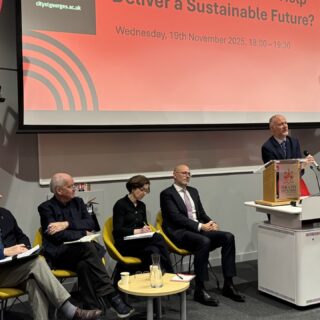
On Wednesday 19th November, Dr Jed Odermatt hosted a Q and A with climate experts Professor John Elkington and Jessica Simor KC (Matrix Chambers). The event was introduced by Dean of the Law School, Professor Richard Ashcroft. The event considered how law may work to face the challenges of Climate change, specifically in the context of the 2015 Paris Climate Agreement. The event closed with a note from Dermot Barnes, the Head of Sustainability at City University. Clemency Fisher was on hand to report the event and below shares the main takeaways from each speaker.
Professor Elkington
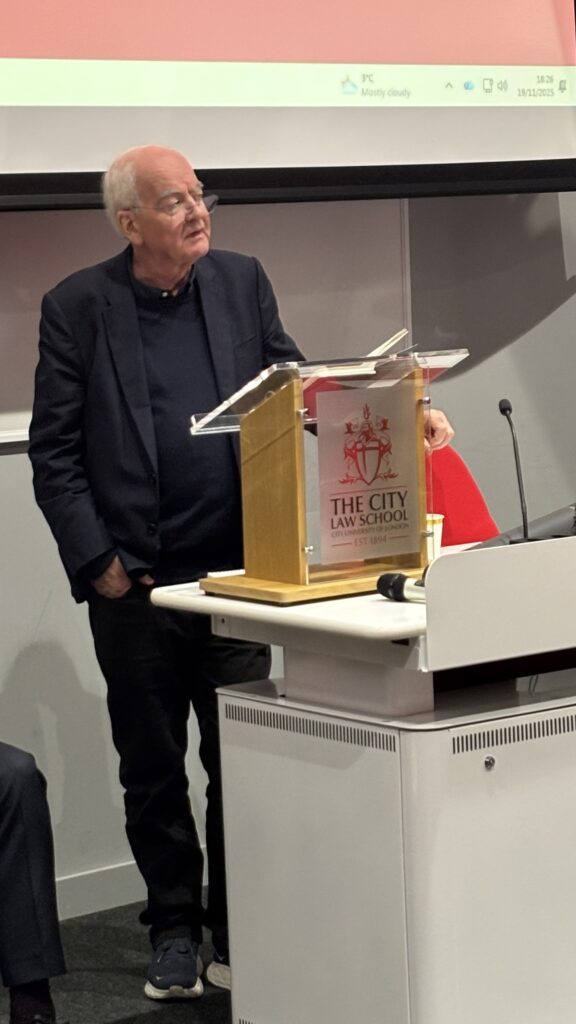
Professor Elkington began his presentation by recalling a conversation with physicist Herman Kahn, in which Kahn urged environmentalists to ‘jump that chasm’ and take a radical stance to tackle climate change. While sceptical at the time, he now has arrived to face the challenge head on, urging the audience to do similarly.
Why?
Because climate change is devastating – in England we only need to look to the destabilising Atlantic Meridional Oscillating Current where climate change has weakened its currents, bringing more extreme weather for the next generation. We have reached a “tipping point”.
The solution?
Elkington believes it is unclear. While the 2015 Paris Summit targets suggested governments would take the reins, Trump’s exit from the Agreement has torn apart its influence. In this vacuum, Elkington argues that the onus is on businesses to act. He believes environmental changes are a win-win for businesses, and companies that fail to adapt will be overtaken: While Mercedes Benz recently announced that they would not meet their 2025 target for electric car production, the Chinese company, BYD, has developed technology to charge electric vehicles in 5 minutes.
Elkington noted the role that new developments may play in creating change. For instance, a recent experiment employed AI chatbot ‘Grok’ to find a way to make electro-magnets with fewer rare earth metals. The simulation ran over 100 mil. compounds, and provided outputs which required no earth metals; were twice as fast; cheaper; and used 70% less carbon. Along similar lines, Imperial College recently announced its new Schools of Convergent Science, an initiative which embraces the potential for different disciplines to use their combined knowledge to tackle the climate crisis.
Professor Elkington urged that lawyers are central to this change and should be inspired to create disruption rather than following a conservative course of action. He noted that older generations with have the power and influence are obliged to help younger generations – it is a communal effort.
Jessica Simor KC
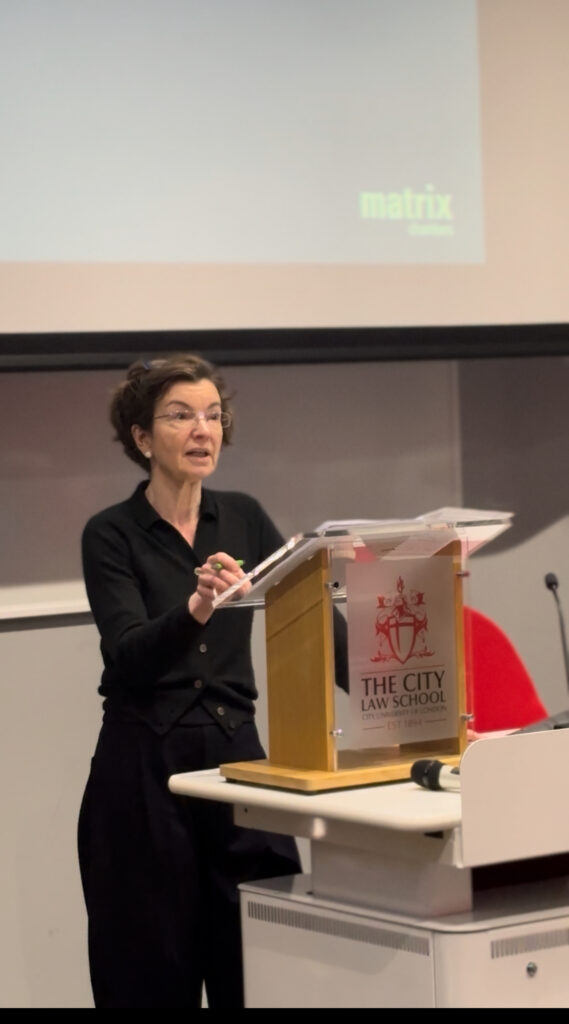
Jessica Simor resolutely rejected Professor Elkington’s suggestion that lawyers tended towards conservatism, and her speech centred on the recent law in enabling change.
Simor was not entirely disheartened by Trump’s influence, noting he represented a ‘temporary pause’ in the trend of increasing public concern about climate change. She contrasted his stance to that taken by the media, observing that the Financial Times always published at least one climate change story per edition. While climate change may be branded as ‘woke’ by Trump, it is not considered optional to businesses. Additionally, she noted that while America had pulled out of the Paris 2015 , China had now become party to the agreement, proving Trump’s influence may not be as global as he hopes.
Simor believes it is the law’s responsibility to place pressure on the public to enact behavioural change, and more education should make individuals aware of their impact. She was impressed by an initiative in France, which broadcast overhead messages after train journeys communicating how much carbon is saved at the end of the journey (as opposed to flying), placing environmental responsibility in the forefront of passengers’ minds.
The global scope of climate change is a challenge for the law but also presents an opportunity to hold states to account. Simor argues incorporating climate responsibilities into international courts prevents countries from escaping their international duties. These incorporations have been rapid recently, and Simor notes that advisory opinions from Inter-American, ITLR and ICJ courts have been published in the last two years. However, enforceability is required to prevent countries prioritising profits over action: while shipping contributes to 3% of all carbon emissions, flag/coastal states don’t wish to limit lucrative maritime registrations.
Simor closed with recent progressive legal developments towards the environmental cause, and specifically noted Verein Klima Seniorinnen Schweiz v. Switzerland (2024). In that case, Switzerland was taken to court by over 2000 elderly women. The case reached the European Court of Human Rights, and it was ruled that Switzerland had breached its responsibility to protect the state against climate change, a novel decision.
Highlights from Dr Jed Odermatt’s Q and A:
(The answers are summaries not quotations)
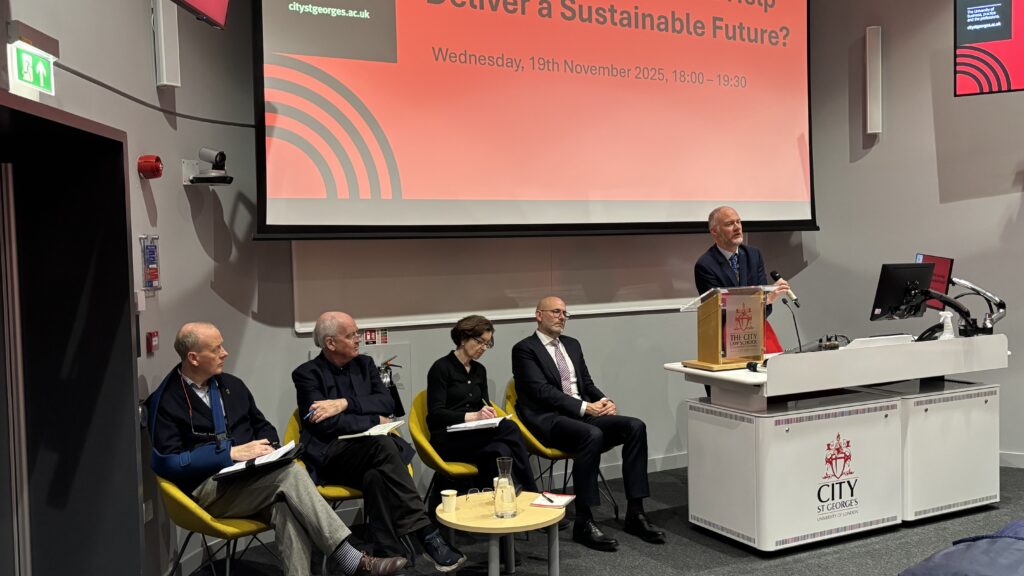
JO: “What are legal obligations of states, and the legal consequences of climate change?”
Jessica Simor: The ITLOS judgments and Law of the Sea show that states’ commitments are no longer territorial. We need to look at the full range of consumption and production to legislate climate change. The consequence of these judgments means that Nationally Determined Contributions under the Paris Agreement must include carbon budgets relating to consumption. The court found that there is a duty to co-operate with other states, and that failure to do so will create liability. Hopefully this extends to arbitration, and impacts business operators.
JO – “What role is there for the law to enforce responsibility?”
John Elkington: The law, and perceived responsibility, is not consistent, but the pressure of climate change is. While company positions such as ‘Chief Sustainability Officer’ may go out of fashion, their work will not go away and will be redistributed within other roles. The law can cause change through environmental liability. For example, the Shell Case in Holland (ordered to cut emissions by 45% by 2030, though later reduced to merely an obligation to reduce), and in RWE case in Germany, hold that companies may be held liable for emissions. However, law is often driven by money, as exemplified by the failed attempt to prevent Totale acquiring the $1.4bn offshore gas project in Mozambique, to harvest 45mil. Barrels of Liquid Natural Gas.
Dermot Barnes, Chief Environmental Officer:
Dermot Barnes closed the evening on a note about hope, which is not blind optimism, but underscored by sincere commitment. Barnes commented on the impact of the recent Wellbeing of Future Generations Act passed in Wales, the first of its kind which aims to enshrine future peoples’ needs. He argued that individuals can enact extraordinary change and highlighted the 100 class actions brought by citizens to achieve decarbonisation. While the modern age is often clouded in pessimism, we should remember that we have the most advanced technologies at our disposal.
“Now is the time for acting”.