

One Thursday afternoon, I found myself with a few hours to kill before I was due to attend a lecture on Insolvency delivered by Dr. Bolanle Abedola as part of UCL’s ‘Current Law Problems’ series. I thought I’d better do some work, and since I had arrived early in Bloomsbury, I went to the Senate House library. The law collection on the seventh floor was pretty meagre compared to the library of the UCL law faculty down the road at Endesleigh gardens, where the lecture was taking place, or to the City Law School’s Law Library on Sebastian Street with which I was familiar. There were no great walls of law reports or statutes in identical binding, at least that I could find; instead, there were a lot of books on the relationship between law and the humanities, and in particular between law and philosophy. I am on the GDL, which puts me in a bit of a bind as it relates to these sorts of books.

So what was this bind? Well, on the one hand, I was an undergraduate in a humanities subject; my dissertation was about First World War poetry through the lens of Nietzsche, so this is much more familiar ground for me than, say, The Land Registration Act 2002. On the other hand, students on the GDL are not famous for their massive amounts of free time. I would love to learn about the philosophy of law — had I done an LLB I’m sure I would have — but I fear I simply do not have the hours in which to do it.
But wasn’t this meant to be an event review? What relevance do these random musings about the relationship between law and philosophy have to attending a lecture on insolvency? I cannot say that I thought they would be at all relevant when I left the library and walked ten minutes down the road, through the rain, to the UCL law faculty. There, Dr Abedola, an Associate Professor at the University of Reading and dual qualified barrister and solicitor of the Nigerian Supreme Court, delivered her talk on what could have been expected to be a rather dry topic with warmth and humour, and with frequent addresses to her students, friends, and academic mentors in the audience.
The talk was chaired gracefully by the eminent and erudite Lord Justice Zacaroli, who sits in the civil division of the Court of Appeal and whose recent decisions include, pertinently, the Court’s approval of the Thames Water restructuring plan. However, the decision regarding Thames Water was, if my memory serves, one no more than two or three cases cited that evening, all of them very much in passing. There were, I think, no references to specific pieces of legislation. Yet there were extended discussions of the theories of myriad philosophers from myriad schools. The pragmatist John Dewey (Dr Abedola’s ‘favourite philosopher’), the idealist T.H. Green, the utilitarian Peter Singer, the libertarian Robert Nozick, and the liberal John Rawls all received consideration in the sweep of the lecture. In other words, this was a lecture about philosophy.
Law and philosophy?

Dr Abedola’s talk, the result of extensive study and research, analysed the three dominant philosophical frameworks that have been applied to insolvency law, and proposed a fourth innovative normative approach, what she terms ‘Justice Driven Insolvency Law’, or ‘JUDIL’. The aforementioned three approaches are the classical ‘CBT’ the ‘Creditors Bargain Theory’, as articulated by Thomas Jackson; the ‘loss distribution theory’, as articulated by Elizabeth Warrren (‘yes, that Elizabeth Warren’, as Abedola confirmed); and the ‘communitarian theory’ as outlined by Karen Gross.
These theories are complicated, and I am too cautious about the extent to which I really understand them to attempt to explain them in any great detail. All I will say is that, as far as I understand it, they differ in the question of whose interests insolvency law should seek to protect, and how narrowly or widely this group should be defined. CBT concerns itself exclusively with the interests of the creditors of an insolvent body; Loss-Distribution expands its scope of consideration to all ‘stakeholders’ in an insolvent body, including employees, and seeks to salvage viable commercial relationships form the liquidation process; communitarian theory includes society itself as a stakeholder, and considers the insolvency in the widest possible context. Dr Abedola suspects that this latter theory is too broad and instead employs Dewey’s concept of plural ‘publics’, rather than a singular ‘society’, to consider who should be factored into considerations in the process of insolvency.
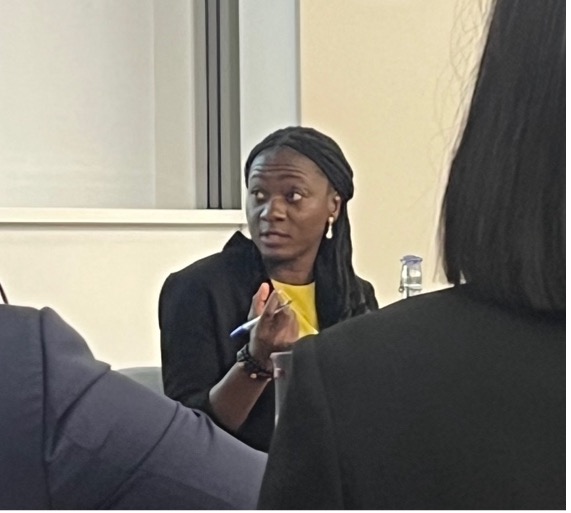
Having outlined the differences between these theories, Dr. Adebola concluded that they were in fact not so different as they may at first appear. While they claim contrasting justifications, Dr. Abedola concludes that they are all, in fact, rooted in the same impulse: to do what is fair, or ‘just’. She expressed a biting scepticism towards the claim that the ‘proceduralist’ proponents of CBT were pursuing economic competence and ‘market efficiency’, and argued that their system was no less normative and ethics-based than the others; it was merely based on a different normative system, of the kind advanced by market-friendly thinkers such as Nozick.
As she strikingly put it:
‘All theories of insolvency law must confront justice directly. They all do; we just haven’t recognised it yet.’
The philosophical approach of the lecture was compelling and refreshing. Zacaroli LJ, as if directly addressing the thoughts I had been pondering the library a little over an hour earlier, said of Dr Abedola’s talk, ‘it’s helpful for us studying the nuts and bolts to look back at the broader principles’. However, I must confess that, being an expert in neither the legal nor the philosophical aspects of the lecture, I could not follow the whole of Dr. Abedola’s argument. While she insisted that her work was in some sense practical, and did not ‘deal with hypotheticals’, I also struggled to see how her very philosophical framework could conceivably be practically implemented. It transpired I was not the only one who was experiencing this concern. I had interpreted Abedola’s reference to having ‘someone who decides the law in the room this evening’ as a reference to Zacaroli LJ; but it became clear during the Q and A that this was instead directed at a Mr. Paul Bannister who sat in the second row.

Mr. Bannister is an important man in the world of insolvency law. Since 2018 he has been at the Head of Policy at the Insolvency Service, part of the Department of Business and Trade, where he has worked for the past twenty years. Safe to say, he regarded Dr. Abedola’s philosophical theories with a significant degree of scepticism. He made this view plain. Mr. Bannister spoke of the difficulty he faced as ‘the one responsible for the framework’, saying:
‘I’m trying to work out what is that the current system doesn’t do that you think it should do. From where I sit, it’s working all right, actually! I’m thinking, really? Really?!’.
His incredulity towards Abedola’s theory was based in an ardent sense of practicality and realism, the result of professional career spent deep amidst the ‘nuts and bolts’ of insolvency law. He asked Dr Adebola how he was meant to convince Parliament to adopt her principles. She replied with a wry declaration: ‘You’re asking all the right questions, Paul’ . Her philosophical framework was, she said, designed to be considered chiefly by policymakers like Mr Bannister in helping them to shape policy. JUDIL would form the underlying normative theoretical basis to specific policies. At this point, I began to feel that I was observing an intellectual clash between two great masters of a field I did not truly understand. I left the law faculty swiftly and returned to the safety of Senate House.

Patrick (who everybody calls Paddy) is an aspiring barrister on the GDL at The City Law School with an interest in public and commercial practice. As an English student by training, he is still keenly interested in literature, film, history and politics. He’s also willing to bet he knows more about dinosaurs than anyone else on the GDL (fighting talk!). Paddy is a member of this year’s Lawbore Journalism Team.