

In summer 2025, City Law School was delighted to financially support a select group of students from its barrister (Bar Vocational Studies) and solicitor (SPP) training routes to undertake law clinic placements in Cape Town, South Africa, through the law school’s Ubuntu Scholarship programme,
The Ubuntu Scholars undertook a month’s internship with prominent human rights’ organisations including the Women’s Legal Centre (WLC) and University of Cape Town (UCT) law clinic, contributing to legal research and advocacy and access to justice for poor South Africans.
The programme aims to support students’ professional development through international legal experience in a public law context.
Two of the participants on the Summer 2025 programme have shared their experiences with Lawbore. The account of Douglas Leung (BVS) follows…
For four weeks from July to August 2025, the letters ‘UCT’ no longer formed part of the acronym for the Unfair Contract Terms Act, but rather stood for the University of Cape Town. It is fair to say that not only will these letters be forever engraved in my memory, but also all the unforgettable professional and cultural experiences that I now associate with UCT.
Pre-internship process
Following a written application and interview, five City Law School students were chosen as Ubuntu Scholars to undertake internships with various law clinics in Cape Town. We were asked for our preferences, and I was fortunately assigned to my first-choice law clinic at UCT.
If you are planning to apply for this or similar opportunities, I would recommend also exploring other sources of funding, such as an Inns of Court.
UCT Law Clinic
Two points to know about UCT generally.
Firstly, it is (probably) the best university on the whole African continent. And I promise that’s not just the UCT students who told me this…the 2025 rankings like QS and The Times agree.
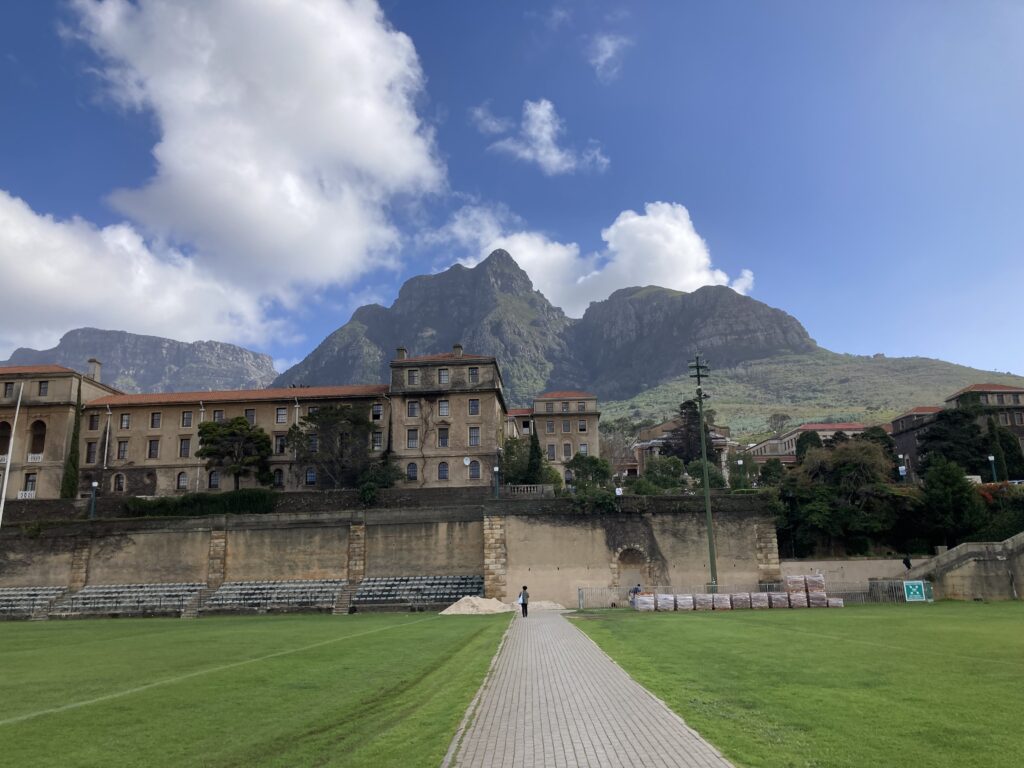
Secondly, UCT has (probably) the most naturally beautiful campus in the world. Although there are no official rankings of this to my knowledge, the views of Devil’s Peak and the city from its location in the foothills of Table Mountain will take your breath away every day. The attached photo does not quite do it justice.
What does do justice, though, is the Law Clinic there. It was the first university law clinic to be established in South Africa and it was a student intiative which grew into a full blown law practice in the early 90’s. The clinic only provides pro bono legal assistance to indigent clients who qualify for legal aid. Its primary area of practice is civil litigation; which includes but is not limited to evictions, divorces, wills, protection orders (domestic violence), monetary claims above R20 000-00 and children’s court matters.
I would recommend looking at the UCT Law Clinic’s social media accounts (mainly Instagram and Facebook), if you are interested in their latest work.
Work inside the office
On my first day, the clinic very helpfully gave me a handbook to get up to speed with the relevant South African law quickly. I also attended the clinic’s weekly lectures for the student advisers, who are involved in the clinic as Clinical Legal Education is one of the elective courses that final year LLB students can take as part of their studies.
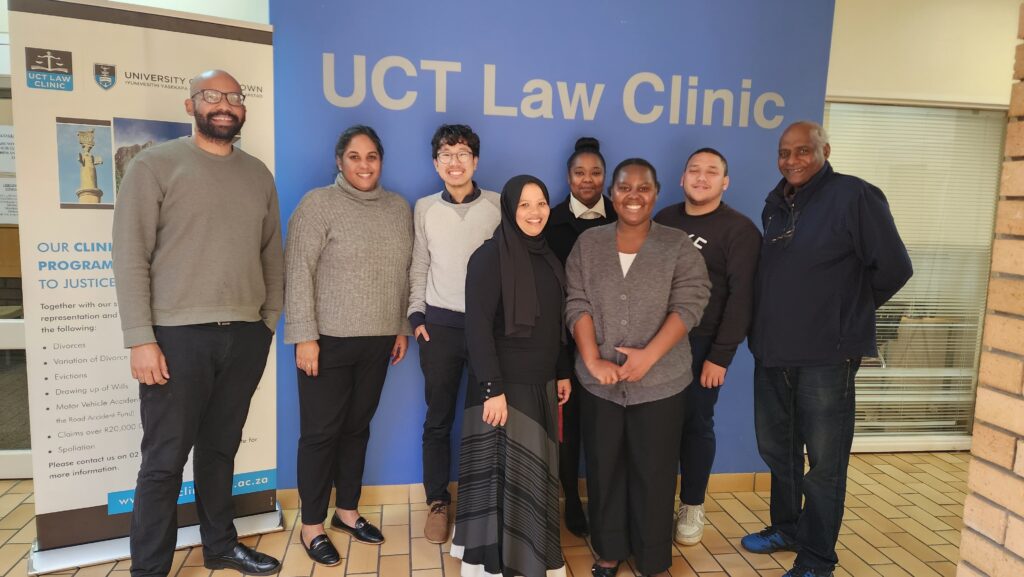
From the second day onwards, I immediately got stuck into the work. I shared an office with two candidate attorneys (i.e. trainee solicitors), who provided me with tasks, guidance, and hilarious moments – all in equal measure. I also shadowed the candidate attorneys when they had a consult with clients who would occasionally come to the office, although the clinic more often goes out to clients through satellite clinics.
I spent most of my time in the office drafting wills and statements of case in divorce proceedings, but I would also have to call clients sometimes, for example to clarify their instructions or previous advice given to them.
Work outside the office
The clinic’s main modus operandi entails holding satellite clinics in the townships and underserved areas around the university, where many of its indigent clients live who may not be able to afford to travel to the office otherwise. I loved having the responsibility of consulting with real clients myself. It was a fascinating window into real life for ordinary people in Cape Town outside the tourist/legal bubble.
As an aspiring criminal barrister, I was very keen to observe proceedings in South African courts. The clinic was very open to my interests, and as a result I managed to visit three different courts thanks to the clinic’s assistance.
Firstly, I shadowed the candidate attorneys multiple times at eviction and protection order hearings in the Magistrates’ Court.
Secondly, one of the clinic’s attorneys arranged for me to shadow an advocate (i.e. barrister) in the High Court. The advocate very kindly took the time to show me around the High Court and give me a real insight into a career at the Bar in South Africa. The similarities and differences with the English Bar were equally intriguing.
Thirdly, the clinic’s director encouraged me to take time away from the office to observe criminal court proceedings. I ended up speaking to prosecutors and observing cross-examination of the defendant in a murder trial. Although I must add a disclaimer to be aware of the safety risks, this was a truly illuminating and eye-opening experience.
Free time with colleagues and students

I spent time with my new colleagues who were very welcoming, such as playing football every week or going on a hike up Table Mountain and Lion’s Head with them.
Through the weekly lectures and satellite clinics, I also got to know some of the UCT students, with whom I spent time, for example, going to a UCT Big Band concert in UCT’s wonderful Baxter Theatre.
My final piece of advice: make a conscious effort to put yourself out there. You never know who you will meet or what experiences may follow, but that’s all part of the fun of being an intern, not tourist, abroad!
Douglas Leung studied the GDL and BVS at City Law School. He is currently working as a Judicial Assistant in the High Court.