
Lawbore journalist Michelle Sin reports back on a fascinating lecture at Inner Temple in mid-November (Ed.note – my fault for delay publishing!). If it sparks your interest, you are able to view the lecture in its entirety online.
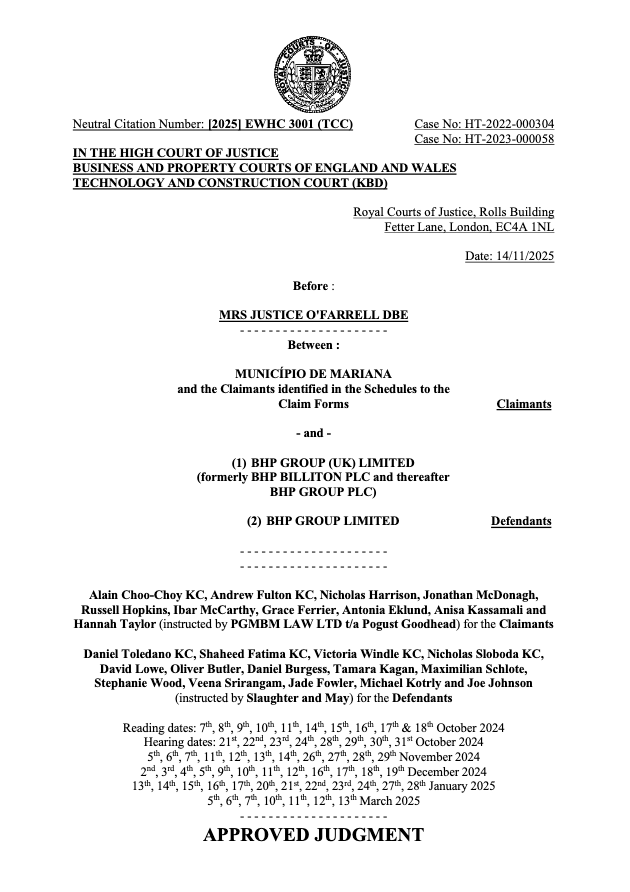
The topic of third party litigation funding was brought into discussion following a series of significant events that occurred earlier this year. In the months of June and July, The Civil Justice Council published a report on the review of litigation funding, providing 58 recommendations on the approach to regulating it. Later, the Office for Budget Responsibility warned that the UK’s GDP was more vulnerable to climate related risks than initially thought. A finding which has significant implications for litigation funding as this raises the risks for third party funders. Then more recently on the 14th of November, the High Court made a landmark ruling on one of Brazil’s biggest environmental disasters; the Fundão dam collapse which destroyed a village with 19 people killed and polluted the river along its entire course to the sea.
The High Court found BHP, the mining company, liable under a strict and fault-based set of grounds. This discussion was led by two panelists from distinct professional backgrounds, the issue was approached from an interdisciplinary perspective that incorporated both legal and economic views:
Martyn Day, Senior Partner Leigh Day, specialising in international, environmental, and product liability claims Fredrik Erixton, economist, and the co-founder of ECIPE, a Brussels-based think tank.
Moderated by: Estelle Dehon KC, Cornerstone Barristers
Understanding how litigation funding works
In his Keynote, Martyn Day emphasises the substantial impact third party funding has had on bringing group claims — claims which otherwise would go unlitigated without these funders. He recalls a time in the early 2000s to mid 2010s where legal aid was withdrawn and the only cases that were brought were small cases worth £1 million with legal costs at around half a million pounds. It was only recently, around 7 years ago, when funders who were helping in the commercial sector thought it would be beneficial to diversify into mass claims. The funders aim to get three times their investment and seeing as how bringing a case would cost £10-15 million, the case must be worth £100 million with funders getting an average of 30% of that sum.

Most group claims operate on an opt-in system; where individuals must take a specific active step to join the group of claimants and be part of the class action. However in the case of an opt-out system where someone represents the class action as a whole, the case may be worth up to hundreds of millions and even billions. In a case concerning the interest rates of Mastercard, a deal of £200 million was made where funders put in £45 million. In the Post Office Horizon cases (e.g. Bates v Post Office Ltd (No 3) [2019] EWHC 606), the claimants won £57 million but funders took £40 million of that sum. Naturally, this raised questions on who the ultimate beneficiary is and if this system needs regulating. A question to which Day responds by putting to attention the huge risks these funders take. If regulators were to put a cap and declare funders can take no more than 30% of the sum, a lot of cases would never get litigated because the risks are too high for funders. Day also reminds that although these numbers look disproportionate, litigation funding is improving access to justice.
What are the consequences of mass litigation: an economic analysis
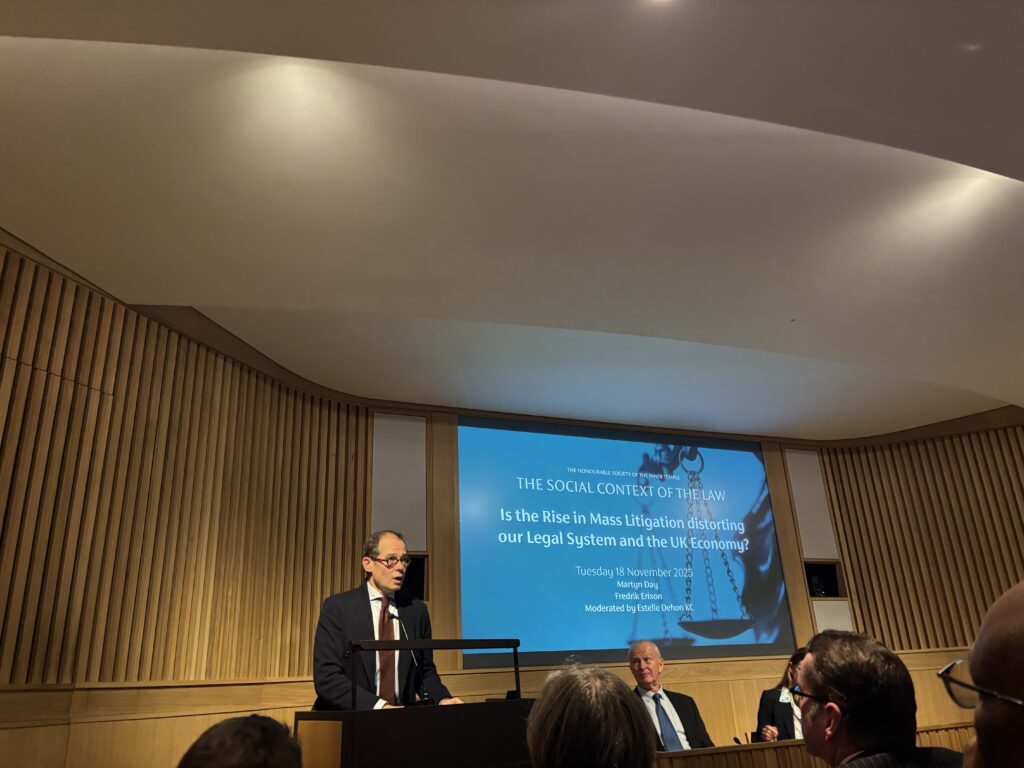
Fredrik Erixton outlines the impact mass litigation could have on the economy. He observes that the 400% increase in mass claims can be attributed to the opt-out system. Comparing the UK to the EU, where the opt-out system is not in use, this discrepancy in the rise in mass litigation comes as a result of third party funding. One of the significant economic consequences that have arisen from this is the ways in which insurance liability has skyrocketed.
This is more worrying for those smaller firms who have patents and good intellectual property protection, yet cannot afford to get decent liability insurance. Furthermore, capital investors are reluctant to invest in small companies, especially those in bio-tech sectors and other sectors that are subject to frequent litigation. These firms are forced to sell to bigger companies which impacts the value chain. The concern here, when the mass litigation system is moving towards this direction of companies not being able to get insurance liability, is alarming from an economic stance because it inhibits the capacity for companies to innovate.
Erixton finds himself in favour of the report published by the Civil Justice Council. The report does not propose a direct regulation but rather disciplines. He finds it particularly important that the report proposes a transparency rule on the funders: the identity of the funder and where the source of the money is coming from. This targets the funders who get money from companies who sue their competitors to achieve competitive gain. He believes the Civil Justice Council has proposed a system to mitigate these consequences while maintaining the opportunities to improve access to justice.
My reflections
I must confess that I had not the slightest clue about this particular topic prior to the lecture. It took me time (quite a while) to consolidate and fully understand what these panelists were talking about. As a second year LLB student, this was not a matter that I had ever come across. My takeaway from this lecture is this. Mass litigation and third-party funding is still a fairly new thing in the UK — nowhere nearly at the level the US is operating at and thus, the full legal implications are yet to be seen. However, the imminent threat is this: mass litigation is distorting the supply chain. It is moving towards a litigation-sensitive supply chain where innovation is discouraged. Additionally, the more serious cause for concern here is the climate-related risks which may be a driving factor that destabilises the entirety of the mass litigation system.

This discussion took place in the Inner Temple as part of their ‘The Social Context of Law’ series. The series is founded so that controversial issues can be discussed. If you have missed this one, you can read more on their website.
Michelle Sin is currently a second year LLB student at The City Law School. She is an aspiring barrister, aiming to specialise in international human rights law. Being from Myanmar, she is committed to advancing legal discourse through a distinct lens shaped by her background and a deep awareness of global human rights challenges. Michelle is a member of this year’s Lawbore Journalist Team.