
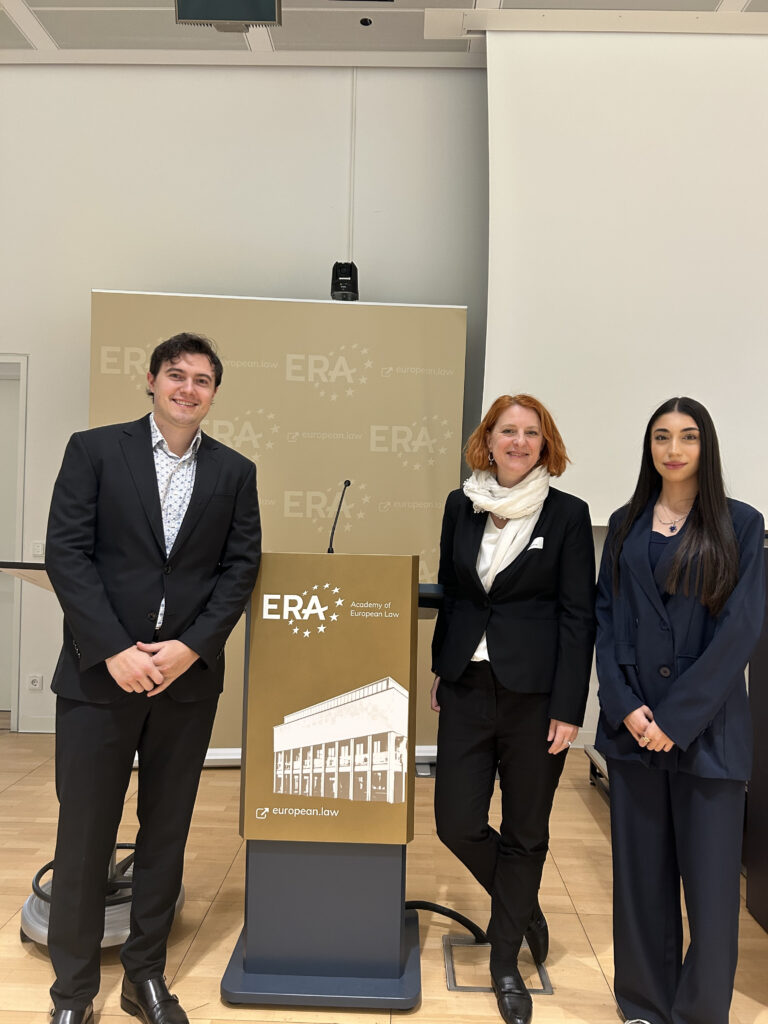
Alessandra De Lucia (LLB3) and Matteo Milroy (GELLB) are both students at the City Law School and back in October 2025 (23rd-24th) they attended a conference on EU Law in the Insurance Sector. They attended as many sessions as they could, and share them with us here:
As part of our HELKC module on co-production at City St. George’s, University of London, we had the chance to attend the ERA Annual Conference on EU Law in the Insurance Sector in Trier, Germany. Attending this event was a unique opportunity to engage directly with the individuals who shape EU insurance law in practice. Over the two days, the conference brought together influential voices from EIOPA, DG FISMA, Insurance Europe, law firms, and industry organisations. Listening to leading practitioners and policymakers gave us valuable insights into the rapidly changing regulatory environment governing the European insurance market and into how law responds to emerging challenges such as AI, sustainability, and consumer protection.
Contributing to the Conference: Co-Producing Case Law Analysis
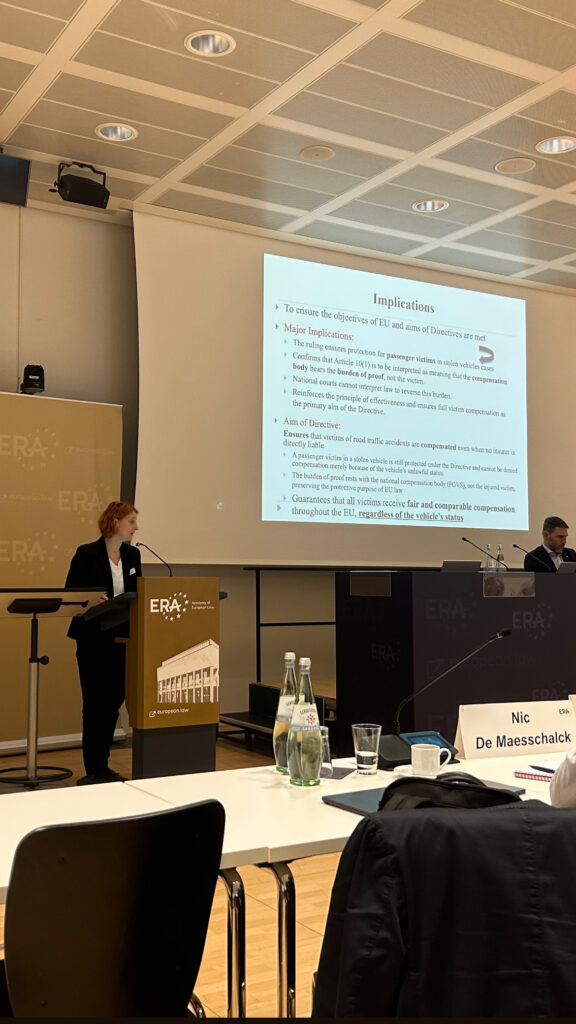
One of the most exciting aspects of our experience was contributing to the presentation delivered by our project leader, Dr Ana Keglevic Steffek. Her insightful presentation focused on recent CJEU case law affecting motor insurance, consumer protection, health insurance and legal expenses insurance. As part of the co-production project, we assisted Dr Keglevic Steffek in preparing two slides on different CJEU cases:
AT v CT (Nostolo) (C-370/24) addressed a motor insurance judgment concerning the burden of proof under Directive 2009/103/EC. The outcome ensures that victims of road traffic accidents involving stolen vehicles are compensated, even where no insurer is directly liable.
Compass Banca SpA v Autorità Garante della Concorrenza e del Mercato (C-646/22) addressed a recent judgment examining the limits of misleading and aggressive commercial practices under the Unfair Commercial Practices Directive (2005/29/EC). The Court reaffirmed the importance of clear pre-contractual information and affirmed national courts’ discretion to safeguard consumer choice.
The significant trends in recent CJEU decisions include the Court’s ongoing effort to fine-tune the balance between EU-level protection and national autonomy. The Court has ensured that victims are protected, contracts are interpreted effectively, and free movement principles are upheld. For us, this was a powerful practical example of co-production: working alongside a leading scholar, contributing to an academic presentation, and seeing our work used in a professional conference environment.
Key Insights from the Expert Presentations
The conference offered perspectives from regulators, intermediaries, policymakers, and academics. These discussions highlighted that insurance regulation is not just technical; it is political, economic, and deeply connected to consumer welfare.
Sustainability Reporting: CSRD, CS3D & ESRS
Speaker: Professor Karel Van Hulle
Professor Van Hulle explained that sustainability reporting in insurance has become overly complex, with overlapping frameworks such as CSRD, CS3D, ESRS, and SFDR. These frameworks have created confusion, high costs, and unrealistic expectations for insurers, especially SMEs. She argued that the EU is now moving towards simplification and alignment with international standards, while still trying to maintain credible climate transition plans and due diligence obligations.
Takeaway: Sustainability reporting is essential, but the current framework is overly complex and must be made more practical and proportionate.
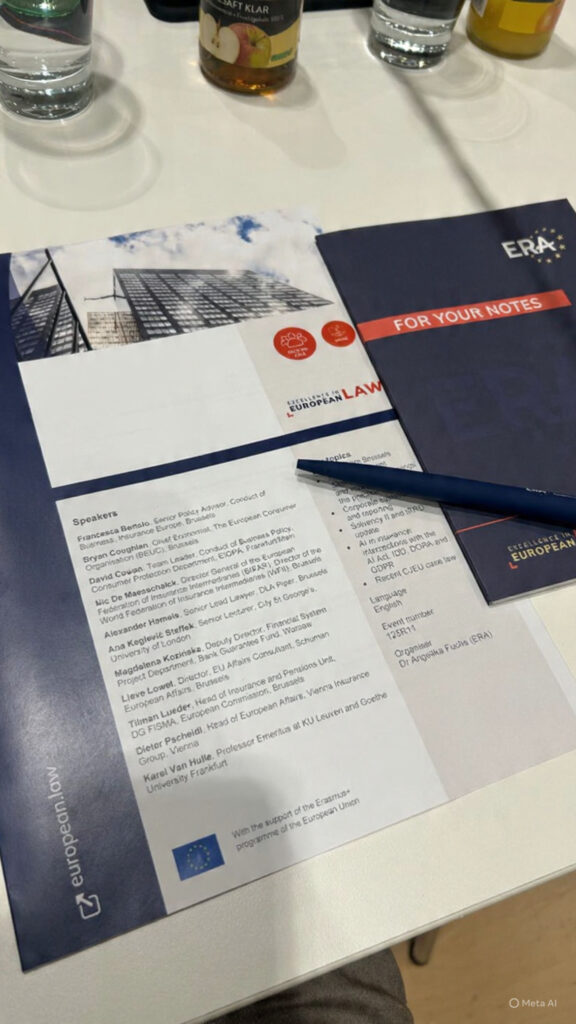
Solvency II Review: Amendments & Implementation Challenges
Speaker: Lieve Lowet
Lieve Lowet outlined the key amendments to the Solvency II Review, especially new proportionality categories, expanded group and cross-border supervision, and primary upcoming Level 2/3 technical standards. She stressed that the framework is becoming more complex, warning that tight deadlines, unclear concepts, and overlapping regimes pose serious implementation challenges for insurers, Member States, and supervisors alike.
Takeaway: Proportionate regulation can paradoxically create more operational complexity if concepts are unclear.
Insurance Recovery and Resolution Directive (IRRD)
Speaker: Magdalena Kozińska
Magdalena Kozińska explained the new EU Insurance Recovery and Resolution Directive, highlighting frequent insurer failures, fragmented national insolvency regimes, and a lack of cross-border coordination. She also outlined the practical challenges ahead, including national financing arrangements, complex group-level planning, and the need to build resolution capacity without relying on public funds.
Takeaway: Harmonisation is crucial, but success depends on Member States’ willingness to coordinate financing and supervisory powers.
Retail Investment Strategy (RIS) & Savings and Investment Union (SIU)
Speaker: Dieter Pscheidl
Dieter Pscheidl discussed Europe’s investment outlook, explaining that trillions sit in low-yield bank deposits and there are new aims to shift households into capital-market investments through tools like savings accounts, PEPP reform, and stricter IDD rules. He stressed that Europe needs better financial literacy, more straightforward product rules, and a more competitive, transparent framework to stop EU savings from flowing to US asset managers.
Takeaway: Citizens must be empowered through financial literacy and simpler product frameworks to shift from saving to investing.
Value for Money in Insurance Products

Speaker: Francesca Bertolo
Francesca Bertolo explained how EU regulators, especially EIOPA, are pushing value-for-money checks in unit-linked and IBIP products through benchmarks, stricter pricing processes, and enhanced product oversight. She stressed the need for a holistic, proportionate approach that respects insurers’ freedom to design products, avoids unnecessary reporting, and uses benchmarks mainly as supervisory tools rather than public metrics
Takeaway: Fair pricing should be encouraged through targeted supervisory action—not excessive, market-wide regulation.
Panel debate: Insurance Practice Meets RIS and SIU Challenges – Regulatory, Consumer, and Market Insights
Speakers: Nic De Maesschalck, Bryan Coughlan (online), Francesca Bertolo, and Dieter Pscheidl
The speakers highlighted how RIS and SIU face significant cultural and structural challenges: consumers are overprotected, reluctant to take risks, and often stuck in low-return products, while excessive, fragmented regulation makes innovation harder and undermines trust. The consensus was that Europe needs simpler, principle-based rules, stronger supervision of genuinely bad products, and a cultural shift toward long-term investment.
Takeaway: These experts agreed that Europe needs clearer rules and a mindset shift for people to feel comfortable taking investment risks. Policy must build confidence, otherwise savings will remain idle.
EU AI Act & Cross-Regulatory Implications
Speaker: Alexander Hamels
Alexander Hamels gave an overview of how the EU AI Act will reshape insurance, explaining the rise of AI across the value chain, the Act’s high-risk classification for life/health underwriting and pricing, and its interaction with GDPR, DORA, IDD, and Solvency II. He stressed that insurers must prepare stricter governance, transparency, and data-quality requirements, while recognising AI’s significant opportunities in underwriting, fraud detection, and claims automation.
Takeaway: AI can transform insurance operations, but trust and accountability remain essential.
Our Reflections as Students

Attending a professional conference of this calibre expanded our learning far beyond the classroom. We observed the tension between legal rules and economic pressures, the shaping role of EU institutions, the negotiation of interests among sector stakeholders, and the regulatory challenges posed by emerging technologies.
Beyond the substantive content, the conference also offered valuable networking opportunities, allowing us to speak directly with policymakers, academics, and industry practitioners. The conference gave us valuable insight into their work and helped us understand how our own research fits within broader conversations in the field. Most importantly, the experience made us feel part of a wider community of practice, rather than merely observers.
Conclusion
Our participation in the ERA Annual Conference was an invaluable extension of our HELKC module. It allowed us to see co-production in action, engage with leading experts, and contribute meaningfully to academic work presented on a European stage. The issues discussed from climate change to AI to consumer protection, touch on some of the most pressing challenges facing Europe today. For students who may not be familiar with insurance law, our message is simple: this field is far more dynamic, interconnected, and impactful than it appears from the outside.
We left Trier with a deeper understanding of the insurance sector, a stronger connection to our academic community, and a renewed sense of curiosity about the legal framework that shapes our society. We extend our sincere gratitude to Dr Ana Keglevic Steffek and to the HELKC project leaders, Professor Tamara Hervey and Professor Francesca Strumia, for affording us this opportunity and for supporting our engagement throughout the project. Their guidance made this an exceptionally positive and meaningful experience.