

Continuing on from coverage of the first ISEL event ‘On Autocracy, the rule of law and the EU’ , three LLB students report back on another ISEL seminar, this time a book talk. Take it away Mahnoor and Omar…
We recently attended an Autumn ISEL CLS seminar: Contemporary Trajectories of Direct Effect in EU Law: A Reappraisal by Professor Daniele Gallo at the Institute for the Study of European Law (ISEL) at City Law School, giving a talk on his new book.
The speaker
Daniele Gallo is Professor of EU Law at the Law Department of Luiss University and litigates before the Court of Justice.
The publication
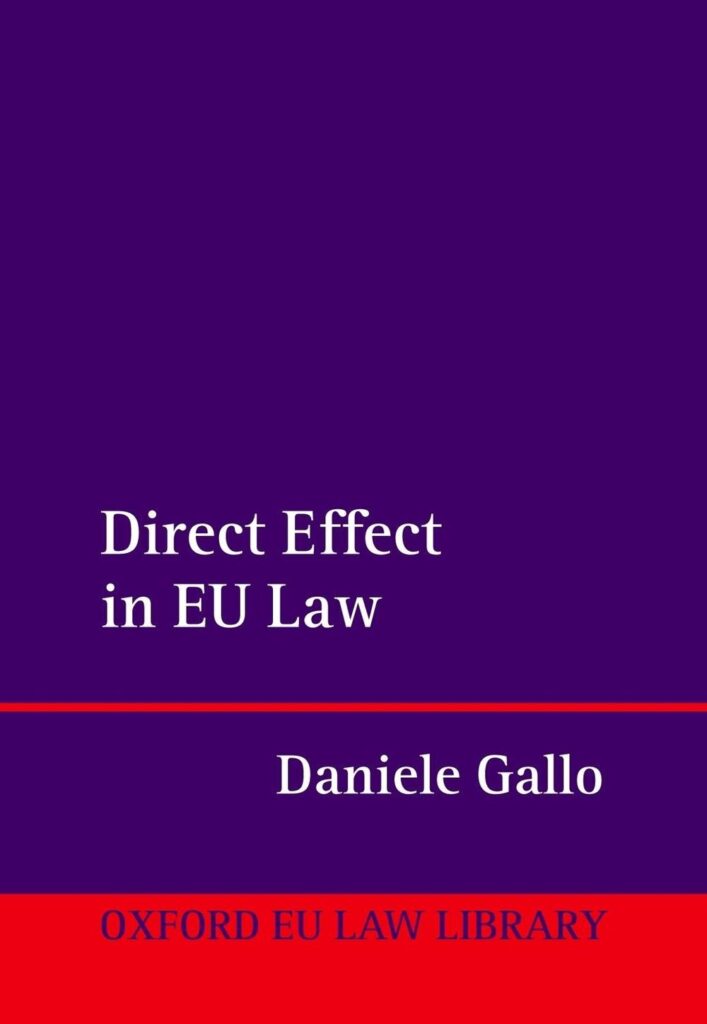
Direct Effect in EU law, published in 2025 by OUP, is a monograph outlining how a key doctrine of EU law has been overlooked and warrants rethinking. The book features case studies, theory and practice, and draws on 70 years of CJEU judgments from the 1950s to 2024.
The CLS event
Prof. Gallo delivered a comprehensive and riveting talk on Direct Effect in EU law (mentioned above). The event explored the doctrine of direct effect, one of the most important and evolving concepts in European Union law. Professor Gallo’s aim was to reflect on its past and future and to offer a fresh understanding of this principle through both practical and theoretical perspectives.
He began by explaining that direct effect has developed more dynamically than many realise. Instead, it continues to evolve to capture the shifting relationship between individuals, institutions, and markets. This adaptability, he argued, is what allows EU law to remain responsive to social and economic change.
Professor Gallo traced the roots of direct effect to its two essential components: rights and enforcement.
The rights element allows individuals to invoke EU provisions before national courts, while the enforcement element turns those individuals into active agents of EU law. Through this, private citizens and companies help ensure compliance with EU obligations, effectively spreading the rule of law throughout the member states.
He linked the origins of this doctrine to figures such as Alexander von Raben, who emphasised the role of private law and individual rights, and Robert Lecourt, who viewed direct effect as a means of ensuring compliance. The combination of these approaches, Gallo said, explains why direct effect has become so central to the European legal order.

Professor Gallo also discussed the judicial and constitutional consequences of the doctrine. When national judges disapply domestic legislation to uphold EU law, they inevitably engage with issues of separation of powers. This, he noted, demonstrates the tension between national sovereignty and the supremacy of EU law. Article 267 TFEU, which allows national courts to refer questions to the Court of Justice, gives the Luxembourg Court a form of centralised judicial review over national measures, extending its influence beyond interpretation into enforcement.
A key part of his argument concerned the traditional test for direct effect — that provisions must be “clear, precise and unconditional.” Gallo suggested that, in practice, the Court of Justice rarely applies these conditions consistently. Instead, the decisive factor has become unconditionality, which he viewed as absorbing the other two elements. If a provision is unconditional, he argued, it is necessarily clear and precise, and therefore directly applicable. This interpretation blurs the distinction between direct effect and direct applicability, suggesting that even directives can operate in ways similar to regulations.
Professor Gallo also highlighted what he called the “judicial minimalism” of the Court of Justice. While the Court plays an active role in shaping EU law, it often avoids detailed reasoning in its judgments. This approach, he said, can preserve flexibility but risks undermining legal certainty and legitimacy.
Following the lecture, two academic discussants joined the conversation. One reflected on how Professor Gallo’s ideas about reciprocal direct effect could apply to cases involving minority and religious rights, particularly in the context of workplace discrimination. They also raised the question of how this complex doctrine should be explained to students and future legal practitioners.
Another discussant connected the topic to data protection and surveillance, noting how direct effect empowers individuals to challenge practices such as data retention and passenger data transfer. They highlighted inconsistencies in case law and asked how judges might be encouraged to provide clearer reasoning in such sensitive areas.
In response, Professor Gallo acknowledged that judicial clarity remains a major challenge and agreed that many Charter provisions still need deeper analysis regarding their direct effect. He concluded that direct effect is not static but a continually developing principle that reveals much about the balance between EU and national authority.
Conclusion
Overall, the event offered a detailed and thought-provoking look at how a doctrine often treated as settled law continues to evolve. It was a reminder that direct effect is not only about enforceability but also about the structure of legal power in Europe. Gallo warns that judicial minimalism risks diluting the doctrine’s effectiveness and calls for more explicit reasoning when applying or disapplying national law. For students, the message is clear: understanding direct effect is key to mastering the structure and authority of EU law.
Thanks to Mahnoor and Omar Ahmed, who are both LLB2. They are part of a small team of students reflecting and reporting back on events, speakers and developments from ISEL, City’s Institute for the Study of European Law. You can find all content from the team by using the ISEL tag.