
I have always had a soft spot for Harriet Harman (Baroness Harriet Harman KC). Perhaps it began because a close friend of mine worked for her for years, or because once, during a meeting, I asked whether she wanted to be slightly more realistic about hosting a party in the Speaker’s House with Elton John. She looked at me, tapped the table, and said firmly, “No.” The party did happen — and Elton John did indeed perform — though I am still not sure whether in the end, the two events were connected.
My affection for her deepened further when, one day, I saw on Twitter in 2022 that her husband had died. In ten minutes, I was meant to have a Teams meeting scheduled with her. I felt an immediate sadness for someone I had always known as part of a very close partnership. Joan Didion captures this devastation perfectly in The Year of Magical Thinking, a book about the sudden death of her husband, John Dunne:
“Life changes in an instant. You sit down for dinner, and life as you know it ends.”
I remember wondering how Harriet would cope with a loss of that magnitude. My colleague and I sent flowers to her home, and I often asked after her well-being through my friend in her office.
Didion also wrote that “mourning has its place but also its limits.” Years have passed since I last had a professional interaction with Harriet Harman, and there I was at Lincoln’s Inn, watching Harriet approach me before the panel event on her review into bullying and harassment at the Bar — the Harman Report. She said I looked “vaguely familiar” and then immediately began discussing her report with my fiancé.
I knew how hard she still worked, even at 75 (and looking incredible for that age). She was uniquely placed to undertake this review: a senior lawyer, former acting leader of the Labour Party, Mother of the House, and a lifelong advocate for women and girls. Commissioned by the Bar Council, her report concludes that widespread bullying, discrimination, and harassment persist across the Bar of England and Wales. Reporting remains low. And for those who do speak out, Harriet identified two particular concerns: the risk of inadvertent professional consequences, and the absence of a clear mechanism to determine who knew what, and when.
The panel — Brie Stevens-Hoare KC (Gatehouse Chambers), Glenn Parsons (Park Square), Eve Robinson (36 Group), Rachel Krys for Barbara Mills KC, and Baroness Harman — discussed these issues frankly. Eve Robinson’s honesty was especially striking: she spoke openly about being sexually assaulted by a barrister when she was a pupil.
“Individuals continue to suffer when they shouldn’t, because the system hasn’t been changed sufficiently — and the institution’s reputation suffers irreparably,” Harriet began.
These behaviours damage not only individuals but also the standing of the profession. High-profile cases in the press only reinforce the need for reform. The Bar Council has already adopted recommendations — but the report is clear that Chambers, Inns, Circuit Leaders, and the Judiciary must also act.
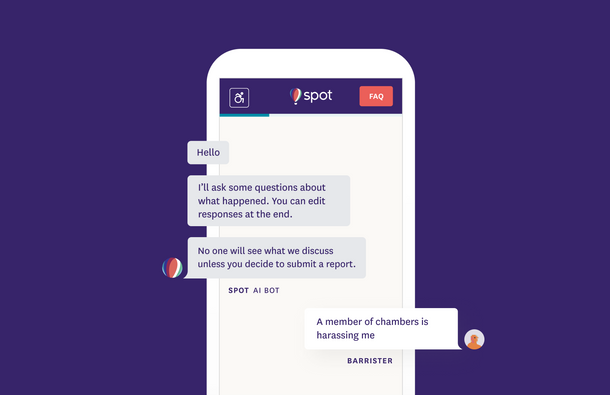
One of the most striking revelations for me was “Talk to Spot”: an excellent anonymous logging tool that everyone entering the profession should know about. It allows individuals to confidentially record inappropriate behaviour in real time, creating a reliable contemporaneous record. Harriet emphasised that it should replace the rumours on WhatsApp groups about avoiding particular judges or colleagues; instead, concerns should be captured formally on Spot so that patterns can be identified.
Two core issues emerged from the review: sexual harassment by senior barristers toward junior colleagues and bullying by members of the judiciary. The latter surprised me — not because bullying is new, but because its inclusion seems so complex and without a straightforward way to sort it. As a KC recently joked at a GDL event at City, “being shouted at by a Circuit Judge is a rite of passage.” Cultural change within the judiciary seems a tougher challenge than that at the Bar, and an issue which probably deserves its own detailed investigation.
Harriet observed that many of the Bar’s strengths — collegiality, a culture of nurturing junior colleagues, Chambers autonomy — are also its weaknesses when it comes to accountability. Reporting misconduct is difficult, and even when it happens, Chambers often lack clarity about how to handle grievances. The new Commissioner of Conduct, expected early next year, should help address this. Rachel Krys confirmed that the Commissioner will support individuals, Chambers, and those running Chambers, complementing the Bar Council’s existing work on bullying and harassment. It is intended to serve a role similar to the Parliamentary Standards Commissioner — something Harriet understands intimately from spending such a long time in Parliament.
One criticism I have, however, is that the panel tended to frame sexual misconduct primarily as male-on-female. My own experience, including during my time in Parliament, is that inappropriate behaviour can arise across genders and sexual orientations. Women can be perpetrators, and misconduct within LGBTQ+ contexts can pose unique challenges that often go unspoken. A broader acknowledgement of this would strengthen the report.
The event ended on a slightly unexpected note: Harriet Harman explaining who pupils may and may not have sex with. Although amusing in delivery, it related to a key recommendation — that sexual relationships between barristers and their pupils constitute professional misconduct due to concerns about influence over tenancy. I remained unsure whether this applied across Chambers or only within the same set, but Harriet did helpfully clarify that pupils may have sex with one another. Thank God.
It was, in the end, a sobering but hopeful discussion: an honest examination of the Bar’s cultural failings combined with practical steps toward a more accountable and safer profession for future generations. Harriet Harman is once again making a difference to women and young people, just like she always has.