
Twenty five years ago, the Freedom of Information Bill was introduced to Parliament. At its second reading in the House of Lords, Lord Falconer declared: “Everyone will benefit from this Bill. It will deliver a more responsive, better informed and accountable public service.” A decade later, Tony Blair, whose government introduced FOI, wrote in his memoirs:
“You idiot. You naïve, foolish, irresponsible nincompoop…I quake at the imbecility of it.”
Successive governments have concurred with Blair – David Cameron once referred to FOI as a “truly malign piece of legislation”, while the current Labour administration has done little to celebrate its 25th anniversary either. Last year, the government responded to only 29% of FOI requests in full – the lowest rate ever recorded.
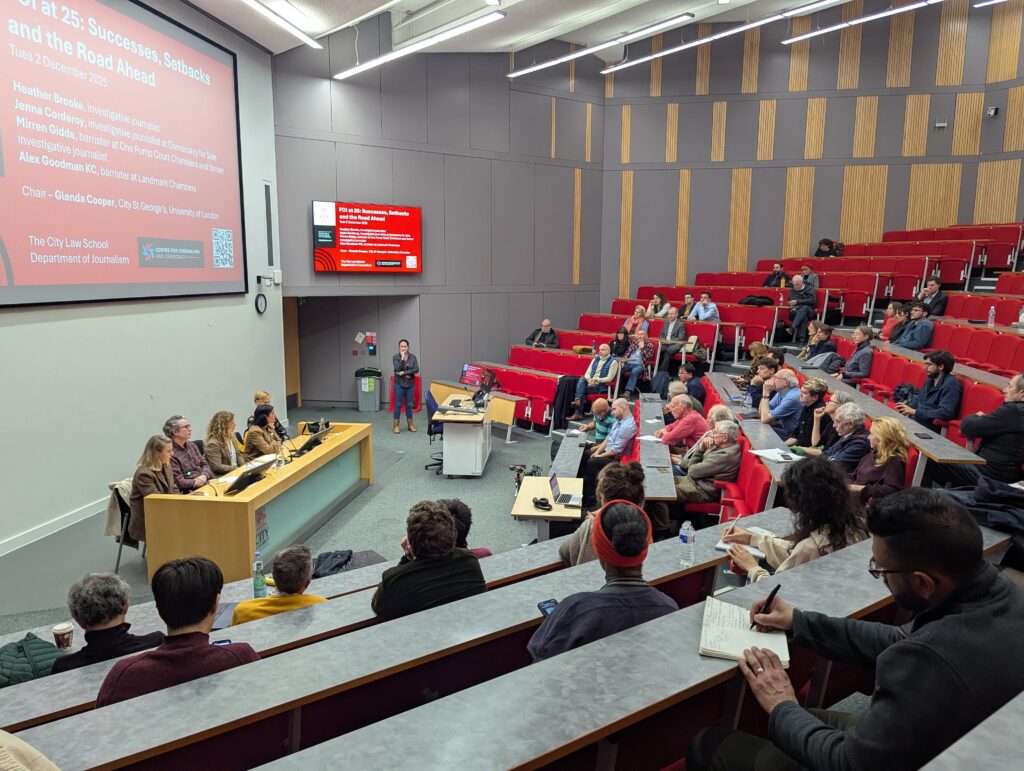
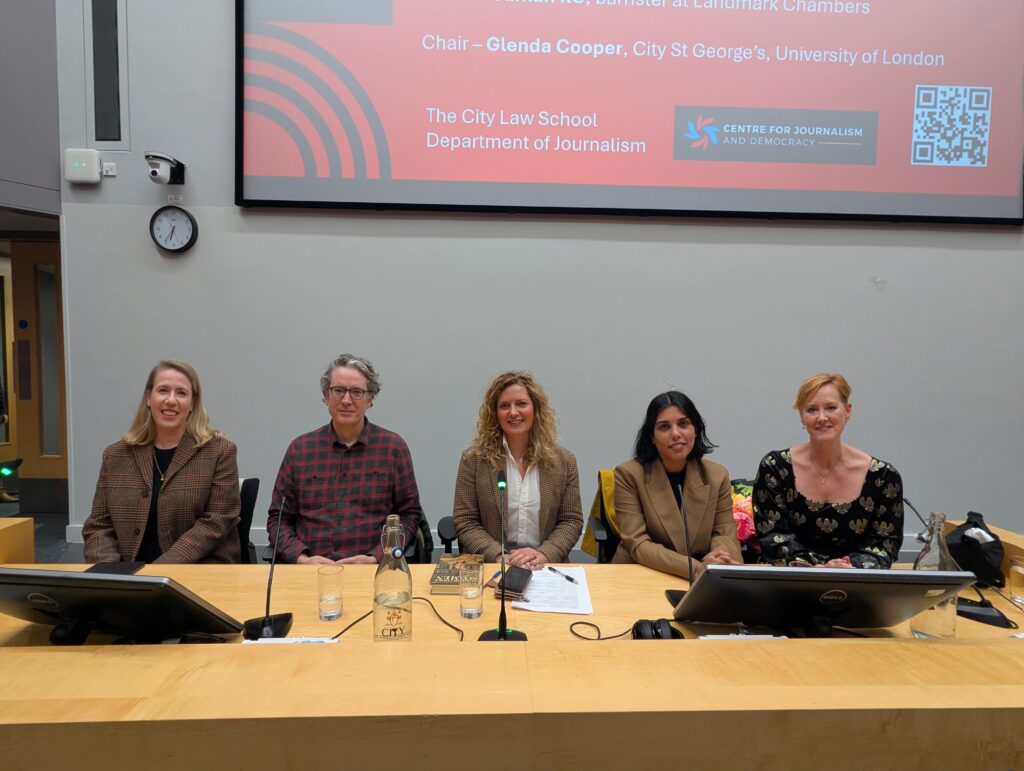
If celebrations of FOI could not be found in Westminster and Whitehall, they could be found instead at City University on 2nd December. The Law School and the Department of Journalism gathered an excellent panel featuring investigative journalists Heather Brooke and Jenna Corderoy, journalist-turned-barrister Mirren Gidda, and Alex Goodman KC to reflect on FOI’s achievements, challenges, and its future.
The panel demonstrated the value of collaboration between journalists and lawyers. Lawyers bring technical precision and expertise; journalists provide persistence, public interest framing, and zeal to challenge official narratives. Used well, FOI is a potent tool for democratic accountability and the rule of law.
By creating a legal right for citizens to request information from public authorities, FOI requests have exposed discriminatory stop-and-search practices in the Metropolitan Police, disparities in the administration of Covid fines, and systemic failures within asylum accommodation. Brooke herself broke the story of the Parliamentary expenses scandal, which took her to the information tribunal and later the High Court where she ultimately won, forcing the House of Commons to publish all MPs’ receipts in October 2008.
Yet the panel was equally clear about FOI’s fragility; government recalcitrance and chronic under-resourcing threatens to hollow out the Act, just as requests reach record levels.
Brooke likened FOI to a “canary in the coalmine”, exposing where power in the UK is distributed. Having trained as a journalist in the US, Brooke was shocked by the disparity of information accessibility across the Atlantic. In America, one could merely walk into a public building and look through the files, whereas in the UK opacity was entrenched across all tiers of government. FOI, Brooke argued, reversed this trend: “It treats the individual as a citizen, not a subject”, and is a powerful corrective to “feudal presumptions” of state superiority.
Mirren Gidda, whose careers as an investigative journalist at Liberty and human rights barrister, have relied heavily on FOI. She described it as a “tool of last resort” when public authorities stonewall requests. Even then, poorly drafted FOIs can be narrowly interpreted by public authorities to escape liability, as when the Home Office under-reported asylum seeker deaths by narrowing its definition to deaths which occurred within one specific accommodation centre. A successful FOI hinges on extremely precise wording which can cut through bureaucratic tendencies towards obfuscation.
Alex Goodman KC situated FOI within a broader constitutional tradition. Secrecy, he argued, is antithetical to a constitutional state and the rule of law. Goodman would know, having helped draft the constitution of Myanmar, whose former charter was written in secret by the previous military regime in 2008.
Goodman has acted in numerous cases where FOI exposed misconduct in public office, including the Welsh government’s undisclosed meetings with car manufacturers who lobbied to delay the roll-out of electric vehicles. ‘R (Lumba) [2011] UKSC’, revealed “pens down” meetings at the upper echelons of the Home Office, where unpublished and illegal detention policies were routine. This case established that a breach of public law renders a detention unlawful, even if the individual would have been detained by a lawful operation of the power. This is what Blair lamented in his memoirs; not the fear of state secrets being revealed, but public knowledge that the government had acted unlawfully.
Jenna Corderoy first encountered FOI as a journalism student at City in 2012, and has used it to great effect in her work since. Yet she lamented that the Act has barely evolved since its inception, failing to adapt to a changed legal and political landscape. Public services have increasingly been outsourced to private contractors, and these bodies are beyond the reach of FOI. Governments have grown increasingly hostile to the process: the Cabinet Office maintains a ‘Clearing House’ specifically dedicated to blocking freedom of information requests, while the previous government spent £1m on lawyers for information tribunals in 2023 alone. The Information Commissioner’s Office (ICO), responsible for enforcing compliance, is chronically under‑resourced, leaving requesters trapped in limbo when public authorities simply ignore FOIs with impunity.

The panel also explored what the next 25 years of FOI should look like. Expanding the Act’s scope was a common theme. In 2010, the Constitutional Reform and Governance Act quietly introduced an exemption shielding the Royal Family from FOI requests. Given the monarchy’s substantial public expenditure and the fact that certain members have not covered themselves in glory recently, the panel argued that scrapping this exemption would be firmly within the public interest.
More robust enforcement mechanisms were suggested for non-compliant departments, including fines, sanctions, or “name-and-shame” league tables ranking authorities by transparency performance. A new research area was proposed – is there correlation between poor FOI compliance and misuse of public funds?
The panel concluded by recognising that public law barristers and investigative journalists are more likely to celebrate FOI than those in government. How then, can public authorities be made to think that FOIs are not just an administrative burden, but are beneficial to them? Cultural change must come from the top of the Cabinet Office, to advance the case that transparent government makes for more effective government.
Freedom of Information, if it is to endure, should be perceived as more than just a tool for muckraking or political point scoring. It should be seen as a fundamental to our constitutional settlement. Lord Steyn argued in R (Anufrijeva) [2003] UKHL 36 that transparency was integral to the rule of law:
“[The rule of law] requires that a constitutional state must accord to individuals the right to know of a decision before their rights can be adversely affected. The antithesis of such a state was described by Kafka…That is not our system.”
Even though FOI is only 25 years old, it should not be taken for granted. Without it, government could easily become opaque once again, and we would all be the worse for it.
Thanks to Joey Ricciardiello for this excellent review (you can read one from City’s Press Team if interested too). The late posting is entirely the editor’s fault! Joey is currently studying the Graduate Diploma in Law and is a member of the Lawbore Journalist Team 2025-26. He is an aspiring barrister interested in the criminal and public Bar. Previously, he worked in the House of Commons as a researcher/speechwriter for an MP. He graduated from New College, Oxford with BA (Hons) in History, followed by an MSt in 18thCentury British and European History.