

Ammnah Ahmed delivers us a review of Daniel Finkelstein’s Gresham lecture “Minor criminal: The trial of the man who murdered my grandmother”.
On the night of 4th November, a diverse audience at Barnard’s Inn Hall had the privilege of hearing Lord Finkelstein’s lecture on the Belsen trial. This talk gave a detailed insight into what he would describe as one of the most important trials of the 20th century, combining retelling with legal reflection and historical perception. Finkelstein’s aim was to shed light on the “worst crime committed”, ensuring that it is not overlooked and remains an unforgettable chapter in history.
The talk forms part of Gresham College’s long-standing tradition of public education, since 1957, where speakers turn complex ideas into accessible lecture for a wider audience. This lecture was delivered as a part of the Royal Historical Society’s Colin Matthew Memorial series, with Matthew’s family members in attendance. Many attendees arrived already aware of Lord Finkelstein’s reputation as a British journalist, author, former executive editor of The Times, and advisor to Prime Minister John Major and expected a blend of biography, law, history, and emotional depth. The story of Belsen holds resonance with Lord Finkelstein, as among many imprisoned and starved were his mother and grandmother, with only his mother surviving.
Finkelstein opens his lecture by allowing the audience to be introduced to his grandmother “Greta” not just as a victim or mere figure on a gruesome death toll, but describing her as woman sculpted by love, strength and resilience. He guides the audience through the legal arrest, evidence building, and the trial of the man charged with Greta’s death.
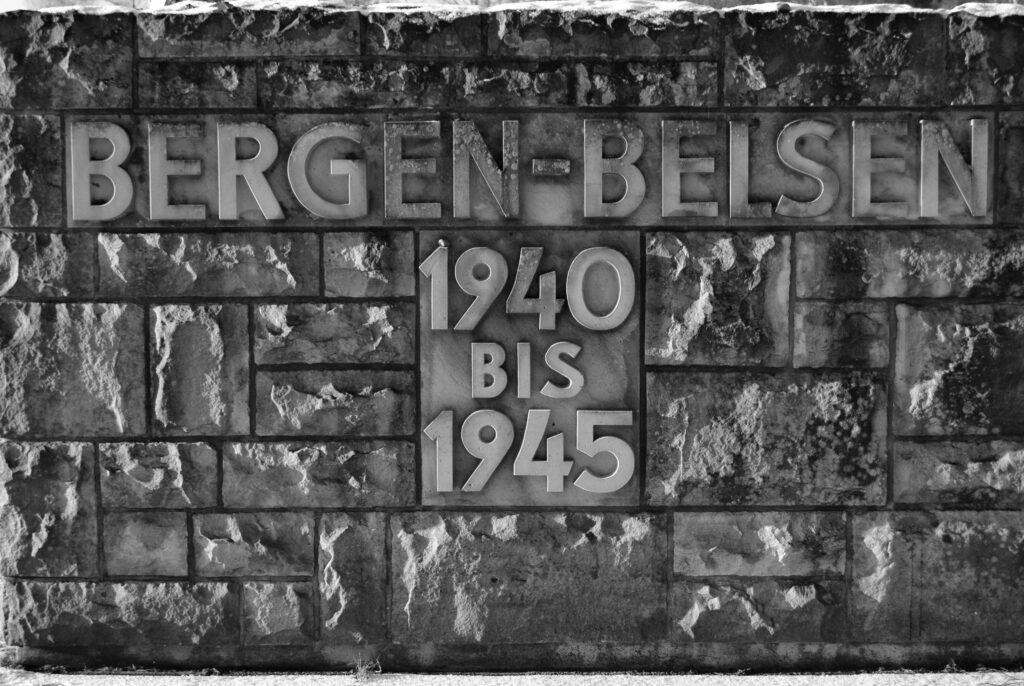
Finkelstein devotes a portion of the lecture to describe the horrific conditions of Belsen, which is crucial in understanding his grandmother’s fate and the trial itself. He makes it clear that Belsen existed as two camps; first the “holding camp” meant for prisoner exchanges, then in late 1944 it transitioned into the “death camp” as prisoners were evacuated from collapsing camps. The sudden increase in “newcomers” resulted in an entire collapse. Distribution of rations decreased, water became contaminated, sanitation failed so much that disease, starvation, and dehydration were unavoidable. Medical care became non-existent, corpses were stacked and unattended, and rooms meant to hold twelve, held hundreds. In these circumstances, established by cruelty, neglect and starvation, Finkelstein’s grandmother yielded.

When examining this environment, through photographs, statements, medical reports, court documents, and maps, Finkelstein shows the conditions of the camps were not simply background to a tragedy but vital to the core of the trial. He demonstrates how the conditions of the camps were deliberately imposed or created by those in position of power/authority, and how those conditions create an evidential basis for allocating responsibility. Each shred of evidence was proof, showing the defendant’s role directly contributing to the deadly environment. Finkelstein highlights that while the defendant was held to have committed what the law would regard as a “minor” offence, his conduct carried moral weight far beyond the label given by the courts.
Finkelstein concludes with a Q&A, allowing the audience to explore and clarify themes of intergenerational justice, survivor trauma, and courtroom truth. Finkelstein responded frankly, creating an atmosphere of openness and reflection.
Daniel Finkelstein’s lecture was a deeply moving contribution to the Gresham College series. It was a great blend of legal examination and personal narration. The audience maintained focus and emotional engagement throughout the duration of this lecture, with their questions reflecting the willingness to understand not only the trial but the broader implications of historical justice. Though at time the lecture was emotionally heavy, it was enlightening and powerful, it was an important event for those interested in law, ethics, or the preservation of historical truth. If I’ve tempted you to watch the lecture, you can view it in full on the Gresham College website.

Ammnah Ahmed is a second-year LLB student with a strong interest in criminal and human rights law. As a member of the 2025-26 Lawbore Journalist Team, she is also drawn to legal journalism as a way of translating key legal topics into engaging narratives that inform and inspire the public. Outside of university, she has a deep appreciation for cinema and classical literature, and enjoys expressing herself through writing. Here are her plans for the future:
I envision myself as a respected barrister in a field I am passionate about, dedicated to ensuring access to justice for those in need. I also hope to continue learning and growing, developing a deeper understanding of the ever-changing world around me.