
LLB3 student Charlotte Pauletto, is a Higher Education Legal Knowledge Coproduction intern this year for the Institute for the Study of European Law (ISEL). Here she provides a summary of publishing activities within ISEL this year.
ISEL researchers are the authors of leading research and they actively contribute to excellent scholarship, practice, government and professional activities by making high-level contributions as to the legal, political and economic development of the EU and the relationship of the UK with the EU.
Let’s put the spotlight on some of their most recent academic contributions.
Maria Kendrick, Differentiated Integration in the EU: Harmonising EU Tax Law (Edward Elgar Publishing, 2025)
“In a moment in which the multiple crises urge the European Union to evolve, steeply increasing its budgetary autonomy, this book provides a timely legal analysis of the harmonisation of EU taxation, focussing on its constitutional entrenchments with differentiated integration.”
Nicola Lupo, LUISS Guido Carli University, Italy
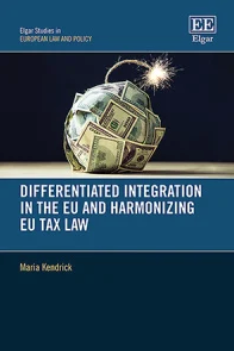
As the EU faces financial pressures and the need to fund its long-term goals, including debt repayment, the book takes a timely look at the potential of EU tax law for raising revenue more effectively.
In the past, attempts to harmonise EU tax law have raised questions of State sovereignty and the Union’s competence in the matter. Maria Kendrick’s work suggests clarifying the concept of differentiated integration and also to reinterpret some of its legal framework to make both concepts more accessible and practically useful. It explains how the EU could move past the problem of requiring every Member State to agree on tax decisions by making the most of the concept of flexibility. This could help the EU introduce tax measures to raise funds and repay shared debt more effectively. The pressures of the financial crisis and the need for revenue should push the EU into rethinking how tax cooperation works and make the EU less dependent on Member states’ national budgets.
This work is essential reading for scholars, policymakers, and practitioners working the balance between the intersection of EU law, tax law, fiscal policies, and the European Union’s own resources.
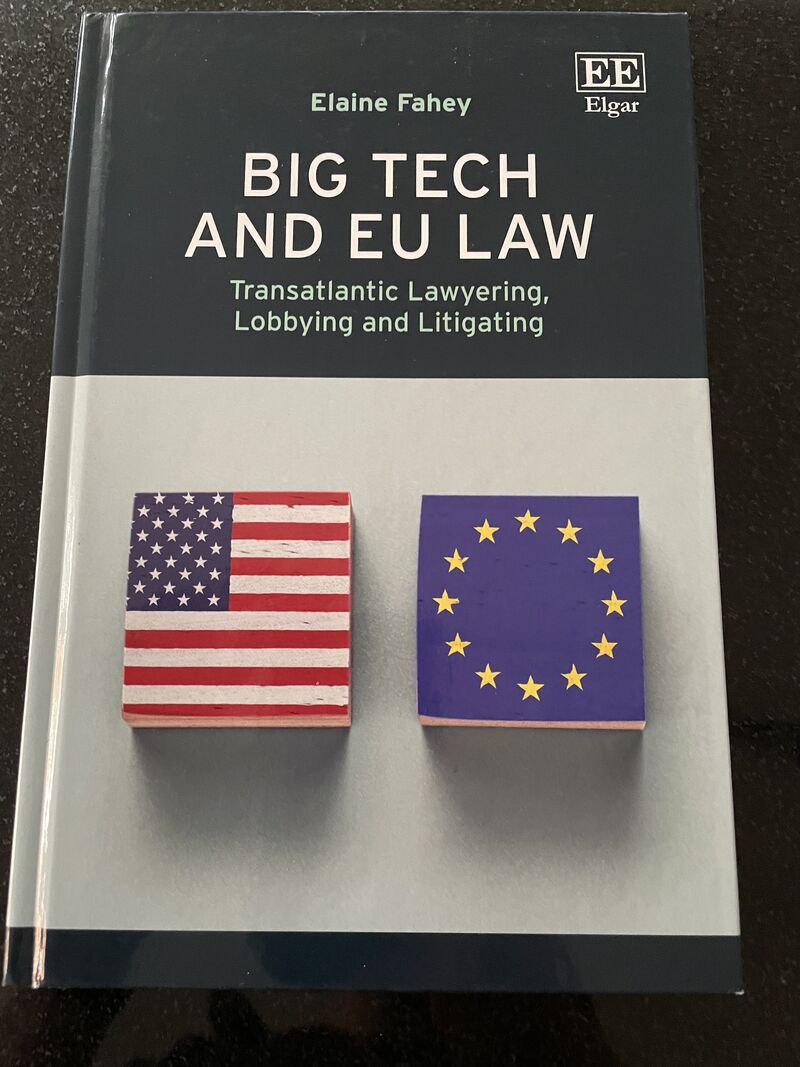
Elaine Fahey, Big Tech and EU Law (Edward Elgar Publishing, 2025)
“Elaine Fahey has taken on a timely and understudied dimension of transatlantic relations – the interaction of US Big Tech with European Union law. As the Trump Administration prepares to push back against iconic EU digital legislation including the Digital Markets Act, Digital Services Act, and General Data Protection Regulation, this study of the intricate dynamics between Brussels and Washington over tech law and policy will stand as a valuable primer.”
Kenneth Propp, Georgetown University Law Center, USA
The work offers a convincing analysis of how Big Tech companies engage with and profit from EU law within the transatlantic legal framework. Professor Elaine Fahey examines how digital platforms use top-down and bottom-up approaches to lobby, litigate, and shape global standards in an attempt to exploit legislation to their advantage.
Using detailed case studies, the book covers key areas of EU law such as data transfer, data protection, intermediary liability, and competition law. It critically explores Big Tech’s direct interactions with consumers and its complex relationship with the Union early lead in global digital regulations. Fahey emphasises how data moves across borders and analyses Big Tech’s efforts to use this to their advantage. The book shows why it is important to look at Big Tech’s legal challenges from a broad, global perspective.
Professor Elaine Fahey demonstrates how data and technology inherently don’t stop at national borders, and urges for a holistic understanding of legal and policy challenges caused by Big Tech. The work is a valuable read for students, scholars and anyone curious in EU law, international digital policy, and the growing EU–US digital relationship.
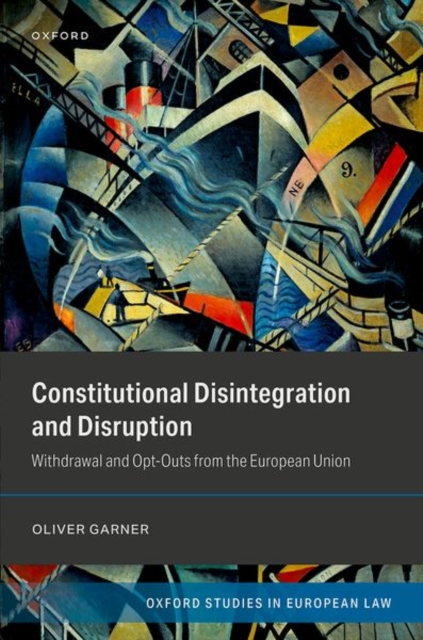
Oliver Garner, Constitutional Disintegration and Disruption : Withdrawal and Opt-Outs from the European Union (Oxford University Press, 2025)
“This book raises important issues concerning the EU and the way in which it functions. It will be of interest to lawyers and political scientists alike.”
Paul Craig
This book offers an exceptional exploration of two defining processes in the evolution of the EU’s constitutional order : European disintegration and disruption. European disintegration is clearly evidenced by the United Kingdom’s withdrawal from the European Union in 2020. This withdrawal was only the result of decades of disruption, during which the United Kingdom, Ireland, and Denmark, negotiated for opt-outs from the European framework.
The work looks into the European Union as a structured order where individuals occupy two roles at once : nationals of a Member state, and citizens of the Union. Through this dual identity, individuals act as both democratic subjects and juridical objects of EU law. The author argues that EU Treaties institutionalise a ‘triptych’ for the exercise of ‘constituted constituent power’ : Article 49 TEU allows accession, Article 48 TEU enables amendment, and Article 50 TEU provides a legal mechanism for the repatriation of power through withdrawal.
Opt-outs are described as exceptions in the framework to allow certain member states to stay in the Union while avoiding full participation in certain areas; this is formalised by Treaty Protocols. On the other hand, the withdrawal clause is an inherent legal right for Member States to leave the Union, governed by a supranational framework which aims to protect both national and EU interests.
With detailed historical and doctrinal analysis, the work highlights how these mechanisms of exception have shaped the European Union’s constitutional development. It offers a balanced critique of their bigger implications for individuals’s democratic participation and legal identity within the Union. Ultimately, the book concludes by advocating for Treaty reforms that would allow EU citizens to use a stronger voice and give a clearer role in shaping the Union’s future.
Whether you are interested in tax law and fiscal policy, data transfers and EU–US digital relationship, or European Union’s constitutional development, the researchers at ISEL have what you need. However, this piece just details recent publications. Whatever your area of interest may be, you’ll find high-quality, insightful work that speaks to it within the Institute over many years.