

The Willem C. Vis International Commercial Arbitration Moot is the world’s largest and most prestigious mooting event in the field of international commercial law. It is held annually in Vienna, Austria. In 2025-2026, 390 teams, over 2,500 students, and over 1,000 arbitrators from across the world participated in the moot. The 2025-26 City Vis team was made up of 4 GDL students: Imogen Cheney, Jack Cobb, Anna Herzog, and Sabina Kyprios. They were coached by two BVS students, Kerem Mumyakmaz and Henry Tann, under the supervision of Dr Frank Zhang. Here, Anna Herzog gives us her take on how it all unfolded…
Vis? SIAC? CISG? If these strings of letters mean nothing to you, that’s exactly how the City Law School Vis Moot team felt in October 2025. For four team-members who had only started the GDL a few weeks earlier, the prospect of diving into the world of international commercial arbitration – something firmly outside the already dense GDL syllabus – was certainly a daunting one. But, in hindsight, we have all agreed that representing City Law School in the Willem C Vis International Commercial Arbitration Moot in Vienna was the highlight of our time on the GDL.
Our journey to Vienna started with a straightforward application process to join the Vis Moot team: a brief written submission on one of the four issues of the moot problem, and then an interview defending those written submissions in front of a mock arbitration panel. The fact that the four of us who made the team knew absolutely no law at the point of applying was clearly not a barrier to entry; the panel, comprised of our coaches, Kerem and Henry, and Dr Frank Zhang, were looking for reasoning, presentation and teamwork skills.
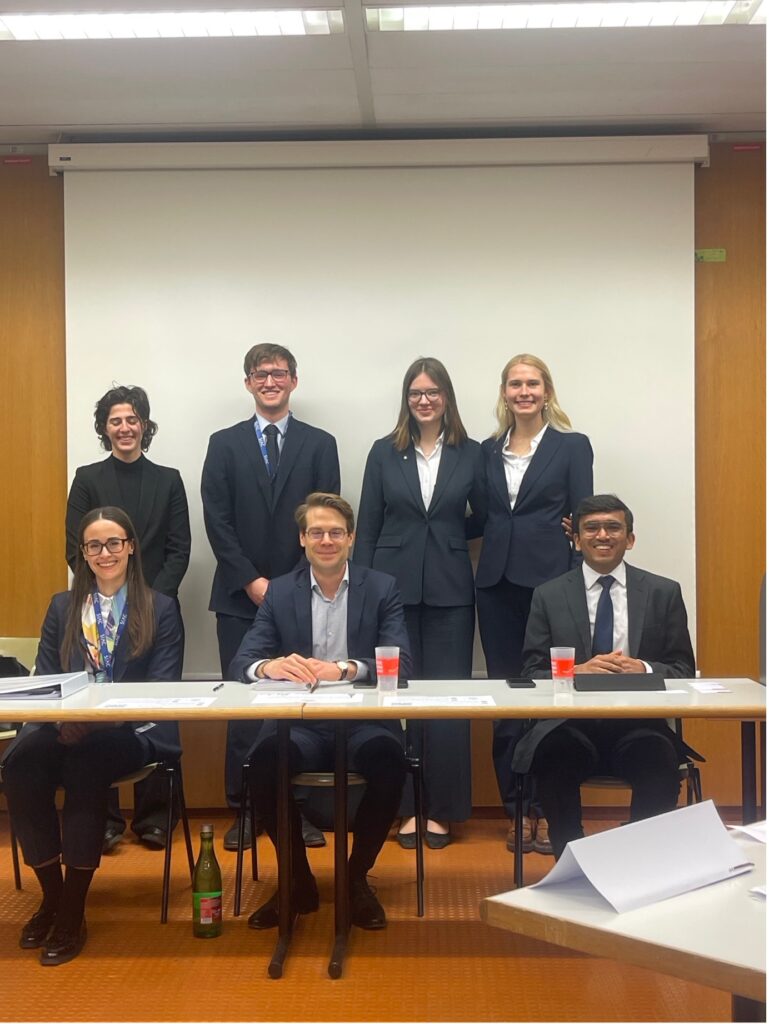
Each year, the Vis Moot problem is split into procedural (how should the tribunal run this arbitration?) and merits (did someone breach this contract?) elements. Once we had split into sub-teams focusing on each of these elements, our coaches, who had represented City at the Vis the previous year, provided a valuable crash course in what arbitration actually is and what textbooks might be useful for our research.
Our first deadline was the Claimant Memorandum, a thirty-page written submission due in early December. This was the most challenging part of participating in the Vis but we were well-supported by Kerem and Henry, who provided helpful feedback on early drafts and gave us examples of what had worked well for them last year. Once the Claimant Memo was submitted, we had a week’s breathing room before we received another team’s submission and had to produce another thirty-page Respondent Memo contradicting all our original arguments.
Producing this, on top of GDL coursework and pupillage applications, over the Christmas break was certainly intense, but it was interesting to see how the other team had approached the problem differently, and amusing to come up with withering take-downs of their arguments.
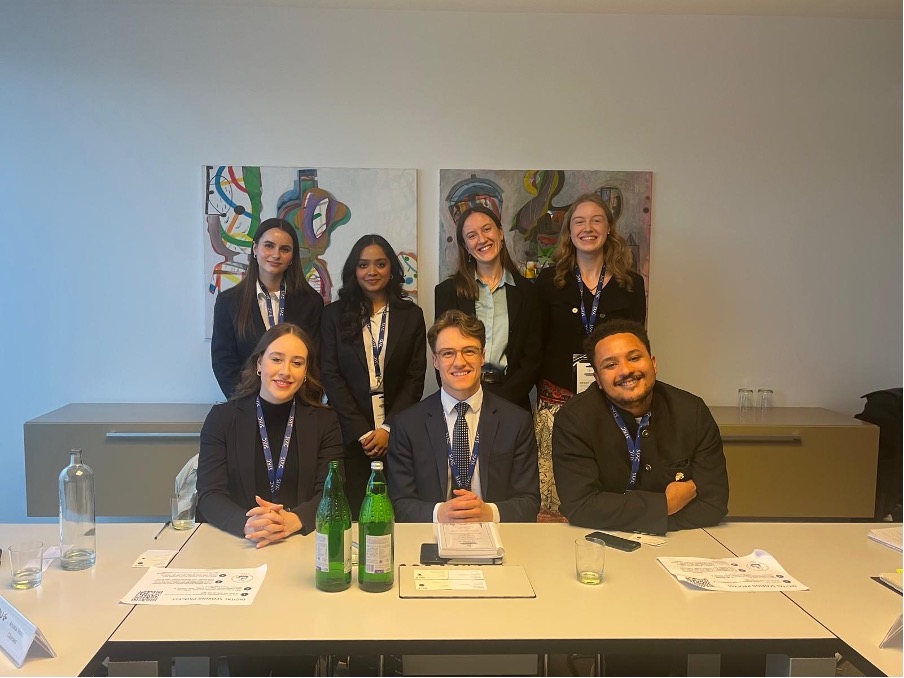
Immy and Anna, oralists from the University of Southern Denmark, and the Arbitral Tribunal
Once the Respondent Memorandum was submitted, we quickly pivoted into oral submissions, pairing off into two teams with one person covering all the procedural elements, and the other addressing merits. Our first friendly pre-moot against UCL was a bit of a shock to the system, but it was useful to get constructive feedback from the coaches, and observe how our opponents presented and prioritised their arguments. While 15 minutes per submission originally sounded like a horrifically long time, we quickly learned just how much of that gets eaten into by tricky questions from the arbitral tribunal, and how important it was to have a moot partner passing you passive aggressive sticky-notes to keep you on track. Sabina emerged victorious as the best oralist against UCL, while Jack took home the best oralist prize at the White & Case pre-moot, where we faced teams from Spain as well as across the UK. As well as being invaluable for honing our arguments and developing our advocacy skills, the pre-moots served as a good opportunity to get to know other teams who we would encounter in Vienna.
Nothing could have prepared us for the scale of the event in Vienna itself. Arriving at the Vienna Law School building on the first day of the oral rounds, we were met by a sea of SIAC lanyards and mooties (yes, this is a real term that people use) rehearsing submissions in every corner. Our first round against the University of Osnabruk saw Jack described by the presiding arbitrator as ‘very, very cool’, while the tribunal in the second round were impressed with the clarity of Sabina’s submissions. Passing the mantle to Immy and Anna in rounds three and four, this duo were praised for their ‘executive’ and ‘earnest’ advocacy styles respectively. We learned a lot from watching each other moot, seeing what worked and what didn’t, and devising new work-arounds to tricky interventions from the tribunal. It was an added bonus that Frank could join us for the first two days, to provide additional feedback on our submissions and pointers for how to improve. While we did not progress to the elimination rounds, we were all extremely proud of the performances we had put out in the oral rounds, which represented the culmination of six months of hard work.
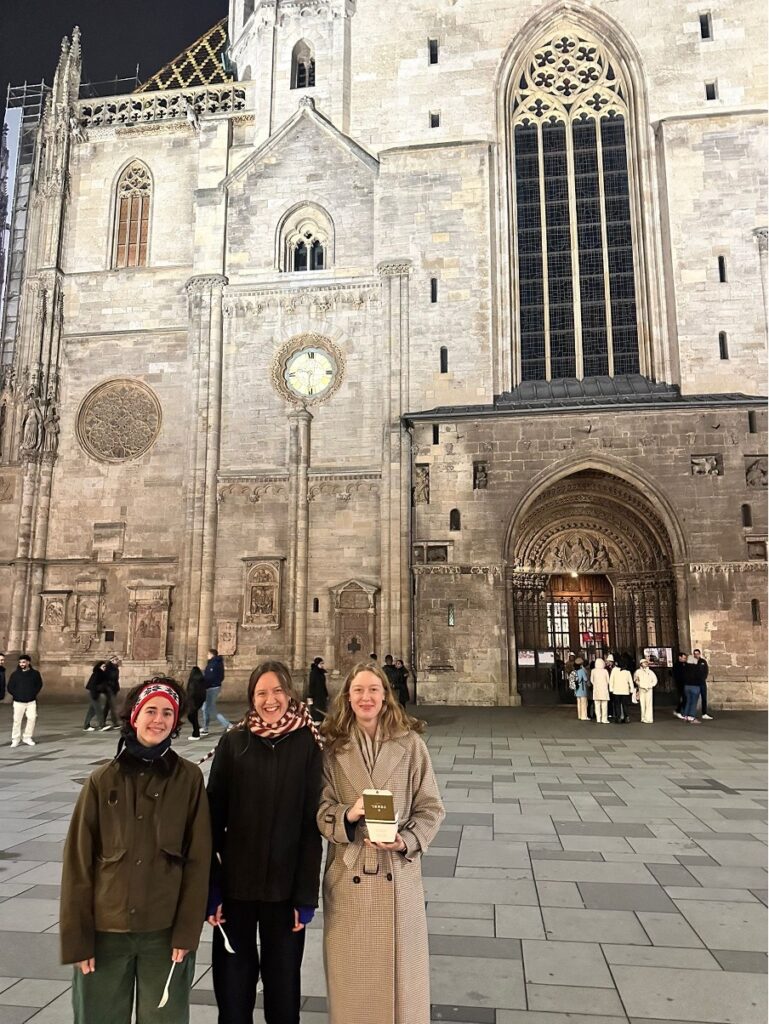
Getting knocked out of the competition also gave us the opportunity to explore Vienna. Immy’s impeccable German and long list of local recommendations helped us make the most of the city, including several (nightly) trips to the Kaiserschmarnn stand next to St Stephen’s Cathedral.
Overall, participating in the Vis Moot was an outstanding experience, which we would recommend to anyone joining City Law School in September. Focusing on one moot problem over several months was a pleasant counterpoint to the relentless pace of the GDL course where you are constantly turning to something new. In addition, the pre-moots and oral rounds provided a valuable opportunity to develop our oral advocacy skills and receive feedback from arbitration practitioners at the Bar. We are extremely grateful to Kerem, Henry and Frank for supporting us throughout the Vis process, and to the administrative team at City for arranging our time in Vienna. Be sure to keep an eye on Moodle in September for applications for the 2026/27 team…