
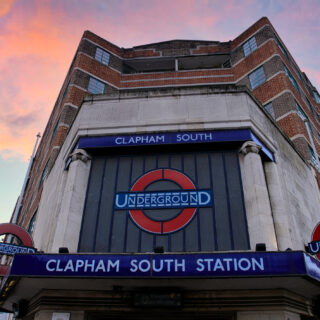
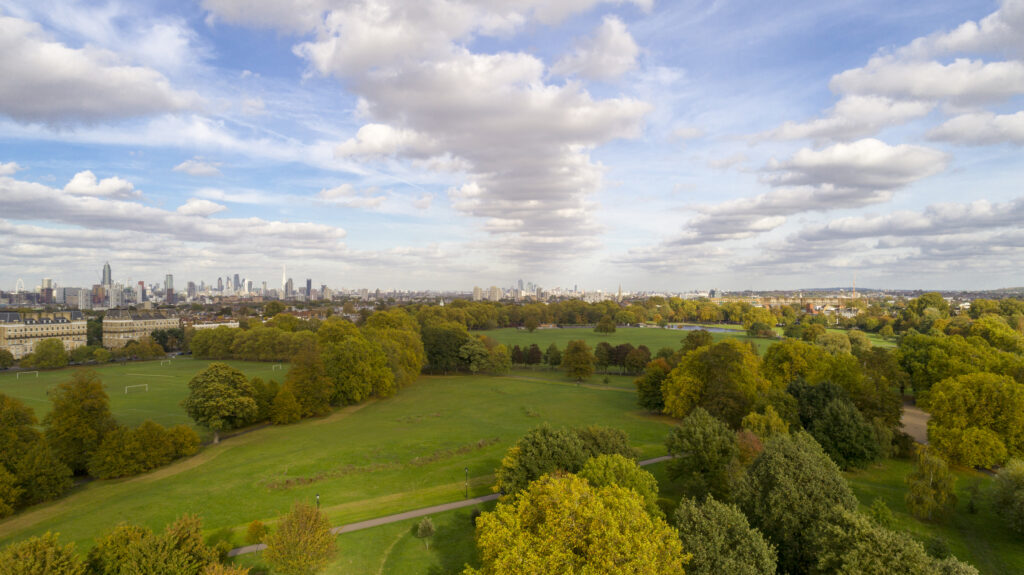
Clapham is a nice place to live. I’m in a position to comment because I live there. It’s a leafy, comfortable, almost suburban feeling district that nonetheless juts into the centre of London: it’s all in Zone 2 and would only take you about an hour to walk to the West End from Clapham Common. In the cultural imaginary of modern London it’s known for a few things: being the heart of London’s Aussie community, home to one of the largest and most pleasant areas of common land in the city, a veritable Mecca for fans of Avocado toast and run clubs, and of course home to the cultural bastion Infernos, Margot Robbie’s favourite nightclub.
However, for those more legally minded, Clapham has its own particular resonances. The foremost among these concerns its transport system. Originating in the late nineteenth century dicta of Lord Bowen, the ‘man on the Clapham Omnibus’ has been the most memorable and significant character created by the English courts. Clapham’s commuter has been the quintessential version of the hypothetical ‘reasonable person’. Take the witty opening paragraph of Lord Reed’s judgment in Healthcare at Home Ltd v The Common Services Agency [2014] UKSC 49:
“The Clapham omnibus has many passengers. The most venerable is the reasonable man, who was born during the reign of Victoria but remains in vigorous health. Amongst the other passengers are the right-thinking member of society, familiar from the law of defamation, the officious bystander, the reasonable parent, the reasonable landlord, and the fair-minded and informed observer, all of whom have had season tickets for many years”.
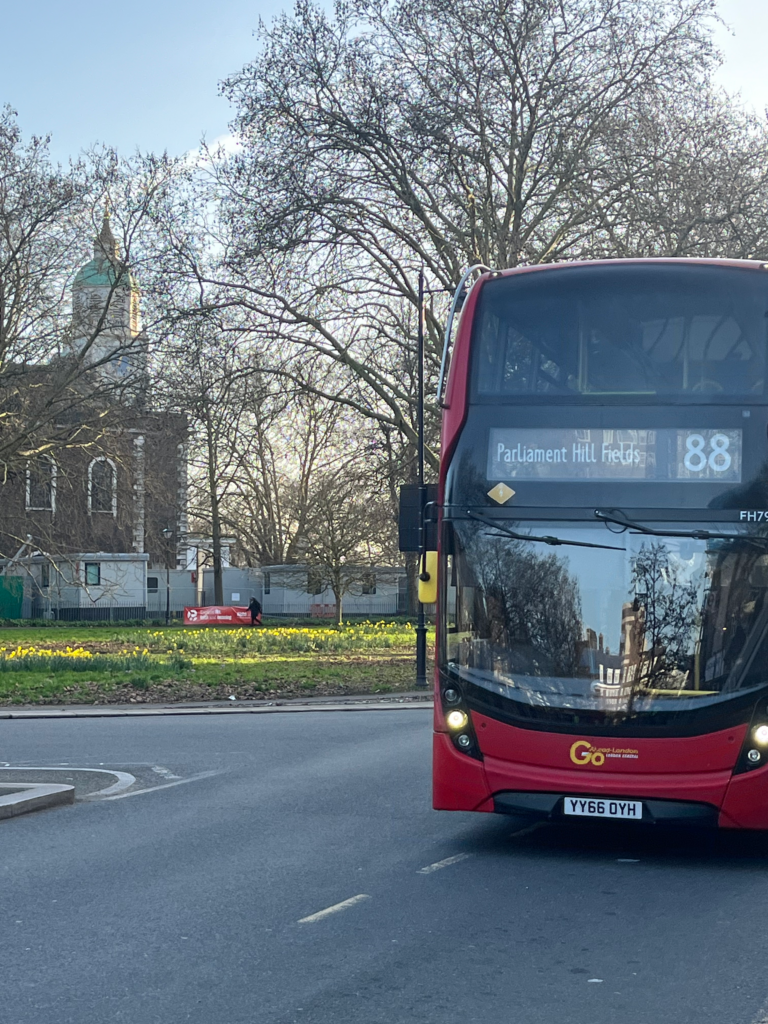
English jurisprudence’s various characters of legal fiction, in Lord Reed’s weirdly adorable vision, appear to rub shoulder to shoulder on what I can only take to be the 88 bus. Why are these reasonable (or decent, or officious) people all going to or from Clapham? Essentially, it appears to be because in nineteenth century London, Clapham developed into one of the city’s earliest and more affluent commuter suburbs: the original Clapham man was presumably a vaguely middle class, fairly educated professional, who worked deeper in the metropolis (probably as some kind of clerk) but started his morning and ended his evening on the back of a horse drawn stagecoach.
This omnibus, and its famous passenger, is memorialised in one of Clapham Old Town’s central squares, ‘The Polygon’, where a bus terminus stores a number of 88 buses. One (pictured) is currently bearing the image of one of Clapham’s most famous modern residents, Margot Robbie, as Kathy in Emerald Fennel’s adaptation of Wuthering Heights. A sign in the centre of the Polygon proclaims “the phrase ‘the man on the Clapham Omnibus’” epitomises Clapham’s ‘commuting past’; the handsome building that once housed the Clapham public library has since been converted into the Omnibus Theatre.
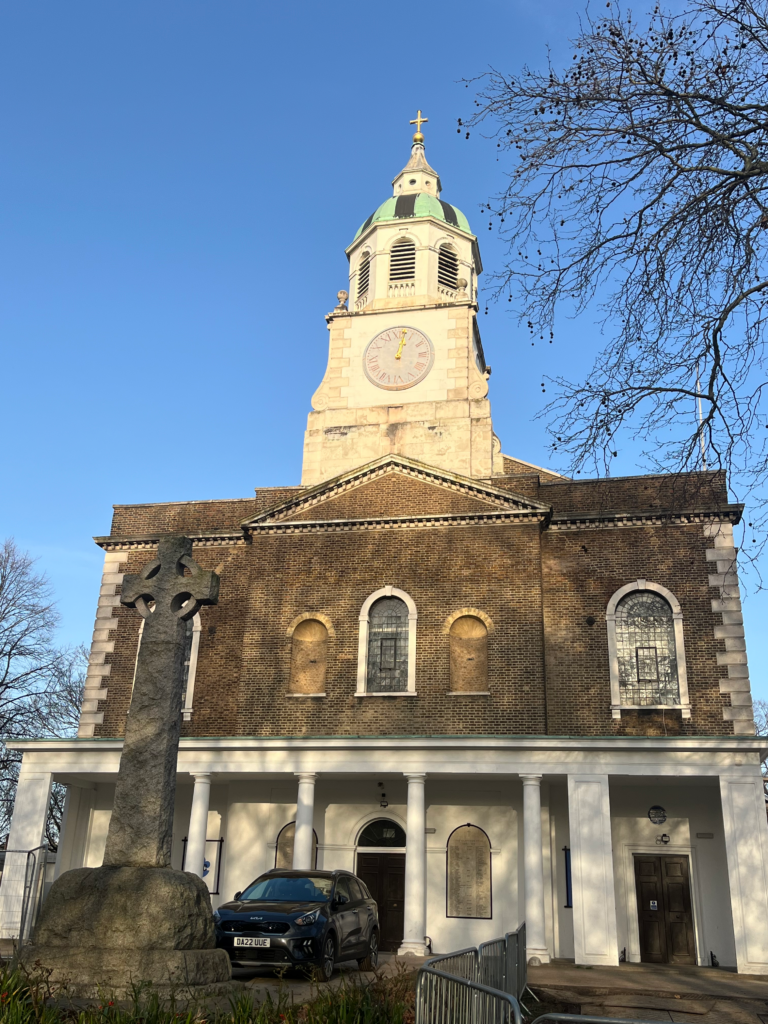
There’s more to the legal history of Clapham, however, than its buses and their imaginary occupants. A short walk over from the Polygon, you will find the large and historic Church of the Holy Trinity on the northeast corner of the Common, constructed by the Bishop of Ely in the 1770s.
This church is still and has for centuries been a bastion of the evangelical, low-church wing of the Church of England. It has also been very significant in the legal history of Britain and its historical Empire. Holy Trinity Clapham (or ‘HTC’, as it now goes by), was the nerve centre of the group of evangelical social reformers known as the ‘Clapham Sect’ between the late eighteenth and early nineteenth centuries.
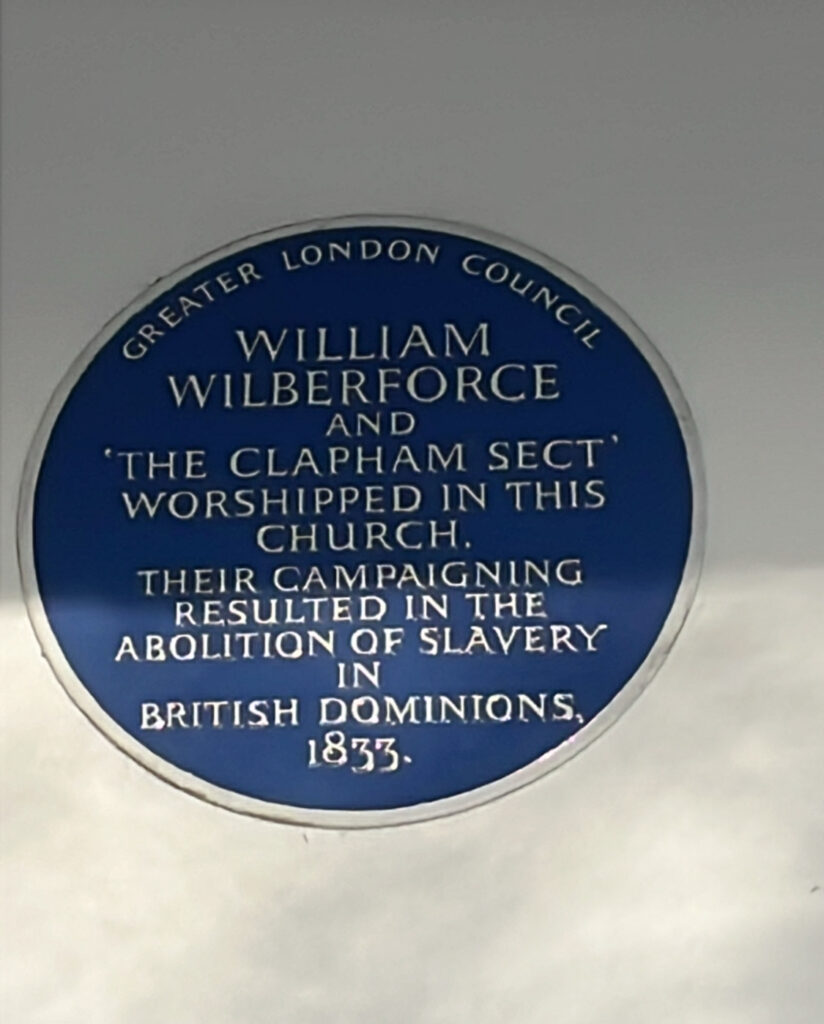
The Clapham Sect, founded by HTC’s curate Henry Venn, was one of the driving forces behind the abolition of the slave trade throughout the British Empire in the Slave Trade Act 1807, and the abolition of chattel slavery itself in the Slavery Abolition Act 1833. Among its members were a Master of the Court of Chancery (and great-grandfather of Virginia Woolf) James Stephen, and a great number of MPs. The most famous of this latter grouping, and possibly Clapham’s most significant historical resident, was William Wilberforce: many foundational abolitionist meetings were held in his townhouse which is a stone’s throw from HTC.
If you carry on down the northside of the common, past Wilberforce’s house and round to the westside, you will reach a fairly large block of flats, built in an elegant 1930s art deco style on the designs of the architect William Richard Herbert Jones. During my gap year I passed these flats on the way to work every morning. Little did I know that they had been the subject of a foundational contract law case. I imagine the place will ring more bells to legally minded readers if they consider the building’s name, rendered in enormous art deco lettering over the central doorway: ‘High Trees House’.
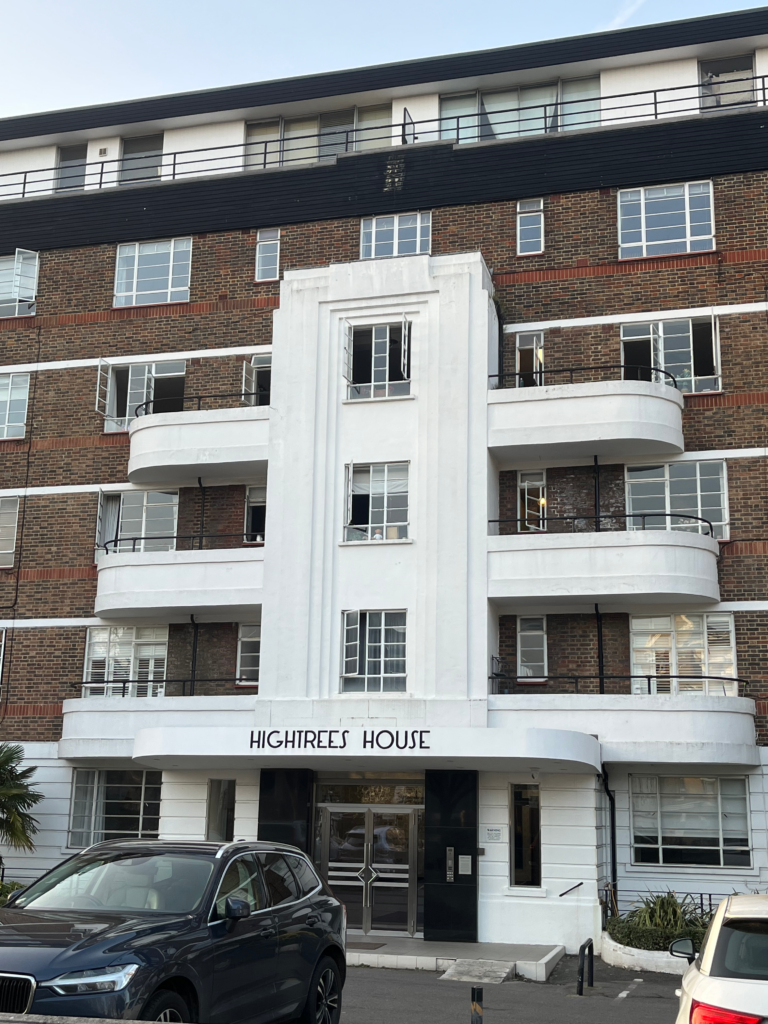
This building was of course the subject of one of Alfred Denning’s most significant judgements in the case Central London Property Trust Ltd v High Trees House Ltd [1947] KB 130 (find it on BAILII). The property trust had leased the building to High trees House Ltd in the 1930s, but the rent which the property trust charged became unworkably onerous after the outbreak of the Second World War, which caused an understandable downturn in the rental market (the ward of Clapham Common managed better than some areas of the metropolis, but still saw 12 significant explosions during the Blitz). High Trees House Ltd therefore negotiated a rent reduction, by way of a written promise from the property trust not to enforce the strict terms of the contract and accept a part payment from their tenant. When the war ended, the property trust requested full payment of all the rent that had not been paid during wartime. Though the actual case ended up being fought on more limited grounds, Denning J was unequivocal in holding that the promise to accept part payment had bound the property trust not to rely on the strict terms of the contract. Hey presto: promissory estoppel was born in English contract law, somewhere between the Clapham Common Tennis Courts and the Sainsbury’s Local where I used to get the occasional meal deal.
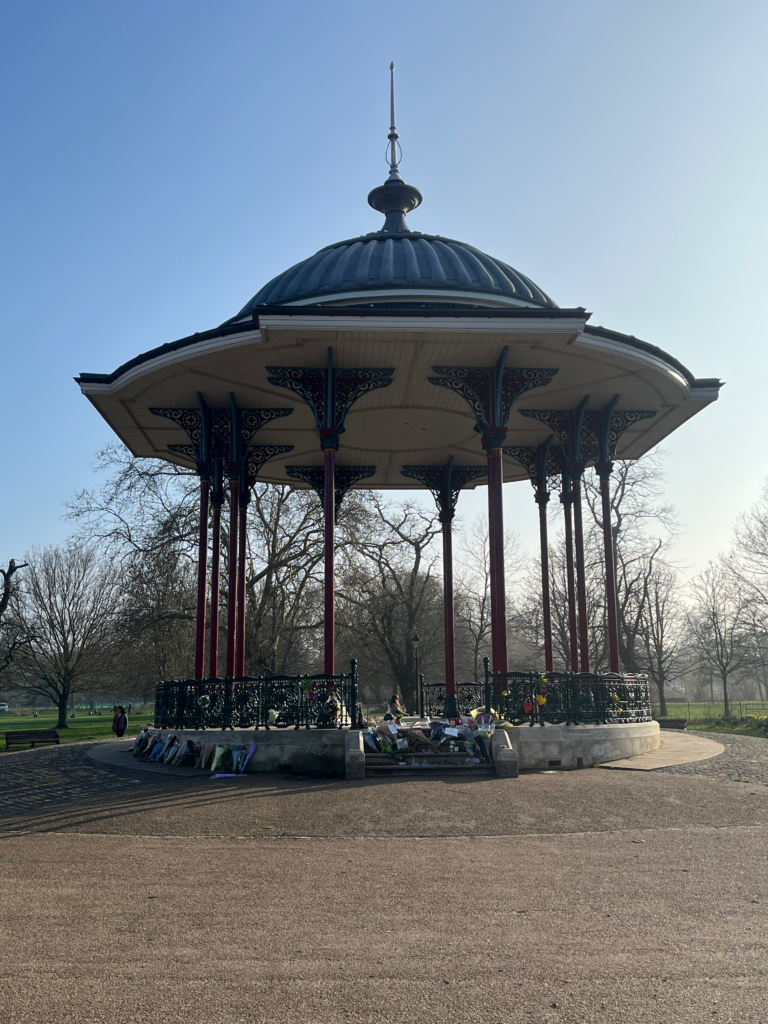
If you were to head back towards the centre of town through the heart of the Common, you would come across a site with a less happy and much more recent legal connection. The Clapham Common bandstand, believed (alas, erroneously) to be the oldest in London, is a lovely spot and something of a spiritual heart of the Common. Yet as I write this article, it is covered in flowers. It has been five years since Sarah Everard was abducted in the vicinity of the Common and subsequently murdered by the police officer Wayne Couzens. The subsequent vigil, organised at the Clapham Common bandstand by the feminist direct action group Sisters Uncut, swelled in attendance to several hundred, while the capital was still in the midst of the Covid-19 Lockdown restrictions. The Met police, whose reputation had already taken a massive knock given the murderer’s line of work, cannot be said to have enforced the provisions of the Coronavirus Act 2020 in a tactful manner, forcefully breaking up the gathering, arresting attendees, and crushing memorial flowers under foot.
Yet this was more than simply a bad look for the Met: as the highly contentious legal case that followed would prove, it was an unlawful response. A judicial review — Leigh v Commissioner of Police of the Metropolis [2022] EWHC 527 — was brought by the group Reclaim These Streets, wherein Warby LJ and Holgate J held that the police’s heavy-handed response violated Articles 10 and 11 of the ECHR (the freedoms of expression and assembly respectively). Leave to appeal the decision was denied to the Met both by the High Court and the Court of Appeal. In so doing, the apparently totalising powers conferred onto public bodies by the Coronavirus Act were significantly curtailed and made subject to a kind of proportionality analysis. And now, 5 years on from that initial vigil, flowers once again cluster at the foot the bandstand, untrampled by any officer’s boot.
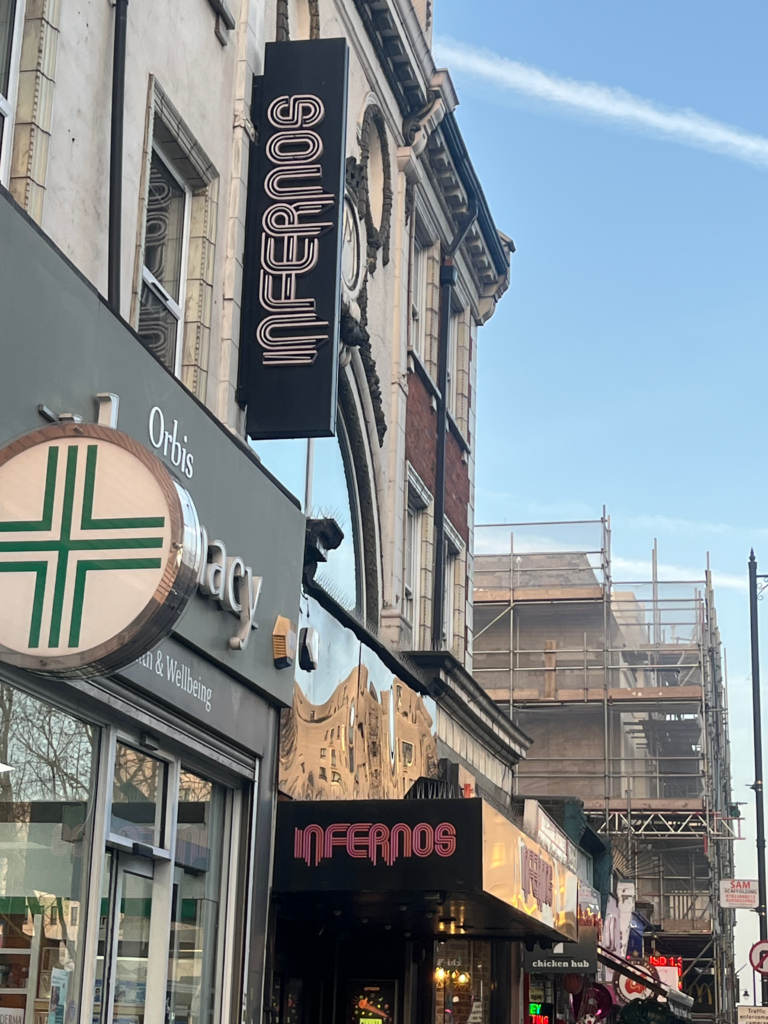
I’ll lighten the tone for the final stop in this legal walking tour of Clapham. If you continue on from the bandstand and on towards Clapham High Street, passing between Clapham Common Station and Clapham North station, you will pass a small building, tucked between a pharmacy and chicken shop. This small front is deceptive: once inside the hallowed halls of the nightclub Infernos, the place expands into a seemingly incomprehensibly large temple of late-night iniquities. For my sins, I have paid the rather eye-watering entry fee and seen it for myself. It’s immaterial for this article whether or you consider the place to be one of Southwest London’s finest cultural contributions or find its Dante-esque naming to be unfortunately revealingly.
What you might not know, however, is that the ownership of the building that houses the nightclub — 146 Clapham High Street — was subject to some fiendishly complicated litigation in the early noughties, which I shall necessarily have to simplify in the telling. A Mr Collier owned the freehold of the building, out of which the nightclub known first a Cinatra’s and later as Infernos. He ran into financial problems and divided the property up between a series of long leaseholds which he granted to his daughter. These leases included options whereby Miss Collier could purchase the freehold reversion of the entire building at an agreed price. However, when Miss Collier attempted to exercise her option, Mr Collier claimed that he had actually intended that she hold the property on trust for him as a nominee and that he retained the beneficial interest. Unfortunately for Mr Collier, his intention in transferring the property was to prevent his creditors from getting access to it; Mr Collier had been involved in some dodgy dealings. It was found in Collier v Collier [2002] EWCA 1329 that Miss Collier was protected by the illegality defence (‘ex turpi causa non oritur actio’) and that she thereby retained the freehold absolutely; equity could not assist Mr Collier as he was tainted by illegality. While not nearly as influential as High Trees, the judgment in Collier v Collier ultimately ended up being quite significant in the Supreme Court’s foundational re-evaluation of the illegality defence in Patel v Mizra [2016] UKSC 42. I suppose that’s something to ponder if you ever find yourself knocking back a Jäger bomb with the cheerful expats of Melbourne and Sydney under the Disco lights.
I doubt that such an activity was exactly what Lord Bowen had in mind when he spoke of the man on the Clapham omnibus. It goes to show that times change, and so do places: yet through the preceding century and a half, Clapham seems to me to have only bolstered its weighty legal heritage. For those enrolled at City St George’s, pay us a visit sometime if you haven’t already. It’s about 20 minutes on the Northern Line, and as I hope I’ve proved, its practically homework.
Editor: So excited to see the Law and Mortar column making a reappearance on Lawbore!
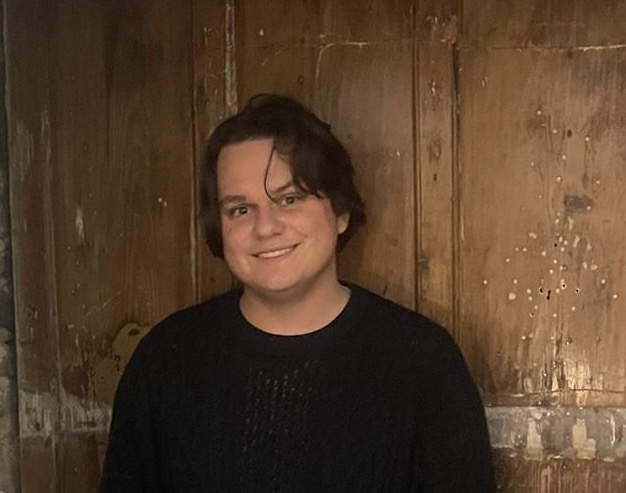
Thanks to Patrick (who everybody calls Paddy) for kicking us off with this fascinating piece all about Clapham. Paddy is an aspiring barrister on the GDL at The City Law School with an interest in public and commercial practice. As an English student by training, he is still keenly interested in literature, film, history and politics. He’s also willing to bet he knows more about dinosaurs than anyone else on the GDL (fighting talk!). Paddy is a member of this year’s Lawbore Journalism Team.