Lawbore Future Lawyer
20Mar/120

Opportunities in International Law – launch of the new LLM at The City Law School

From September The City Law School will run an LLM Public International Law, adding to its successful spread of LLM programmes. Find out about our existing LLM International Commercial Law.

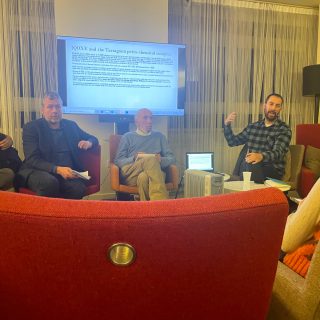
To launch the new course City hosted an evening focused around 'Opportunties in International Law' with four speakers involved in international law in very different ways. They were: Nigel Parker (FCO), Professor Peter Slinn (University of Notre Dame),  Andrew Hickman (Environmental Justice Foundation) and Carla Clarke (Minority Rights Group International).

Amisha Jani (LLB2) and Rojin Kiadeh (GELLB1) report on the event:

Impressions of the evening from Amisha Jani

Author Amisha

The Opportunities in International Law event invited a panel discussion with leading experts in the field. This included Nigel Parker from the Foreign and Commonwealth Office and Andrew Hickman from the Environmental Justice Foundation (EJF).

Nigel Parker kick-started the event with his experiences in working for the Foreign and Commonwealth Office. He illustrated the wide spectrum of law the Foreign Office deals with, ranging from the preparation of cases against the UK in the European Court of Human Rights, to the vast amount of judicial review cases. Interestingly, the work is proximate to the decision making, so much so that the Office was directly involved in the drafting of the highly influential Lisbon Treaty.

City alumnus Andrew Hickman then took to the floor, describing his ‘detective work’ in identifying illegal fishing practices in the waters of Sierra Leone. Examining pictures to identify vessels (‘ship spotting’), counteracting false claims of legal fishing and presenting cases to lawyers are the basis of his work but unlike working for the government, the EJF attempt to get as close to the decision making as possible. Thus he emphasised the large extent to which maritime law, which is sometimes forgotten, is growing into an international problem that needs to be combated by future lawyers.

Overall the event gave a great overview of the wide range of careers available in Public International Law. It painted a colourful picture of the exciting opportunities open to students and all the speakers spoke with great enthusiasm about their respective areas. Whether it is drafting EU treaties or catching fishermen in Sierra Leone, the importance of international law is as relevant as ever and the City Law School recognised this in the form of the LLM in Public International Law. I, for one, left the event with a new found appreciation of International Law.

Impressions of the evening from Rojin Kiadeh

Author Rojin

The international law talk held at City University on the 8th March provided an invaluable insight into an area of law that is growing and proving to be more and more relevant in our increasingly globalised world.

As well as presenting City’s new LLM in Public International Law, the talk featured four speakers who shared their varying experiences within the field of international law.

One of the speakers was Professor Peter Slinn; formerly Head of the Law department and Director of International studies and Diplomacy at SOAS, he is currently Professor of Law at the University of Notre Dame.

Having qualified as a solicitor in 1967, he began his career as a legal adviser in the Foreign and Commonwealth Office. His experience as a practitioner and as an academic in the field allows for a great depth of perspective on the growing importance of this area of law, an area he says has vastly developed since his qualification as a solicitor: pointing out the fact that in 1967 there were very few textbooks on international law in itself underlines its growing importance in modern society.

Filed under: News Continue reading
16Mar/120

Sweet Tweet? – Elizabeth Cruickshank and Penny Cooper

Social media: career suicide or career success in your hands?

We expect you have heard that good old fashioned advice about not sending letters written in anger until you have reviewed them the next day. Chances are you will bin them or at least tone them down. You could call this “the cold light of day” test.

Sending an irate letter requires a certain amount of effort on the part of the writer. Apart from the drafting there’s the printing, the envelope-filling, the stamping and the posting which are not demanded by more modern forms of communication. In fact the easier communication methods become, the more vigilant you should be about what you say.

Tweeting and booing

Easy to get hooked! Credit: carrotcreative

Online communication has morphed from email through the blogosphere to the latest forms of Twitter and Audio Boo, and the new freedom has made many of us a lot more casual about what we say. We forget that sending a tweet, post or audio boo into the world is the virtual equivalent of sending a letter in indelible ink.

We forget that tweeting, posting and audio booing weren’t exactly designed with serious and contemplative communication in mind. Some of the most successful tweeters (if you measure success by the number of followers) have their tweets read so intently precisely because they are immediate and informal. The followers get the scoop direct from the tweeter as it happens: from the movie star at the premier of her latest movie, from the rock star back stage at his concert, from the MP in the Commons -- or even from the lawyer at a hearing.

Good personal publicity

If you decide to boo, post or tweet, the upside can be good personal publicity, although possibly not as effective as some journalists have suggested. The Guardian reported recently that a law graduate had landed a training contract at a top City firm thanks in part to his tweeting. That law graduate was Ashley Connick who rather gave the lie to this piece of information by writing in his blog that he had had posted only one article prior to getting his contract – and that his interviewers had not been remotely interested in his writing.

Perhaps they should have been because his pieces are informative, well-crafted and sensible.

13Mar/120

The City Scholars Moot Final at the Supreme Court

Tuesday 7th March saw the final of the City Scholars Moot; open to LLB, GELLB and LLM students. Catherine Elliott, organiser of this popular moot gives us a rundown of the evening's competition, held in the fantastic surroundings of the Supreme Court.

Star mooters: Merrow, Althea, Mackenzie and Eden

The final of the competition proved to be a really memorable experience for both the finalists and the students who attended as spectators. With Lady Hale as the judge, this was a unique experience for the students to experience at first hand the intellectual challenge of advocating in front of a leading judge from the top court of the land.

Lady Hale stretched the competitors to their limits with rigourous questioning on the legal issues raised by the moot problem, a contract law problem case involving promissory estoppel. The students performed fantastically well, joining in with the spirit of the occasion, managing to think quickly on their feet and adapting their legal arguments as the moot progressed. Ultimately it was MacKenzie Common who managed to walk away with the prize of £100 but all of the students were praised by Lady Hale for their mooting skills. Well done!

Those students facing Lady Hale were Merrow Golden, Althea Brooks, MacKenzie Common and Eden Ifergan, all from our GELLB course... what were their impressions?

8Mar/120

LLB1 students – PP:Law 2012 coming up…

If you are interested in a career in City law, want to meet leading law firms and receive guidance on vacation schemes and training contracts, then it's worth applying to attend the PP:Law event on 5th April 2012. Organisers Pure Potential are running this day in collaboration with Allen & Overy, Baker McKenzie, Berwin Leighton Paisner, CMS Cameron McKenna, Herbert Smith, Linklaters, Norton Rose, Slaughter and May and SNR Denton.

Those attending are promised from panellists:

    an insight into working in the industry
    hearing of their experiences completing the LPC and GDL
    advice on applying to vacation schemes and training contracts
    tips on how to develop your interview skills and answer challenging competency questions.

In addition, you will get the opportunity to go and tour the offices of one of the nine law firms listed, meeting partners, associates and members of the graduate recruitment team.

To apply you must have attended a state school or college and have achieved 320 UCAS Points. You will need to submit a 250-word explanation of why you would like to attend the event and what makes you a credible candidate.

The deadline is Friday 16th of March, but PP will allocate places as soon as they receive applications - so get going!

Filed under: News No Comments
5Mar/120

Mooting Game Plan… A talk given by Judge Cryan – Dola Ajibade

Dola

Our author, Dola.

Last term Judge Donald Cryan came to City to talk about mooting to eager students - as a law student mooting is an absolute must. It is nervewracking of course, but the only way to boost your confidence is to do as much as possible in order to conquer the fear.

For all you wannabe solicitors, do not think that it is designed solely for barristers, because advocacy skills are essential and you will wish you had a practice round first. That’s what mooting does, it is the closest that a law graduate can get to actually being in a courtroom scenario and being involved, without being qualified.

This is why we do it of course, sign up with our eyes closed and get on with it. Once your turn is over it’s a sigh of relief, until you start worrying about whether you have made an impression or not. I was very excited to attend an evening of useful tips in the art of mooting with Judge Cryan.

Judge Cryan was called to the bar in 1970, is a member of Inner Temple and currently sits on the Education and Training Committee there. He became a recorder in 1993, progressed to become a Circuit Judge in 1996 (South East circuit) and currently sits in the Family Division of the High Court . He actively participates in the reform of Family Law (he is a member of The Centre for Child and Family Law Reform) and has co- written a paper on forced marriages. His expertise in this area is widely known, and he has delivered papers in Australia and Japan.

Apart from the usual advice about arriving on time and switching your phones off, Judge Cryan offered a range of hints on how to approach mooting...

4Mar/120

Opportunities in International Law: interview with Katherine Reece-Thomas – Amisha Jain

City interviews Katherine Reece-Thomas on the launch of her new Public International Law LLM, ahead of the ‘Opportunities in International Law’ event.

Author Amisha

What did you do before joining City University?

A Canadian, I studied law at Oxford and did my LLM in Public International Law (“PIL”) at Cambridge University. I taught PIL at Cambridge for many years while I qualified as a solicitor and then an attorney in New York. Having practiced a bit of Public International Law, it has always been an in interest to me to see how it works on the ground, so to speak, how it affects individual lives through the court systems of individual countries. But I also publish research in company law, in particular shareholders’ agreements.

Why introduce the new LLM?

CLS run a very successful LLM in International Commercial Law but we haven’t done any of the public international for some time. International Law is of great interest to students at the moment and to the world as a whole, of course. There are too many tragedies in the world to let it out of the public eye for long. In addition CLS has recruited a number of academics who specialise in PIL and who are passionate about sharing their knowledge and appreciation for this important subject.

What can students expect to gain from the new LLM? Why study at City?

The LLM is modelled on the existing International Commercial Law LLM. In that sense, students have to take 4 modules over a year, 2 in the first term, 2 in the second term and write a dissertation. They can specialise in particular branches of Public International Law, such as Human Rights, Minority Rights, The Law of State Responsibility, Dispute Settlement or International Criminal Law, but they obviously don’t have to.

There is a stable of modules on offer, a bit of a pick and mix. The thing about City is that we will teach all the modules in house as we are not relying on any visiting professors. Our team are dedicated Public International lawyers who are very keen to teach in the areas they research and publish in. We will be giving it a very much hands on approach from the point of view of admin staff and personal tutoring.

2Mar/120

Mooting & Advocacy Competition Updates

City students have been showing their competitive streak recently...

Verity Coutts (LLB3) and Samantha Tayler (LLB2) won their first bout in the Preliminary Round 1 of the University of Hertfordshire/Blackstone's National Criminal Advocacy Competition (endorsed by the Criminal Bar Association). They face the University of Westminster on the 16th March for the return match. This is a really interesting competition as most participants have had no experience of advocacy before.

Laura Inglis and Harriet Tolkien faced up to BPP in the first round of the UKSLA Mooting Competition, over at their Waterloo campus and came out on top. Well done both!

Jamie, Hugo, Andrew and Hannah

Finally this Tuesday saw the semi-final of the ICLR National Mooting Competition. The team of four in this moot competition have done brilliantly so far, competing against Kings, University of Hertfordshire and Exeter to get to this stage.

The semi-final was held at Grays Inn and we were up against an extremely strong University of Buckingham team, with the judges Mr Justice Newey and Mark Cunningham QC. It was edge-of-seat stuff and was wonderful to hear the announcement that the City team were going through to the final. The final is on March 28th.

Very well done to all four members of the team representing City in this competition: Hannah Gomersall, Hugo Flaux, Jamie Susskind and Andrew Rose. Big congratulations go to Hugo and Jamie for securing the place in the final.

1Mar/120

Webinars a-go-go! Emily Allbon

Watch this! Credit: JK

There are a couple of useful webinars I've come across recently: the Junior Lawyers Division of the Law Society put out a very interesting panel discussion around Women, Feminism and the Law towards the end of last year. Participants included Lady Hale of the Supreme Court, Vera Baird QC and Harriet Wistrich of Birnberg Peirce solicitors. Elizabeth Forrester, legal officer at the Free Representation Unit chairs discussions about the importance of bringing feminism into your work whatever your role.

Subject of earlier webinars include alternative careers and pro bono.

Another one worth a look is the International Bar Association video interview regarding their recent work on social networking and the legal profession. The project around social networking looked to establish the concerns around this and whether the IBA needed to work with bar associations, councils and societies worldwide to establish global guidelines.

The video involves an interview with Anurag Bana (IBA) and media lawyer Mark Stephens CBE. You can download the February report and learn about its findings.

10Feb/121

Interview with Campaspe Lloyd-Jacob – Kate Nutter

Barrister and author, Campaspe Lloyd-Jacob

After spending all day reading textbooks and cases, I am incredibly lazy when it comes to reading for pleasure. I don’t want to think too hard about what I am reading, I want something funny, quick and witty. “Ophelia in Pieces” is exactly that, the story of a female criminal barrister and everything that comes with life - interviewer Kate Nutter.

At the launch Edwin Glasgow QC suggested that every BPTC student, or indeed anyone thinking of entering the Criminal Bar should read this book, in order to see the highs and lows that come with the profession. The author, former City GDL student, Campaspe Lloyd-Jacob (who writes under the pen name Clare Jacob) discusses life at City, the profession and the book.

You completed your GDL at City Law School, can you tell us a bit about your time there?

I read English and Italian as an undergraduate and in my last year, I decided I needed to do something so I was more employable. I needed a professional qualification. I met some barristers who seemed intelligent and enjoyed their work. I was also a fan of John Donne and John Webster who qualified as barristers. I was taken with the idea of the law being a training for my mind, in the same way as it was for poets and playwrights in the 17th Century. I decided to become a barrister to understand the world a bit better and more clearly.

Why did you choose City?

I had heard very good things about City. There are not very many places where you can do the conversion course, but City was by far the best. It had very good lecturers, who came from top universities, and a good mixture of lectures and seminars. It was a very intensive course, but I needed it because it was a quick entry into a career. I enjoyed my year at City University. It was very focused and there were lots of very interesting people. It was where I met my husband, who was on the same course.

Is there one thing that you wish you had known before starting law school?

I suppose I feel about this about university generally:I wish I had worked harder at university, because the harder you work, the more you get out of it academically. On the other hand it is impossible to say that, because the reason you are not so engaged with university work is because you are engaged in lots of other things and growing up. I have never regretted working too hard at something, but I have regretted not making the extra effort sometimes.

2Feb/120

New Evidence & Justice Forum launches this month – Emily Allbon

Credit: me'nthedogs

The City Law School will launch their new Evidence and Justice Forum (EJF) with a guest lecture by Michael Mansfield QC on February 22nd at 6.30pm.

Earthquakes, tsunamis, volcanic eruptions, hurricanes and floods show us the extreme and unpredictable power of Mother Nature. These events leave devastation in their wake both human and physical. We can monitor the earth, we can build barriers, and nations can sign climate change agreements but there is little we can do to protect ourselves.

Is it time now to move beyond goodwill? Is it time to invoke the law - an international law on Ecocide, the environmental equivalent of genocide? Is it legally possible?

In September 2011, at London's Supreme Court, a Mock Trial played out as though this crime were already adopted by the UN. Michael Mansfield QC, the prosecuting barrister, and Nick Lickley QC, the defence barrister led the case for and against two fictional CEOs. The trial outcome was not pre-scripted; it was for the jury to declare whether or not the Earth's Right to Life had been violated and if the crime of Ecocide was proven. This trial was one of the first steps in a sustained campaign to raise awareness of these issues and to air them within Government, business and communities. This lecture continues that momentum. In his lecture, Michael Mansfield will give evidence to support such a law and aim to set out the implications for businesses - regardless of whether they simply provide the funding for activities which impact the environment or are the main protagonists.

(Background: Polly Higgins, barrister and international environmental lawyer proposed to the UN in April 2010 the need for an international law on Ecocide.)

The objects of the EJF are the advancement of research (including facilitation of the supervision of research students), scholarship and education in the fields of evidence and justice within both criminal and civil jurisdictions.  'Evidence and justice' covers such subjects as the process of proof, accuracy in fact-determination, probability theory, adversarial, inquisitorial and alternative dispute resolution processes, pre-trial, trial and post-trial procedure, advocacy, the roles of judges, magistrates, jurors and witnesses, including expert witnesses, and the use of 'special advocates' in relation to secret evidence. It also covers non-legal disciplines that have a bearing on evidence and justice, including, for example, psychology and the forensic sciences.

Be sure to book online for this launch event.